








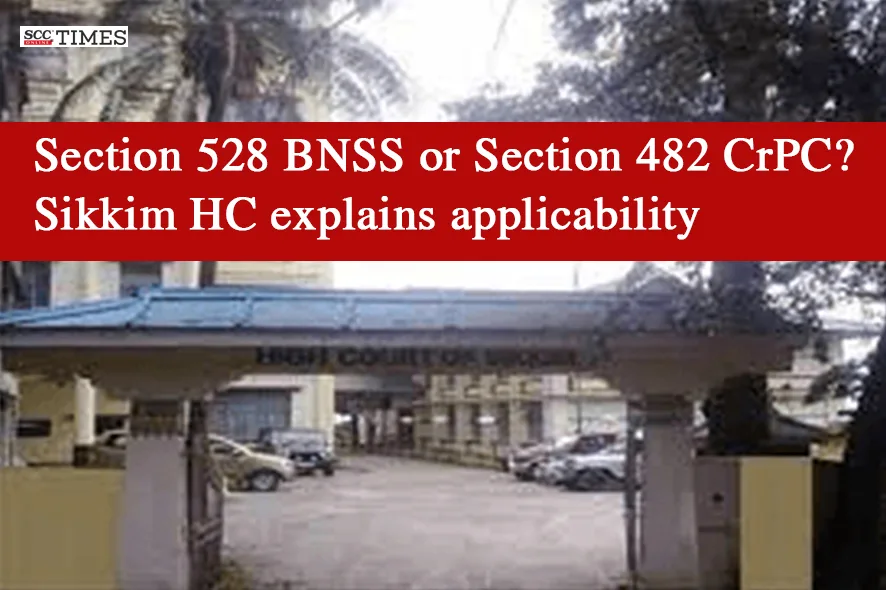
Sikkim High Court: The present petition was filed by the petitioners, seeking quashment of the FIR and criminal proceedings arising from a land dispute, which had been registered under non-compoundable offences of the Penal Code, 1860 (‘IPC’). Following the resolution of the matter through a Settlement Agreement, the petitioners invoked the inherent powers of the High Court under Section 528 of the Bharatiya Nagarik Suraksha Sanhita, 2023 (‘BNSS’). A Single Judge Bench of Meenakshi Madan Rai, J., allowed the petition and held that the matter between the disputing parties had arisen out of a civil dispute, which formed a fit case for the exercise of its jurisdiction under Section 528 BNSS, and accordingly quashed the FIR and the proceedings.
Background:
The case arose out of a land dispute between the parties who were boundary holders of properties situated adjacent to each other. The respondents alleged that on 13-8-2022 the petitioners and their domestic help came to their house and started breaking down the brick wall and assaulted them. Subsequently, an FIR was registered against the petitioners under Sections 447, 323, 354, 442, 448, 452, 351, 426, 120B and 34 IPC.
Later, through a Compromise Deed the parties had settled their respective claims over the suit land and resolved their civil dispute amicably. Further, on 4-2-2025, a Settlement Deed/Agreement was executed between the parties, affirming they had jointly agreed not to pursue the matter to maintain cordial relations with each. Since, some of the offences under which the petitioners were booked and charged were non-compoundable, they urged the Court to exercise its jurisdiction under Section 528 BNSS to quash the FIR to secure the ends of justice and prevent abuse of the process of the Court.
The respondents did not object to the prayers made by the petitioners, as the parties had amicably resolved their differences, which had essentially arisen out of a civil dispute. However, they raised the issue of maintainability of the petition, stating that instead of filing the said petition under Section 528 BNSS, it ought to have been filed under Section 482 of the Criminal Procedure Code, 1973 (‘CrPC’), in view of the fact that the BNSS came into force on 1-7-2024, whereas the FIR sought to be quashed is dated 16-8-2022.
Analysis and Decision:
The Court, while addressing the argument regarding the correct provision of law that ought to have been invoked in present case, observed that any appeal, application, trial, inquiry, or investigation instituted on or after 1-7-2024 had to be considered under the provisions of the BNSS, however if any appeal, application, trial, inquiry or investigation was pending when the BNSS came into force, then such matters should be disposed of, continued, held or made as per the provisions of the CrPC. The Court referred Prince vs. State of Govt of NCT of Delhi, 2024 SCC Online Del 4909, wherein it was held that since the petition had been filed after 1-7-2024, it ought to have been filed under the BNSS and not the CrPC. The Court, therefore found no error in the present petition filed under Section 528 BNSS.
The Court emphasised that it was clear that the FIR and the proceedings were the outcome of the civil dispute between the parties, which had now been settled through decrees passed in civil suits and a mutual agreement not to pursue the criminal matter. The Court further relied on Gian Singh vs. State of Punjab, (2012) 10 SCC 303, wherein it was held that certain offences which bore a civil flavour arising out of civil, mercantile, commercial, financial, partnership, matrimony, or family disputes, and where the wrong was basically between the victim and the offender, and the victim had settled all disputes between them amicably, irrespective of the fact that such offences had not been made compoundable, the High Court might, within the framework of its inherent power quash the criminal proceeding, criminal complaint, or FIR if it was satisfied that there was hardly any likelihood of the offender being convicted, and that by not quashing the criminal proceedings, justice would be a casualty and the ends of justice would be defeated.
The Court, therefore, allowed the petition and held that the matter between the disputing parties had indubitably arisen out of a civil dispute between them as neighbours, which was a fit case where this Court could exercise its jurisdiction under Section 528 BNSS and thereby, quashed the FIR and the proceedings.
[Deepam Pradhan v. Krishna Kumari Bhandari, 2025 SCC Online Sikk 53, decided on 2-6-2025]
Advocates who appeared in this case:
For the Petitioners: Rahul Rathi, Advocate
For the Respondents: M. N. Dhungel, Advocate — Respondents 1 and 2.
Yadev Sharma, Additional Public Prosecutor with Sujan Sunwar, Assistant Public Prosecutor — Respondent-State.
Buy Penal Code, 1860 HERE
Buy Code of Criminal Procedure, 1973 HERE










0 replies