








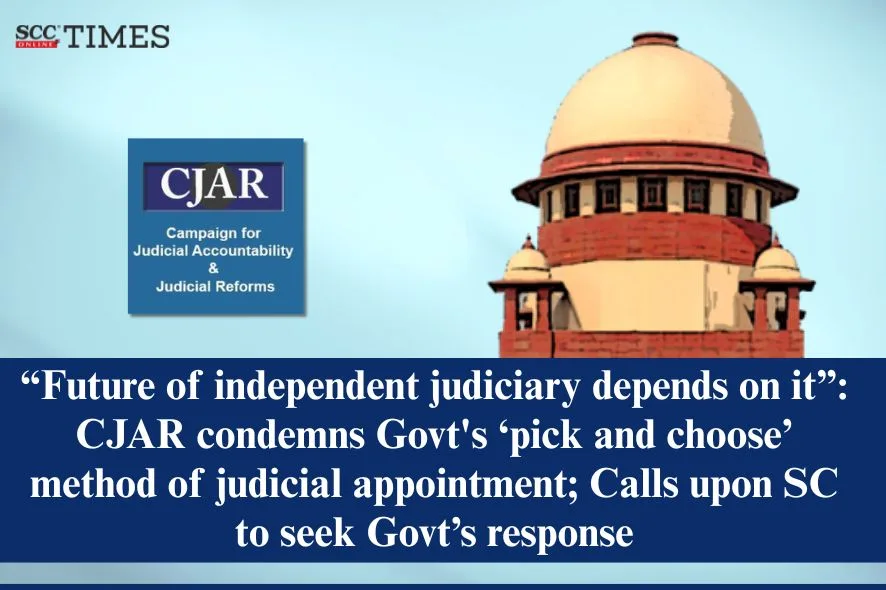
Campaign for Judicial Accountability and Reforms: On 08-08-2025, the Campaign for Judicial Accountability and Reforms (‘CJAR’) released a statement expressing disappointment over the judicial appointment process in light of the recent withdrawal of consent by Advocates Swetashree Majumder and Rajesh Datar due to the delays in their appointment as High Court judges.
The statement noted that Majumder withdrew her consent after her recommendation by the Supreme Court Collegium (‘SC Collegium’) for appointment as a Judge of the Delhi High Court was kept pending by the Union for over a year. Whereas, Datar withdrew his consent for appointment as an additional judge of the Bombay High Court, after his name was segregated by the Union from the list of four advocates who were recommended for appointment as additional judges.
CJAR remarked that it was unconscionable that the aforementioned advocates were not appointed as judges only because the Union Government has refused to process their names for appointment despite being found suitable in all respects by the collegiums of their respective High Courts and the Supreme Court. The same happened with Senior Advocate Aditya Sondhi in 2022, and unfortunately, no measures were taken by the SC Collegium to prevent such a recurrence.
CJAR proceeded to condemn the Union Government’s “unconstitutional and illegal” move to “segregate” Majumder and Datar from other recommendations. It reiterated that the practice of picking and choosing names for appointment from the list of names recommended by the SC Collegium had no sanction in law and was a direct violation of the Supreme Court’s decisions in the Second Judges1 and Third Judges2 cases. This circumvention of the appointment procedure by the Government is also under challenge before the Supreme Court in Centre for Public Interest Litigation v. Union of India3.
Thereafter, CJAR called upon the Supreme Court to uphold judicial independence as mandated through its judgments and take immediate steps against the Union Government for its wilful disregard of the law and Constitution. While appreciating the SC Collegium’s greater efforts in scrutinizing candidates for judgeship, it remarked that such efforts would come to naught if the Union Government was allowed to simply discard qualified and suitable nominees for no good reason.
Accordingly, CJAR called upon the Supreme Court to revisit the issue of judicial appointments on the judicial side and demand explanations from the Union Government regarding the circumstances under which the appointments of Majumder and Datar were stymied, as nothing less than the future of an independent judiciary depended on it.
1. Supreme Court Advocates-on-Record Assn. v. Union of India, (1993) 4 SCC 441
2. Special Reference No. 1 of 1998, Re, (1998) 7 SCC 739
3. WP (C) 895/2018








0 replies