








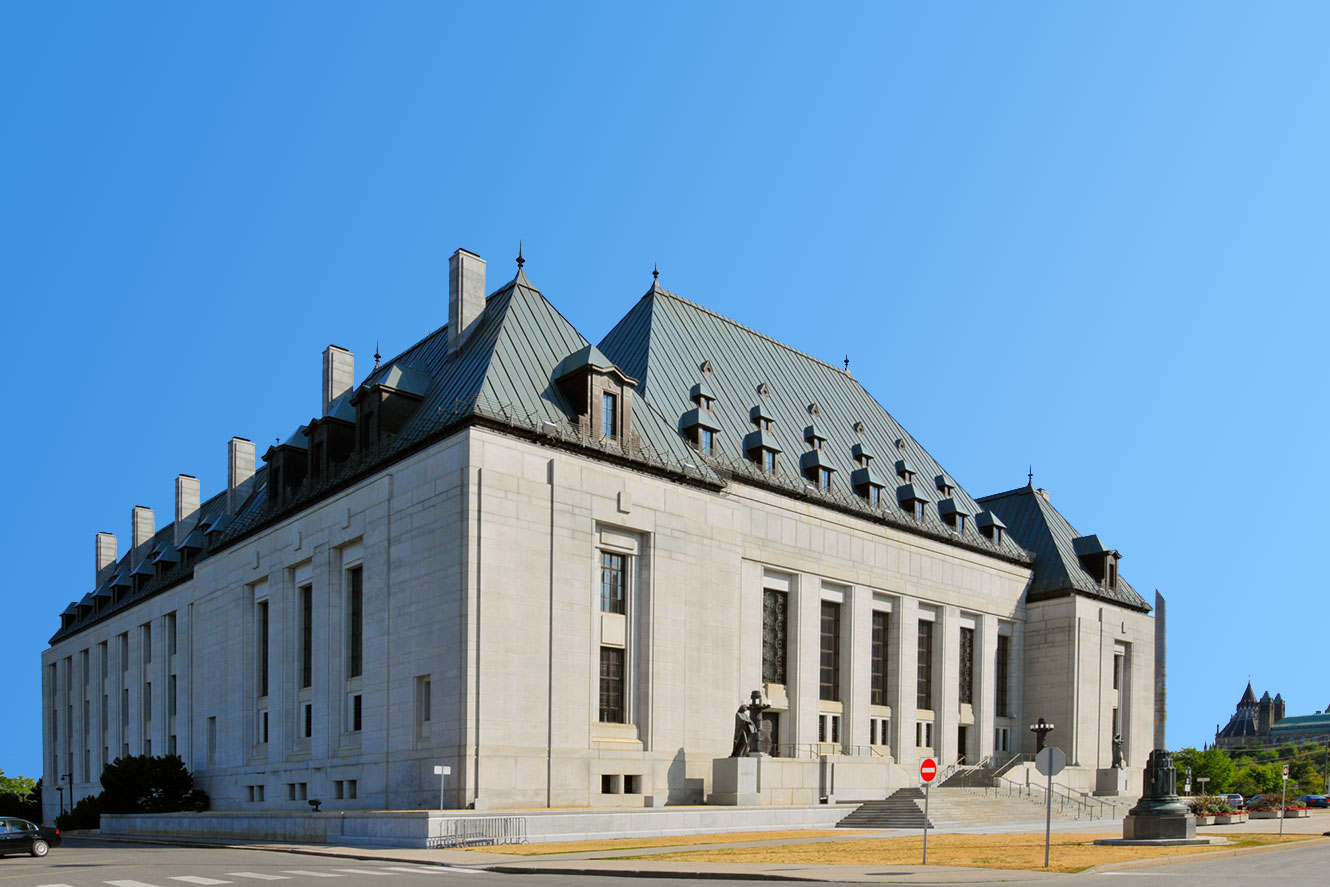
Supreme Court of Canada: The instant matter revolved around a challenge to the constitutionality of Section 33.1 of the Criminal Code which dealt with the unavailability of self-induced intoxication as a defence for criminal acts like assault etc. The bench of the Court comprising of Wagner C.J. and Moldaver, Karakatsanis, Côté, Brown, Rowe, Martin, Kasirer and Jamal JJ., in an unanimous decision, held that, Sec. 33.1 violates S. 7 of the Canadian Charter of Rights and Freedoms by allowing a conviction without proof of mens rea or proof of voluntariness. It was observed that, “Section 33.1(1) of the Criminal Code eliminates the defence of self-induced intoxication akin to automatism applied to violent offences… Section 33.1 does not create a new predicate act offence of self-induced extreme intoxication or a new criminal negligence offence. The accused faces the full stigma of conviction and the full brunt of punishment for the general intent offence.”
Facts of the Case: The appellant [hereinafter ‘B’], at a house party, had consumed ‘magic mushrooms’ which is a hallucinogen. The consumption of the drug led to ‘B’ losing his grip over reality. As per ‘B’, he was not simply drunk or high: while capable of physical movement, he was in a psychotic state and had no willed control over his actions.
He broke into the nearby house of a stranger and attacked the occupant, causing permanent injuries. He further broke into another residence and the occupants called the police. Consequently, ‘B’ was charged with break and enter and aggravated assault, and mischief to property.
Contentions: The appellant contended that he is not guilty of the offences by reason of automatism. The appellant’s contentions were corroborated by the expert witnesses who confirmed that ‘B’ had no voluntary control over his conduct at the time.
The respondent (the Crown) invoked S. 33.1 of the Criminal Code preventing ‘B’ from relying on self-induced intoxication akin to automatism as a defence to the charge of aggravated assault. The respondents stated that the Canadian Parliament added S. 33.1 in response this Court’s ruling in Henri Daviault v. Her Majesty the Queen, 1994 SCC OnLine Can SC 83, wherein the majority had confirmed a common law rule that intoxication is not a defence to crimes of general intent.
The respondents, however, prayed to the Court to interpret S. 33.1 as validly imposing liability for violent crimes based on a standard of criminal negligence
Observations: Perusing the facts and contentions of the case, Justice Kasirer (who delivered the unanimous decision) observed that the impugned provision does not establish a proper measure of criminal fault by reason of intoxication; instead, it imposes liability for the violent offence if an accused interferes with the bodily integrity of another “while” in a state of self-induced intoxication rendering them incapable of consciously controlling their behaviour.
Given the gravity of the issue, the Court some salient observations –
- It was held that the provision is violative Canadian Charter of Rights and Freedoms because an accused person under the impugned provision is not being held to account for their conduct undertaken as free agents, instead, the accused is called to answer for the general intent crime that they cannot voluntarily or wilfully commit. “To deprive a person of their liberty for that involuntary conduct committed in a state akin to automatism — conduct that cannot be criminal — violates the principles of fundamental justice in a system of criminal justice based on personal responsibility for one’s actions. On its face, not only does the text of S. 33.1 fail to provide a constitutionally compliant fault for the underlying offence set out in its third paragraph, it creates what amounts to a crime of absolute liability.”
- The Court observed that the impugned provision also transgresses the right to be presumed innocent until proven guilty guaranteed by S. 11(d) of the Charter. To convict the accused, the Crown must prove all the essential elements of an offence beyond reasonable doubt.
- The Court noted that the rights of victims of intoxicated violence, in particular the rights of women and children, should be considered at the justification stage under S. 1 of the Charter rather than informing the analysis of a possible breach of the accused’s rights under S. 7. “Balancing competing Charter rights under the breach analysis should occur where the rights of the accused and another party conflict and are directly implicated by state action. The equality, dignity and security interests of vulnerable groups informed the overarching public policy goals of Parliament but they are best considered under S. 1”.
Along with the aforementioned observations, the Court pointed out that the Parliament has before itself a strong record that highlights the strong correlation between alcohol and drug use and violent offences, in particular against women. The issues regarding ensuring the equality, dignity, and security rights of all victims of intoxicated violence must be looked upon thoroughly by the Parliament, therefore it is all the more necessary that the Crown must show on a balance of probabilities that the limits of Ss. 7 and 11(d) of the Charter brought by S. 33.1 are reasonable and demonstrably justified under S. 1 of the Charter. “Given the patent risk that S. 33.1 may result in the conviction of an accused person who had no reason to believe that their voluntary intoxication would lead to a violent consequence, S. 33.1 fails at the proportionality step and thus cannot be saved under S. 1”.
[R. v. Brown, 2022 SCC 18, decided on 13.05.2022]








0 replies