








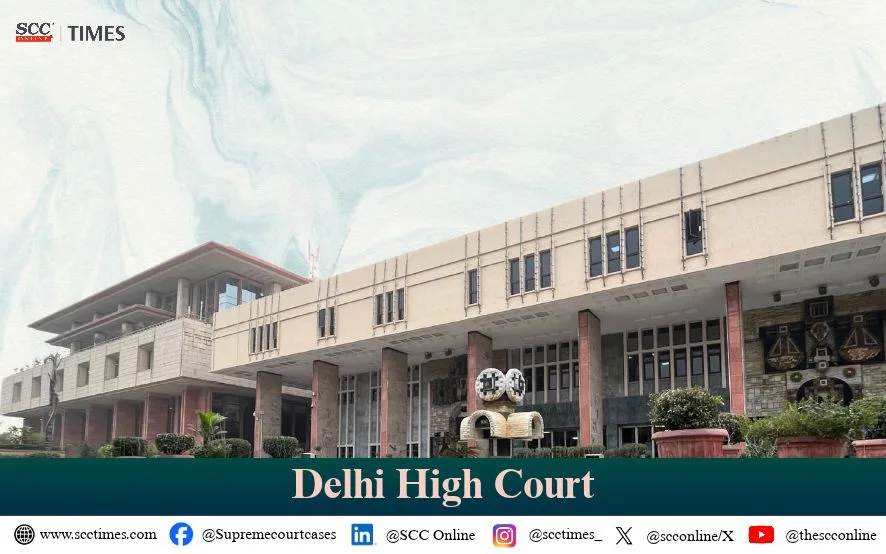
Delhi High Court: In a significant ruling on the scope of claims by legal representatives under Section 166 of the Motor Vehicles Act, 1988, a Single Judge Bench of Anish Dayal, J. held that financial dependency is not a prerequisite for maintaining a compensation claim and that a married daughter or sister cannot be denied compensation merely because she is married, earning or residing separately. The Court clarified that dependency is relevant to the computation and apportionment of compensation, but not to the right to maintain a claim. The Court rejected the Tribunal’s reliance on notional loss of estate and reassessed compensation on the basis of loss of dependency and enhanced the award granted to the claimant.
Background
The present cross-appeals arose from the award dated 12-03-2019 passed by the Motor Accident Claims Tribunal in respect of an accident that occurred on 31-08-2015, whereby compensation was granted in relation to the death of deceased-1(sister of claimant) and deceased-2(father of claimant). The Tribunal, while calculating compensation, adopted the principle laid down in Keith Rowe v. Prashant Sagar, SCC OnLine Del 4686 and computed compensation under the head of notional loss of estate. In respect of Deceased-1, total compensation of Rs. 9,27,100/- was awarded, whereas Deceased-2 was awarded compensation amounting to Rs. 13,15,600/-. Aggrieved by the award, the Insurance Company preferred appeals challenging the compensation awarded, while the claimant filed cross-appeals seeking enhancement of compensation.
The Insurance Company contended that since the claimant was a married daughter with a separate family and was not dependent on the deceased, she was not entitled to compensation under the head of loss of dependency. It argued that, at best, she could claim compensation for loss of estate, which should be calculated at 15% of the deceased’s income.
The claimant, on the other hand, contended that her deceased sister was earning approximately ₹15,000 per month and regularly contributed ₹8,000 per month to her, indicating that they were financially dependent upon each other. She also relied upon judicial precedents recognising the right of married children, married siblings and other legal representatives to claim compensation, even in cases where complete financial dependency is not established.
Analysis and Decision
The Court examined several issues relating to entitlement to maintain a claim, principles governing dependency, categories of dependants, standardisation of compensation, deduction of personal and living expenses and disbursement of compensation.
I. Who can file a claim
The Court referred to Section 2(11), Code of Civil Procedure, 1908 (CPC), which defines the expression “legal representative”. The Court noted that the definition is inclusive and of wide amplitude and is not confined to legal heirs alone. The Court while relying upon Custodian of Branches of Banco National Ultramarino v. Nalini Bai Naique, 1989 Supp (2) SCC 275, and Manjuri Bera v. Oriental Insurance Co. Ltd., (2007) 10 SCC 643, reiterated that a legal representative need not necessarily be a legal heir or a dependent of the deceased. It held that a person may be a legal representative and consequently entitled to maintain a claim notwithstanding the absence of financial dependency. It mentioned that mere absence of dependency does not, by itself, extinguish the right of a legal representative to maintain a claim under Section 166, MV Act.
II. Principle of restitutio in integrum
The Court, while examining the judicial precedents on the principle of “restitutio in integrum”, observed that the object of awarding compensation is to place the injured person, as nearly as possible, in the same position, in monetary terms, as he would have been, had the wrong not occurred. The Court observed that compensation is not intended to provide a bonanza, but to compensate for the loss, injury and deprivation suffered as a consequence of the wrongful act. The Court while applying this principle to motor accident claims, held that the right to claim compensation is not confined to the legal heirs of a deceased victim but extends to all legal representatives who have suffered loss on account of the death. Such legal representatives are entitled to maintain an application under Section 166, MV Act, and cannot be denied the right to claim merely because they were not financially dependent upon the deceased.
III. Various categories of dependants who do potentially file a claim
The Court, while referring to various judicial precedents concerning different categories of claimants, including married and earning children, siblings, earning spouses and non-family members, observed that the right to maintain a claim under Section 166, MV Act, is not confined to financially dependent family members. Married or earning children, siblings, earning spouses and even persons outside the immediate family may maintain a claim if they qualify as legal representatives. The Court emphasised that marital status, independent income or absence of financial dependency does not, by itself, disentitle a legal representative from maintaining a claim. However, actual dependency including partial dependency, remains relevant for determining compensation towards loss of dependency, while non-dependent legal representatives may still be entitled to compensation towards loss of estate.
IV. Standardisation and uniformity in compensation assessment
The Court, while examining the evolution of principles governing the assessment of compensation in motor accident claims, observed that initially, computation of compensation in cases of death was guided by the principle of loss and gain. However, a more structured approach subsequently emerged through the multiplicand-multiplier method, under which annual dependency is calculated after appropriate deductions towards personal and living expenses and multiplied by the appropriate multiplier. The Court particularly relied on Sarla Verma v. Delhi Transport Corporation, (2009) 5 SCC 121, and noted that the Supreme Court standardised the deductions towards personal and living expenses based on the number of dependent family members and prescribed a structured method for computing compensation. It further observed that the assessment involves four essential elements, namely, determination of income, addition towards future prospects, deduction towards personal expenses and application of the appropriate multiplier having regard to the age of the deceased. The Court further emphasised that the standards prescribed in Sarla Verma were intended to ensure uniformity and consistency in compensation assessment. It noted that Tribunals and Courts should ordinarily follow standardised principles, while retaining the discretion to depart from them where the circumstances of a particular case justify such departure.
V. Dependency compensation – Deduction of personal and living expenses and apportionment and distribution of compensation
The Court, observed that assessment of compensation requires a combination of standardised methods provided in Sarla Verma v. Delhi Transport Corporation, (2009) 5 SCC 121 and a subjective evaluation of the facts and circumstances of each case. It further observed that once the compensation is decided, the next step is apportionment which the Tribunal and Courts must undertake carefully. It held that the manner in which such amount is to be distributed or apportioned has to be assessed having regard to the circumstances of the individual claimants. The Court further identified three distinct stages at which dependency becomes relevant: first, dependency is not determinative of the right to institute a claim as a legal representative under Section 166 of the MV Act; second, it must be considered while determining deductions towards personal and living expenses, having regard to the contribution the deceased would have made towards the family income; and third, the calculated loss of dependency is used to purchase an annuity, providing claimants with a regular monthly amount for their maintenance. This amount is then apportioned among the claimants, taking into account the nature of their dependency.
The Court, while applying these principles in the present case, observed that although the claimant was married and residing separately, she could still have received financial assistance from her father and sister through the family income pot. The Court considered the practical financial arrangements within an Indian family, and held that the claimant was partially dependent upon both deceased persons. It accordingly considered 50% of the income of each deceased as personal and living expenses and treated the remaining amount as contribution towards the family income pot for assessing loss of dependency.
The Court rejected the approach adopted by the MACT of calculating compensation on the basis of notional loss of estate under Keith Rowe v. Prashant Sagar, SCC OnLine Del 4686 and reassessed compensation by applying the multiplicand-multiplier method. The Court enhanced the compensation to Rs.14,38,054/- in respect of deceased-1 and Rs.20,20,871.50/- in respect of deceased-2, resulting in an enhancement of Rs.5,10,954/- and Rs.7,05,271.50/-, respectively, along with interest at 9% per annum from the date of filing of the respective claim petitions. The enhanced compensation included amounts towards loss of dependency, loss of consortium, loss of estate and funeral expenses. It issued directions regarding deposit and disbursement of the enhanced compensation and disposed of all connected appeals.
[United India Insurance Co. Ltd. v. Savita., MAC.APP. 586/2019, MAC.APP. 588/2019, MAC.APP. 47/2023 and MAC.APP. 48/2023, decided on 06-11-2026]
Advocates who appeared in this case :
For the Insurance Company: Ravi Sabharwal, Advocate.
For the Claimant: Jatinder Kamra and Mr. B. P. Saxena, Advocates.
Social Media Template: No quote









0 replies