








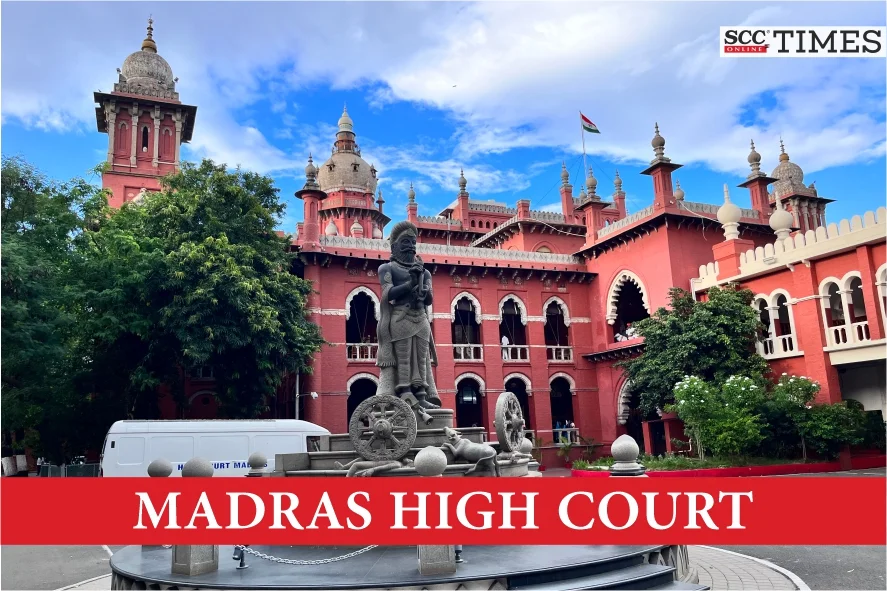
Madras High Court: While considering a contempt petition filed under Section 11, Contempt of Courts Act, 1971, alleging wilful and deliberate disobedience of its directions issued in the judgment dated 19 June 2024 in S. Krishnan v. Secretary to Government, Department of Higher Education, 2024 SCC OnLine Mad 14055, concerning transparent procurement of books for public libraries, a Division Bench of G.R. Swaminathan* and M.D. Sumathi, JJ., sought detailed explanations from the State Government regarding alleged irregularities in the procurement of books for the Kalaignar Library, Madurai, and Periyar Arivulagam. The Court called for a comprehensive review of book procurement over the preceding 2 decades, emphasised accountability in the utilisation of public funds and observed that artificial intelligence and digital processes had been subverted in the alleged scam.
The Court underscored that the existence of procurement guidelines alone would not ensure transparency unless supported by an effective and binding mechanism ensuring accountability at every stage of the procurement process. Noting that the earlier guidelines had been rendered ineffective, the Court called for a foolproof procedure, sought details regarding the collection and utilisation of library cess and indicated that the contempt petition could be closed once a binding procurement framework was put in place, subject to appropriate directions.
Background
The underlying proceedings concerned the procurement of books for public libraries in Tamil Nadu and the need to ensure transparency and accountability in the selection and purchase process. The present contempt proceedings arose against the backdrop of allegations of large-scale irregularities in the procurement of books, including the purchase of allegedly fraudulent, AI-generated and falsely attributed titles published by Agal Vilakku and other publishers.
Questions raised by the Court
During the hearing, the Court posed 9 specific queries to the State authorities, seeking details concerning the procurement process for the Kalaignar Library, Madurai, and Periyar Arivulagam. The queries included:
-
Whether the same principles and conditions applicable to general book procurement were followed for special-category procurement undertaken for Periyar Arivulagam.
-
The time taken to select and procure books for the Kalaignar Library and Periyar Arivulagam.
-
The number of books procured for the 2 libraries, including the procurement undertaken for the Kalaignar Library between January and December 2025.
-
The number of books rejected by the Expert Committee under the 2-stage procurement process and whether any rejected titles were subsequently procured for Periyar Arivulagam.
-
The number of books recommended by the 137-member Expert Committee, the time granted to it for the exercise and the number of books ultimately procured.
-
The circumstances in which approximately 600 out of the more than 2300 titles submitted by Agal Vilakku were rejected, while the remaining approximately 1700 titles were selected and procured, including the identity of the officials responsible, the stage at which the rejection took place and the reasons recorded in the relevant minutes.
-
The number of English books procured for Periyar Arivulagam, the mode of procurement, the separate budgets allocated for English and Tamil books and whether the entire allocation had been utilised.
-
Whether the work of librarians appointed as nodal and coordinating officials was supervised by the Director of Public Libraries and the Secretary for School Education, and whether the relevant files had been examined or written instructions issued.
-
The number of books recommended by the Expert Committee but not procured, together with the reasons for non-procurement.
Submissions by the State
When the matter was taken up in the afternoon, the Advocate General sought further time to respond to the Court’s queries. He assured the Court that all persons involved in the alleged scam would be dealt with and submitted that 5 officials had already been suspended in connection with the matter.
The State Public Prosecutor informed the Court that, pursuant to the departmental enquiry and the Court’s directions, the Directorate of Vigilance and Anti-Corruption (DVAC), Chennai City, had registered FIR for offences under the Nyaya Sanhita, 2023 and the Prevention of Corruption Act, 1988. The proprietor of Agal Vilakku who was stated to figure prominently in the alleged scam, had also been named as an accused.
The Advocate General further submitted that the government would consider suggestions made by the Court for streamlining the future book procurement process.
Stakeholder suggestions for reform
The Court also considered suggestions placed before it by 3 stakeholders concerning reforms to the book procurement mechanism.
The suggestions addressed several aspects of procurement reform, including transparency in the selection process, public disclosure of purchase orders and payments, preservation of digital audit trails, verification of publishers and authors, safeguards against fabricated and AI-generated content, independent audits and accountability in procurement decisions.
The Court expected the government to examine all 3 submissions carefully and respond positively by the next hearing. Observing that the existing guidelines had been rendered ineffective, it called for a foolproof procedure and indicated that a formal government order should be issued without undue delay. The Court stated that once a binding procedure was put in place, it would close the contempt petition, while issuing suitable directions.
Court’s observations and directions
The Court took judicial notice of the fact that library cess was being levied and collected. It sought clarification on whether the amounts collected had been duly credited and how the funds had been utilised. The Court specifically directed that the affidavit to be filed by the authorities should contain a separate paragraph addressing these aspects.
The Court also observed that the government would do well to undertake a detailed examination of book procurement over the preceding 20 years or more and place a statement before it by the next hearing date. It suggested that the government submit a white paper setting out the manner in which procurement had taken place, observing that public confidence in the system needed to be restored.
Emphasising the importance of public libraries and their role in promoting general knowledge, the Court observed that the alleged irregularities were particularly serious in view of the public purpose served by the library system.
The Court noted that the alleged scam was significant not merely because of its scale but also because of the manner in which it had been carried out, observing that artificial intelligence and digital processes had, for the first time, been subverted to achieve improper ends.
The Court was conscious that it could not direct the investigating officer to arrest any particular accused. However, it observed that the alleged bogus publishers had already been identified, at least in part, and that custodial interrogation could be necessary to uncover the modus operandi and ascertain whether public servants had received payments in connection with the alleged irregularities. The Court left these matters to the investigating agency and expressed the expectation that a clearer picture would emerge by the next hearing.
The Court directed that the matter be listed on 20 November 2026 at 10.30 a.m. as the first item. It also stated that the impleading applications filed in the proceedings would be considered on the next date of hearing.
[Ramasubbu v. K. Gopal, Contempt Petition (MD) No. 3763 of 2026, decided on 16-11-2026]
*Order by: Justice G.R. Swaminathan
Advocates who appeared in this case:
For the Petitioner(s): Mr. K.P.S. Palanivel Rajan, for Mr. P.M. Vishnu Varthanan.
For the Respondent(s): Mr. Vijay Narayan, Advocate General, assisted by Mr. P.V. Balasubramanian and Mr. B. Saravanan, Additional Advocates General; and Mr. M. Kannan, Special Government Pleader.
Mr. R. John Sathyan, State Public Prosecutor, assisted by Mr. D. Venkatesh, Additional Public Prosecutor.






0 replies