








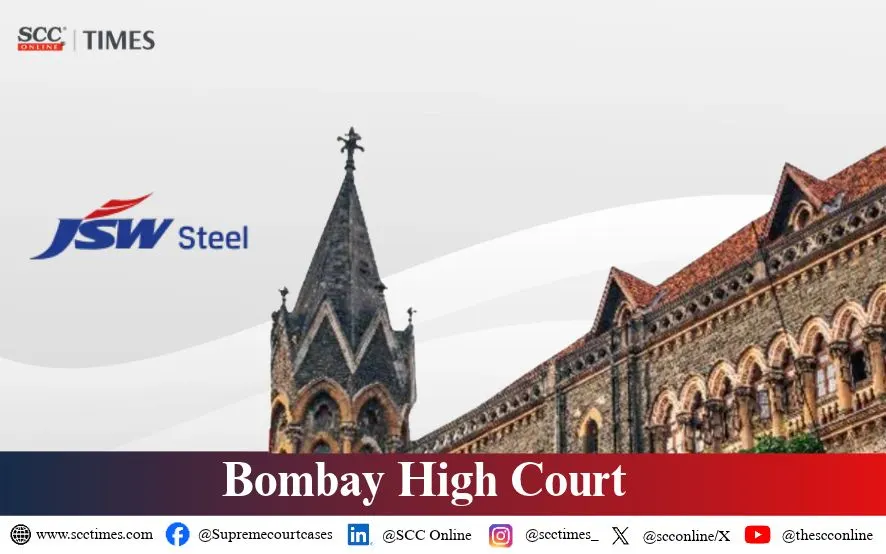
Bombay High Court: While examining whether the sale of counterfeit tin sheets bearing the name of JSW Steel Ltd. amounts to copyright infringement under Sections 51 and 63 of the Copyright Act, 1957, the Single Judge Bench of M. W. Chandwani, J., held that mere use of a company’s name on counterfeit goods, in absence of any allegation regarding infringement of a copyright-protected artistic work or logo, does not constitute copyright infringement. The Court observed that the allegations, at best, fell within the ambit of Section 104 of the Trade Marks Act, 1999. Accordingly, exercising its inherent powers under Section 528 of the Bharatiya Nagarik Suraksha Sanhita, 2023, the Court quashed the FIR and consequent proceedings.
Also read: Original, yes. Author, no: Copyright Office rejects AI authorship, but not AI-generated art
Background
JSW Steel Ltd., a manufacturer of steel products, had authorised the complainant, an Investigating Officer, to take action against persons dealing in counterfeit products bearing the company’s name. Upon receiving information that counterfeit tin sheets bearing the name of the Company were being sold within the territorial jurisdiction of a local Police Station, the complainant along with the police party conducted a raid at the premises of a trader dealing in such products. During the raid, the complainant allegedly found 137 pieces of counterfeit tin sheets bearing the company’s name. Alleging, that the trader was found selling counterfeit products of the Company, the complainant lodged an FIR for the offence punishable under Sections 51 and 63, Copyright Act.
Aggrieved by the above, the trader filed an application under Section 528 of the Bharatiya Nagarik Suraksha Sanhita, 2023 (BNSS), seeking to quash of the FIR. It was contended that the present case is not a case of copyright infringement but of engaging in manufacturing/selling counterfeit tin sheets of the Company. It was argued that since there is no allegation copyright infringement mentioned in the FIR, the allegations at best attracted the offence under Section 104, Trade Marks Act. He further contended that the FIR is vitiated as investigation is not carried out by the Deputy Superintendent of Police.
The complainant, on the other hand, contended that the trader was engaged in selling counterfeit tin sheets of the Company. It was argued that the Company’s logo constituted an artistic work protected under the Copyright Act, and that copyright subsisted in such work irrespective of registration. Further, the allegation in the FIR discloses a cognizable offence and therefore it can be quashed in a rarest of rare case. It was submitted that it is a settled law that the FIR is not an encyclopaedia which must disclose the facts and details of the offence reported and that the investigation is yet to be concluded, therefore it would be premature to decide the case based on incomplete facts.
Analysis and Decision
The Court observed that in order to claim Copyright, there must subsist Copyright. It examined the provisions of Section 13, Copyright Act and noted that copyright subsists only in the classes of works specified therein, which includes artistic work. It noted that as per Priya Shrivastava v. State of M.P, 2019 SCC OnLine MP 7185 even a logo, if qualified as an artistic work, a Copyright can be claimed for the said logo. However, as per the FIR, there is no allegation that any logo of the Company has been used on those tin sheets. Rather, the specific allegation was that the name of the Company appeared on the products. The Court emphasised that there is a distinction between the use of a company’s logo and the use of its name.
The Court noted that the FIR neither alleged that the company’s name was an artistic work nor that copyright subsisted in it. Since there was no allegation of infringement of any copyright-protected work, the Court held that the storage and sale of counterfeit tin sheets bearing the company’s name did not amount to copyright infringement. The allegations, at best, disclosed an offence under Section 104, Trade Marks Act.
The Court further examined Section 115 of the Trade Marks Act, and observed that the power to conduct search and seizure in relation to offences under Sections 103, 104 and 105 of the Act could be exercised only by a police officer not below the rank of Deputy Superintendent of Police. Since the search and seizure in the present case had been conducted by a Police Sub-Inspector, the mandatory statutory requirement had not been complied with. Consequently, the registration of the FIR and the investigation conducted pursuant thereto stood vitiated.
The Court observed that the inherent power to quash an FIR must be exercised sparingly and only in limited circumstances. It observed that one of the golden principles for quashing the FIR is that even if the allegations made in the FIR are taken at its face value and if they do not constitute any cognizable offence, the High Court in its inherent jurisdiction can quash the FIR being the abuse of the process of law. The Court further mentioned that as the present FIR relates to the selling of counterfeit products falling within the ambit of Section 104, Trade Marks Act, and not copyright infringement under the Copyright Act, the continuation of FIR is nothing but an abuse of the process of the Court.
Accordingly, the Court while exercising its inherent powers under Section 528, Bharatiya Nagarik Suraksha Sanhita, allowed the criminal application and quashed the FIR and the consequent proceedings.
[Shadab Sheikh Qayyum Sheikh v. State of Maharashtra, Criminal Application (APL) No. 918 of 2026, decided on 6-11-2026]
Advocates who appeared in this case:
For the Applicant: Shoeb Asgar Khan and Syed Salman Ali, Advocates
For Non-Applicant-1: Abhijeet G. Mate, Additional Public Prosecutor
For Non-Applicant- 2: Kartik N. Shukul and Gaurav Khatwani, Advocates






0 replies