At the Indian Mediation Federation’s (IMF) ‘An Evening with Mediators’, held on 31 October 2026 in New Delhi, a panel discussion brought together experienced mediators and legal professionals to examine the practical changes needed to strengthen India’s mediation ecosystem. The discussion moved beyond the question of recognising mediation as an alternative to litigation to explore how institutional reforms, professional expertise and technological innovation could make mediation a more accessible, credible and trusted process. The experts also considered what India could learn from international mediation practices and the approaches it could contribute to the global dispute resolution landscape.
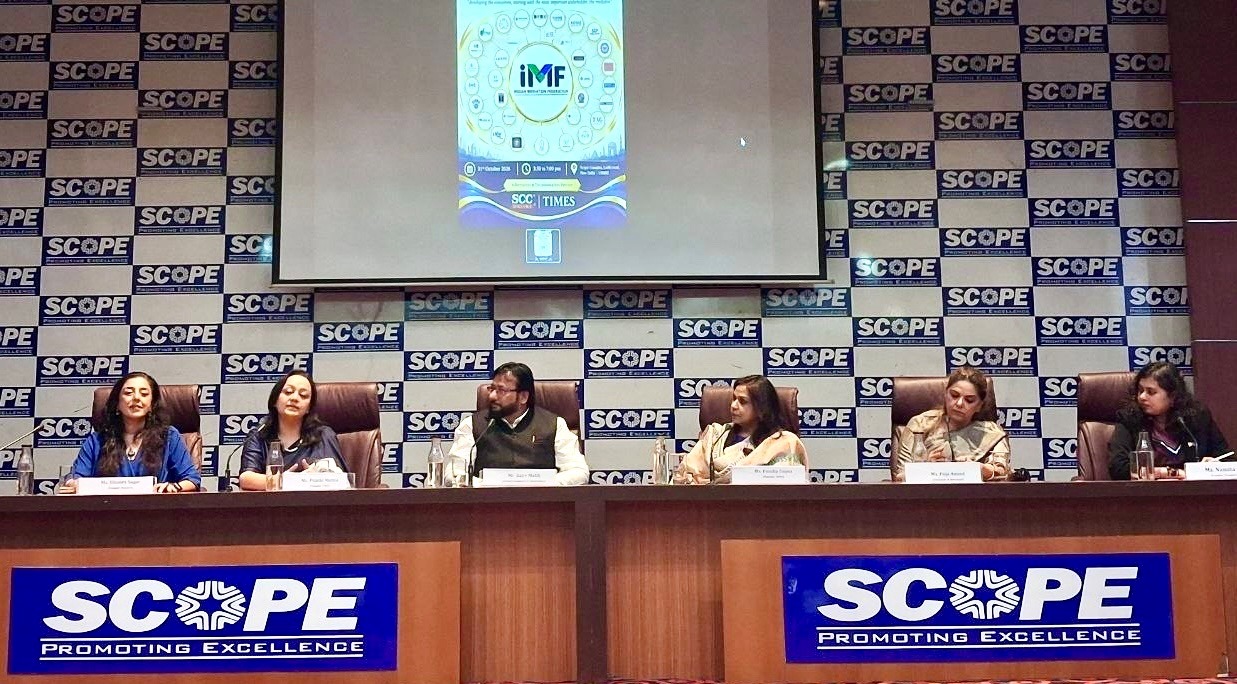
[In picture from left to right: Ms. Siboney S., Ms. Prachi Mehta Mr. Rajiv Malik, Ms. Pusshp Gupta, Ms. Puja Anand and Ms. Namita Shah]
Moderated by Ms. Namita Shah, Co-founder, Presolv360, the discussion featured Ms. Pusshp Gupta, International Mediator, Ms. Siboney S., Founder and Managing Partner, Resolve — The Effective Dispute Resolution Chambers, Ms. Puja Anand, Internationally Accredited Mediator and Senior Partner, CGC Partners, Ms. Prachi Mehta, Mediator and Founder, TAG, The ADR Group, and Mr. Rajiv Malik, Legal Leader, LG Electronics India. Through three rounds of discussion, the experts examined what the mediation ecosystem should retain, discontinue and create, the practices India could adopt from other jurisdictions and share with the world, and the choices that could shape the future of mediation by 2035.
Rethinking mediation: What should the ecosystem keep, kill and create?
Opening the discussion, Ms. Namita Shah asked the panellists to move beyond general observations about awareness and mindset and identify tangible changes that could be made through rules, processes, technology, skills, institutions and market structures.
Ms. Siboney S. emphasised the need to retain escalation mechanisms in commercial contracts, while making them more specific. Referring to the Government as one of the largest litigants in India, she highlighted the importance of clearly identifying who is authorised to negotiate, who has the necessary decision-making powers and the extent of that authority. She also questioned the use of settlement figures as a measure of mediation’s success, observing that the number of settlements does not necessarily establish whether parties have reached a genuine consensus. She suggested moving beyond treating mediation merely as a means of resolving individual disputes and developing conflict-resolution systems within organisations, particularly in sectors such as construction and technology. Such systems, she explained, could help organisations identify recurring disputes, understand where conflicts originate and address them before they escalate. Emphasising the role of government, she called for senior officers to be empowered to negotiate, supported by appropriate accountability mechanisms. She emphasised:
“The success of mediation really lies in where parties are seen as finding consensus, as being able to move beyond dispute and create.”
Ms. Pusshp Gupta highlighted the contribution of courts and court-annexed mediation centres to the development of mediation in India. She observed that these institutions had helped bring mediation to its present stage, including through their efforts before the enactment of specific legislation. However, she also identified the dominance of court-annexed mediation as a possible obstacle to the growth of private and pre-litigation mediation. She called for an inclusive institutional framework in which court-annexed centres and private mediation institutions could operate alongside one another. Under such an approach, disputes could be referred to specialised private institutions and domain experts, where appropriate, rather than relying exclusively on court-annexed mediation centres. She further emphasised that mediation should not be viewed merely as a mechanism for reducing judicial pendency. Instead, the focus should extend to preventing disputes and creating opportunities for parties to resolve conflicts before litigation becomes necessary.
Mr. Rajiv Malik stressed the importance of developing an ecosystem in which mediation becomes an early option for resolving commercial disputes. Drawing attention to the role of legal departments within businesses, he observed that litigation often becomes a cost centre for organisations. He suggested incorporating mediation into commercial relationships from the contractual stage itself, including agreements with suppliers and vendors. He proposed creating a structured mechanism involving all relevant stakeholders, including procurement and finance departments, to consider referring disputes to mediation at the earliest stage. In his view, mediation should form part of an organisation’s approach to managing commercial relationships rather than being considered only after a dispute has escalated.
Ms. Prachi Mehta focused on preserving the human element of mediation while identifying processes that could be automated. She emphasised that party autonomy, including the freedom to reject a proposed settlement, must remain central to the process. Referring to the growing use of artificial intelligence (AI), she cautioned that technology-generated settlement suggestions could influence parties into accepting outcomes they might otherwise reject. She called for an appropriate framework to protect party autonomy in technology-assisted mediation. She highlighted:
“Party autonomy should also have the autonomy to say no.”
At the same time, she supported automating administrative processes, including document preparation and settlement drafting, subject to human oversight. Ms. Mehta also questioned the conventional measurement of mediation success. Referring to situations in which a settlement agreement is later litigated, as opposed to disputes in which parties continue their relationship despite not reaching a formal settlement, she questioned whether settlement figures alone could accurately reflect the effectiveness of mediation. She called for the development of a more meaningful measure of the durability of mediated outcomes.
Ms. Puja Anand highlighted the emotional and human dimensions of mediation, emphasising that technology should assist mediators without replacing their human judgement. She questioned the perception of mediation as a secondary or inferior alternative to litigation and called for greater institutional recognition of the process. She also stressed the need to develop specialised mediation institutions with domain expertise. In her view, mediation requires more than procedural knowledge, particularly where disputes involve technical or specialised issues. She suggested creating institutions with mediators who possess relevant subject-matter knowledge and can provide a trusted and secure environment for parties.
What should India borrow from other jurisdictions, and what can it offer the world?
In the second round, Ms. Shah invited the panellists to identify one practice from international mediation ecosystems that India could adopt more actively and one capability or idea from India that other jurisdictions should recognise. She emphasised that the exchange should not be approached as a one-way adoption of foreign practices, but as an opportunity for mutual learning.
Mr. Malik identified institutional credibility and trust as important lessons India could draw from other jurisdictions. He observed that parties must have confidence that their disputes will be heard and addressed through a reliable institution. At the same time, he highlighted India’s digital capabilities and suggested integrating digital infrastructure with institutional mediation to strengthen access and the delivery of mediation services.
Ms. Mehta identified the professionalisation of mediation advocacy as an area requiring greater attention. She observed that lawyers appearing in mediation often approach the process with the preparation and arguments associated with litigation, rather than with the skills required for negotiation. In her experience, mediators frequently have to guide lawyers through the negotiation process, although effective mediation advocacy should also be part of the advocate’s role. She called for changes in legal education to better prepare lawyers for negotiation and mediation. On what India could contribute internationally, she drew attention to Indian Knowledge Systems (IKS), referring to concepts such as Samvad, Sama and Dharma. She suggested that these traditions could provide an indigenous philosophical foundation for negotiation and mediation, while contributing to India’s development as an international centre for mediation.
Ms. Siboney emphasised the importance of adapting international practices to India’s social and cultural context. She observed that the ability to facilitate consensus requires specialised skills and cannot be assumed merely from seniority or a position of authority. She also highlighted the value of learning systems that enable mediators to develop their capabilities while respecting the confidentiality of mediation proceedings. She identified India’s cultural diversity as a significant strength that could contribute to the global mediation ecosystem. According to her, the ability to navigate differences across languages, regions and cultural backgrounds forms an important part of India’s capacity to facilitate dialogue and consensus. She suggested that this cultural sensitivity could be shared with other jurisdictions as a valuable contribution to international mediation practice.
Ms. Anand identified professionalism and the structured conduct of mediation as practices India could learn from other jurisdictions. She specifically referred to shuttle mediation, drawing on her experience of working with Canadian mediators. She explained that dedicating substantial time to a single mediation could allow mediators to devote their full attention and mental resources to the parties and the issues involved. She also highlighted the importance of appropriate remuneration and recognition of the emotional demands placed on mediators. As India’s contribution to the global mediation community, she highlighted empathy and the human element in dispute resolution. She observed that the warmth and personal engagement often associated with Indian mediation practice could offer valuable lessons to other jurisdictions.
Ms. Gupta called for greater adoption of administrative mediation, particularly in government departments and public sector undertakings. She observed that the Government’s significant role in litigation made it important to develop mechanisms through which inter-departmental disputes and grievances could be addressed through mediation. She also referred to ombudsman-led mediation as a possible avenue for resolving disputes within administrative structures. She suggested that administrative mediation could help government departments save time and resources while allowing them to focus on policy and governance. As an Indian practice that could be shared internationally, she highlighted Lok Adalat, describing it as a model that demonstrates the potential for large-scale dispute resolution through structured, accessible mechanisms.
The mediator’s hot seat: Mandatory mediation, AI and the choices ahead
The final round, described by Ms. Shah as the “mediator’s hot seat”, involved short questions requiring the panellists to state their positions on some of the most debated issues concerning the future of mediation.
On whether mediation should be mandatory before commercial litigation, the responses were varied. Ms. Anand and Ms. Gupta supported such a requirement, while Ms. Mehta qualified her support by favouring a first mediation step rather than repeated mandatory attempts. Ms. Siboney supported time-bound escalation mechanisms, while Ms. Shah’s response was negative.
On the use of AI as a co-mediator, the panellists generally recognised its potential, while emphasising the need for human judgement. The suggestions included using AI to generate settlement options, identify gaps, assist with profiling and support systematic analysis. Ms. Anand supported its use, provided the mediator also exercised independent judgement. The discussion also considered whether mediators should be permitted to receive private settlement suggestions generated by AI during mediation. The panellists highlighted the importance of informed consent, authorised information, transparency about assumptions and human verification. Ms. Mehta supported such use subject to informed consent, while Ms. Siboney emphasised that AI should not be given the authority to press parties towards a particular outcome.
On the choice between online and in-person mediation, online mediation emerged as a preferred option in the rapid-fire exchange. The panellists also identified lawyers, legal education and institutions as significant barriers to the wider adoption of mediation, with some responses pointing to more than one obstacle. Another question concerned whether commercial contracts should require a mediation step before arbitration or litigation. While several panellists supported such a requirement, their responses reflected different views on whether it should be mandatory, time-bound or limited to an initial attempt.
The panellists were also asked which phrase they would remove from mediation vocabulary: “without prejudice” or “meet halfway”. Ms. Siboney questioned the expression “meet halfway”, observing that a midpoint between two unreasonable or unviable positions would not necessarily produce a fair outcome. Ms. Anand also favoured removing “meet halfway”, suggesting that the expression “win-win situation” could itself retain an adversarial framing. Ms. Gupta and Mr. Malik expressed reservations about removing either expression, while Ms. Gupta questioned the use of “without prejudice” in the mediation context.
Looking ahead to 2035: What will keep mediators relevant?
Towards the conclusion of the rapid-fire round, Ms. Shah invited the panellists to reflect on the skills and capabilities that would determine a mediator’s relevance by 2035. Ms. Gupta highlighted the need for mediators to upgrade their technological capabilities and remain adaptable to changing times. Mr. Malik also emphasised the growing importance of technology in mediation. Offering a different perspective, Ms. Mehta drew attention to the ability to translate, underscoring the importance of bridging differences and facilitating communication between parties. The responses reflected the evolving demands on mediators, requiring them to engage with technological developments while retaining the skills essential to effective dialogue and dispute resolution.
International perspective: AI, conflict prevention and the human element
The discussion also included a contribution from a mediator from Poland, whom Ms. Shah invited to share perspectives on the use of AI in mediation and developments in her jurisdiction. The mediator explained that she used a private AI agent for case management in her work involving a court-annexed mediation pilot programme concerning bank-consumer disputes. She also referred to using an AI-based mediation coach to prepare for sessions, formulate difficult questions and reflect on the mediation process after each session.
However, she emphasised that the future of mediation should not be limited to the use of technology. Highlighting the importance of conflict prevention, she suggested that AI and other tools could help mediators identify risks, improve communication and prevent disputes from arising. She also stressed the importance of introducing mediation and amicable dispute resolution processes at different levels of education, including through peer mediation for students. Emphasising the need to preserve human values, she observed that technology should provide people with additional tools to prevent and address conflict, while keeping human dignity, empathy and individual values at the centre of the process.
“But people can create the resolution”
Towards the conclusion, Mr. Malik shared a poetic reflection on mediation, describing it as a celebration of dialogue and resolution. His remarks emphasised that the purpose of mediation should not be to determine who won or lost, but to find a way forward through conversation and mutual understanding. Summing up the discussion, Ms. Shah observed that the future of mediation should not be framed as a choice between mediation and technology, India and the West, or courts and private institutions. Instead, it would depend on developing systems in which each component contributes according to its strengths. She observed:
“The future lies in designing systems where each does what it does best. Technology can create access. Institutions can create structure. Data can create insights. Law can create legitimacy. But people can create the resolution.”
She further emphasised that the real measure of progress would be whether mediation could help people feel heard and resolve disputes earlier, fairly and with dignity.
Closing Remarks:
The discussion underscored that the future of mediation in India would depend not merely on legislative recognition or technological advancement, but on building a collaborative ecosystem that combines institutional credibility, professional competence, accessible processes and human judgement. From strengthening private and administrative mediation to developing specialised institutions, integrating AI responsibly and drawing upon India’s own traditions of dialogue and dispute resolution, the panellists highlighted the need to move beyond treating mediation merely as an alternative to litigation. The session concluded with a shared vision of making mediation an integral part of how societies address disagreements, resolve disputes with dignity and prevent conflicts before they escalate.
SCC Times is the official Information & Documentation Partner for the event. Read more about the Indian Mediation Federation’s ‘An Evening with Mediators’ here: