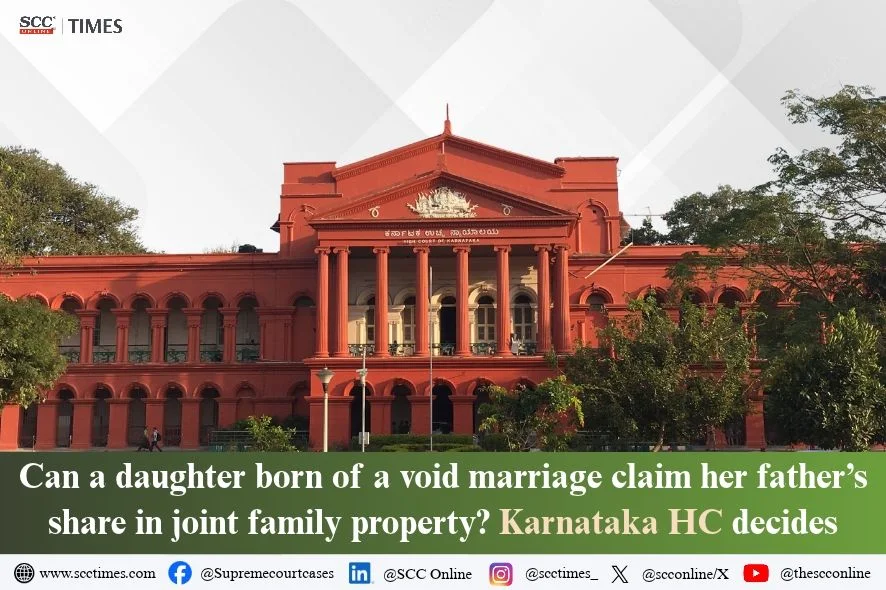
Karnataka High Court: While deciding a family property dispute concerning the inheritance rights of a daughter born from a void marriage, a Single Judge Bench of S.R. Krishna Kumar, J., held that Section 16 of the Hindu Marriage Act, 1955 (HMA) confers legitimacy to a child born out of a void marriage and entitles such a child to succeed to her deceased father’s notional share in joint family property. It ruled that although the trial court had held that the 2nd wife was not entitled to a share on account of the void marriage, the daughter was rightly granted a ¼ share in the joint family property. Accordingly, it dismissed the second appeal, finding no substantial question of law arising for consideration.
Background
The appellant is the son of deceased AH (AH)and his 1st wife. The Respondents 1 and 2 herein, are the 2nd wife and daughter of AH. The dispute arose pertaining to partition of shares in the joint family property (suit property) of AH.
Before the suit for partition was filed, the appellant had sold a portion of the suit property (3 acres and 2 acres out of 17 acres 24 guntas) to Respondent 3 and 4 through registered sale deeds. The same was challenged by Respondents 1 and 2 before the trial Court on the ground that suit properties were joint family properties in which they were entitled to a share after the death of AH. The appellant denied both the relationship and the Respondent 1 and 2’s entitlement to any share in the suit properties.
The trial Court held that the second marriage was void as it took place during the subsistence of AH’s first marriage, with no evidence that it was solemnised before 1956. The trial Court held that Respondents 1 and 2 were the 2nd wife and daughter of AH. Respondent 1 had no right to claim a share as the second marriage was void. It held that Respondent 2 was entitled to inherit from her father and awarded her ¼ share in the suit properties, while defendant No. 1 was held entitled to ¾ share. It also declared that the sale deed executed by appellant in favour of Respondents 3 and 4 was not binding on Respondent 2’s share. It further directed that a copy of the decree be sent to the Sub-Registrar for noting cancellation of the sale deed.
The said order was challenged before the first appellate court wherein it was allowed partly. It confirmed that the Respondent 2 was entitled to ¼ share in the suit property. It set aside part of the trial court’s decree directing the Sub-Registrar to record cancellation of the sale deeds, holding that no such relief had been claimed in the suit. It modified the decree by directing that the lands already sold to Respondents 3 and 4 would be allotted towards appellant’s share during partition.
Aggrieved by the same, the appellant filed the second regular appeal before the High Court.
Also Read: Daughters’ Property Rights — Before & After 2005 Amendment | SCC Times
Contentions
The appellant stated that the suit properties were the ancestral joint properties belonging to late AH. He contended that both the courts were not justified in coming to the erroneous conclusion that the Respondent 2 being the illegitimate daughter was entitled to a share in the suit properties after the demise of AH. Hence, the orders passed by both courts upholding the relationship of AH with the Respondents 1 and 2 and declaring that the Respondent 2 was entitled to ¼ share in the suit properties deserved to be set aside.
On the other hand, the Respondents 1 and 2 relied on Revanasiddappa v. Mallikarjun, (2023) 10 SCC 1 and supported the impugned judgment and decree. The same does not warrant interference by this Court in the present appeal.
Issue
Whether both the Courts were justified in declaring that the Respondent 2 being illegitimate daughter of late AH was entitled to 1/4th share i.e. half share in the notional half share of late AH in the suit property?
Analysis
The Court found the said issue to be no longer res integra in light of the Supreme Court judgment in Revanasiddappa which held that children who are legitimized under Section 16 HMA are entitled to inherit the property of their parents, even if the marriage of their parents was void. Such children cannot claim rights in the property of persons other than their parents, but they can succeed to the share that belonged to their parent. Referring to Revanasiddappa, the Court noted that under Section 6(3) Hindu Succession Act, 1956 the coparcenary property is deemed to have been partitioned immediately before the coparcener’s death, and the children legitimised under Section 16 HMA share in the interest so ascertained.
Applying the above principle, the Court observed that the suit property was joint family property in which AH had a half share and the other half belonged to the appellant. Upon death of AH, that half share had to be divided among his heirs. Respondent 2, though born from a void marriage, was entitled to succeed to her father’s share because Section 16 HMA conferred legitimacy on her for inheritance from her parents.
Therefore, she was rightly granted half of her father’s notional half share, which equalled to ¼ of the entire property, while appellant retained ¾ of the property.
Also Read: Family and Personal Law July 2026 Roundup | SCC Times
Decision
Finding no other substantial question of law arising for consideration in the present appeal, the Court dismissed the same being devoid of merit.
[Hanumanthappa v. Shanthamma, Regular Second Appeal No. 719 of 2017, decided on 8-10-2026]
Advocates who appeared in this case:
For the Appellant: Siddappa B.M., Advocate.
For the Respondents: K.R. Lingaraju, M.G. Kantharajappa, Advocates.