What if the next landmark resolution begins with a conversation? With this thought at its heart, the Indian Mediation Federation (IMF) hosted ‘An Evening with Mediators’ on 31 October 2026 in New Delhi, bringing together experienced mediators, legal professionals, institutional representatives and other stakeholders to deliberate on the future of mediation in India and the collective efforts required to establish it as a preferred mode of dispute resolution.
The discussions focused not merely on recognising mediation as an alternative to litigation, but on building an ecosystem that parties can trust and access, and that encourages them to consider dialogue before turning to adversarial proceedings.
Building a movement: Sanjeev Ahuja on awareness and advocacy
The programme commenced with the opening address by Sanjeev Ahuja, President, IMF, who described IMF as a movement, a platform and an ‘umbilical cord’ connecting individuals and institutions committed to the cause of mediation.
Highlighting the circumstances that often transform ordinary disagreements into disputes, he observed that human conflicts arise not merely from differences in perception and perspective, but also from ego, greed, insecurity, and several emotional factors. He called for a common platform that could bring stakeholders together and encourage a coordinated approach to addressing these conflicts.
Explaining the twin objectives of IMF, Sanjeev Ahuja emphasised that IMF seeks to promote awareness and advocacy for mediation across the country and beyond, while working towards an ecosystem that brings together stakeholders and facilitates a better understanding of this mode of dispute resolution.
“We feel it quite strongly that awareness alone can get the required change that we desperately seek.”
He said greater public awareness could encourage parties to consider mediation before approaching courts. It could also create opportunities for mediators, ease the burden on courts and gradually change how society approaches dispute resolution.
“IMF has been a wish and a dream for a while, hence this attempt to create a platform where we all who believe in mediation, who believe in a dialogue, who believe in the importance of communication can all get together and move forward for the common and the larger goal of making mediation the preferred tool.”
He further highlighted that creating demand for mediation must be accompanied by strengthening the competence, skills, and professional standards of mediators. As mediation gains wider acceptance, the quality of the process and the capabilities of those facilitating it would become equally important.
Calling for a collective assessment of the journey so far, he emphasised the need to identify what has not worked, deliberate on what needs to change in the present and work towards the future that stakeholders envision for mediation.
Strengthening institutional credibility: P.K. Malhotra on making mediation a preferred choice
While Mr. Sanjeev Ahuja’s address underscored the need to build a collective movement around mediation through awareness, advocacy and collaboration, P.K. Malhotra, Chairperson of IMF and former Secretary, Department of Legal Affairs, Government of India, turned the focus to the larger institutional challenges confronting its adoption in India.
Delivering the welcome address, Mr. Malhotra highlighted the persistent challenge of establishing mediation as the preferred mode of dispute resolution despite sustained efforts by the Government, institutions and other organisations to promote alternative dispute resolution (ADR).
Reflecting on India’s litigation landscape, Mr. Malhotra observed that parties involved in disputes often instinctively turn towards litigation, with the familiar response being, “Main tumhe court mein dekh lunga” (“I will see you in court”). He recalled that concerns regarding judicial pendency had existed since his early years in the Law Ministry in 1991—1992, and noted that despite the creation of several institutions and efforts to strengthen the judiciary, the problem of pendency continued to persist.
He observed that mediation had historically faced challenges in gaining acceptance, particularly in private disputes, because parties lacked sufficient confidence in the finality of mediated settlements and could withdraw from the process. The absence of adequate legal backing had consequently affected the willingness of parties to adopt mediation.
In this context, he highlighted the significance of the Mediation Act, 2023, describing it as a welcome legislative development that provides greater assurance to parties opting for mediation. He noted that the statutory framework strengthens the enforceability of mediated settlements by giving them the status of a decree of the court, addressing an important concern that had previously affected confidence in the process.
However, Mr. Malhotra cautioned that legislative recognition alone would not ensure the success of mediation. The confidence of litigants must be built through credible mediation institutions and a professional ecosystem capable of delivering satisfactory outcomes.
Drawing lessons from the evolution of arbitration in India, Malhotra referred to the Arbitration and Conciliation Act, 1996, and its subsequent amendments. Cautioning against a similar trajectory for mediation, he observed that the Mediation Act must succeed without undergoing the prolonged journey of deliberations and amendments that characterised the evolution of arbitration law in India. Instead, mediators and institutions must work from the outset towards creating an ecosystem that demonstrates the practical benefits of mediation, particularly its cost-effectiveness, time efficiency and ability to facilitate mutually acceptable resolutions.
Mr. Malhotra also acknowledged Mr. Sanjeev Ahuja’s initiative in establishing a federation that could bring mediators together on a common platform. He observed that such a collective effort could help identify the challenges confronting mediation, draw upon the experience of practitioners across the country, and contribute towards strengthening the Government’s efforts to reduce litigation.
Emphasising the purpose of the gathering, Mr. Malhotra invited participants to share their experience and suggestions on how IMF could contribute towards making mediation a successful dispute resolution mechanism.
He also encouraged professionals who had not yet joined IMF to consider becoming members and contributing to its initiatives. Among the possible areas of collaboration, he highlighted the development of a pool of mediators, including professionals accredited by the Government of India, with expertise across different areas of dispute resolution.
He stressed the importance of identifying appropriate methodologies that would inspire confidence among litigants while enabling mediators to conduct proceedings effectively and deliver outcomes that meet the expectations of the parties.
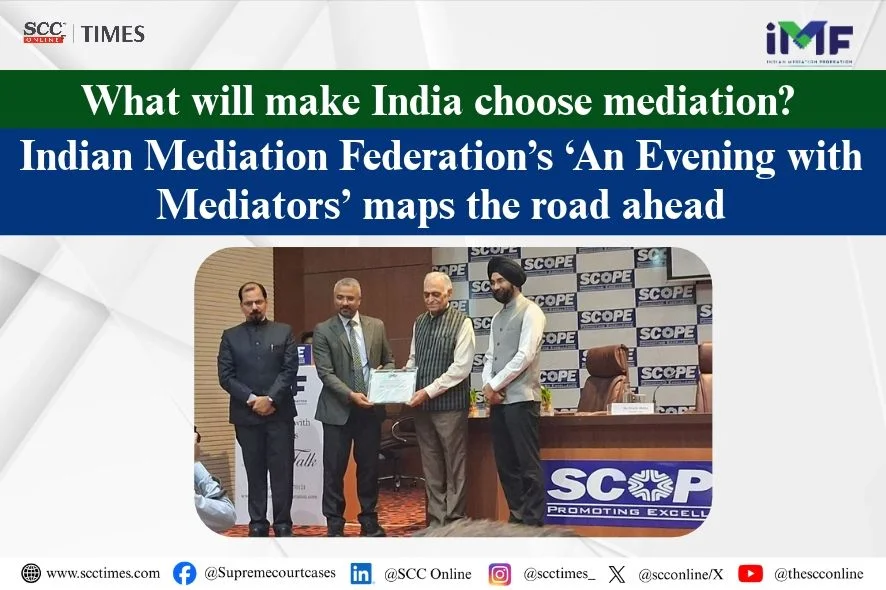
The inaugural proceedings also featured the felicitation of members of IMF’s Advisory Board and its founding members in recognition of their contributions and support towards establishing IMF.
The evening thus set the stage for further deliberations on the future of mediation, with a shared call for greater collaboration among practitioners, institutions and policymakers.
SCC Times is the official Information & Documentation Partner for the event. Follow comprehensive coverage, key insights and highlights from the event here!