“… (He) is not a knight errant roaming at will in pursuit of his own ideal of beauty or of goodness. He is to draw his inspiration from consecrated principles”
– Justice Benjamin Cardozo
Supreme Court: In a case concerning the permissibility of including the “Sinking Fund” in tariff determination of electricity generated and supplied by Damodar Valley Corporation (DVC), a Division Bench of J.B. Pardiwala and K. Vinod Chandran*, JJ., allowed the appeal and set aside the Appellate Tribunal for Electricity’s order allowing review of its earlier judgment. The Court held that the contribution to the Sinking Fund, constituted for redemption of bonds issued by DVC, could be treated as an item of expenditure recoverable through tariff, alongside depreciation on the capital assets acquired out of the bond proceeds, in terms of Section 40, Damodar Valley Corporation Act, 1948 and the Terms and Conditions of Tariff Regulations, 2009 (CERC). Rejecting the contention of double allowance, the Court held that the issue had already been considered and upheld by the Supreme Court in Bhaskar Shrachi Alloys Ltd. v. Damodar Valley Corpn., (2018) 8 SCC 281.
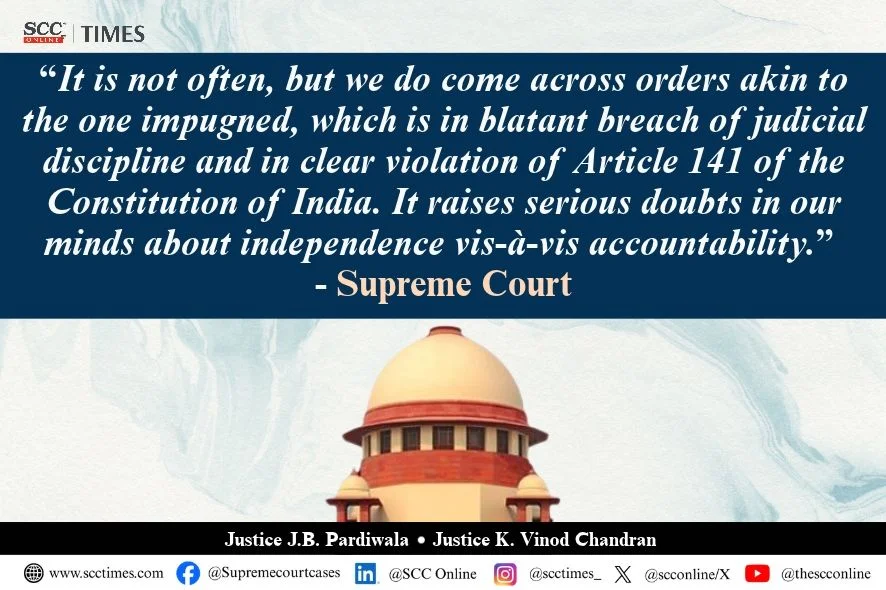
The Court further held that the fourth proviso to Section 14, Electricity Act, 2003, preserved the continued application of the provisions of the DVC Act to the extent that they were not inconsistent with the Electricity Act. Disapproving the Tribunal’s exercise of review jurisdiction after more than five years, the Court held that reopening an issue settled by a binding precedent amounted to a blatant breach of judicial discipline and Article 141 of the Constitution. Emphasising the sanctity and finality of judicial decisions, the Court restored the Tribunal’s original order dated 17 May 2019 and imposed exemplary costs of ₹2,00,000 on the first respondent and ₹1,50,000 on Steel Authority of India Ltd. for their respective roles in the proceedings.
Background
The dispute arose out of tariff fixation by the Central Electricity Regulatory Commission (CERC) in respect of the power generated and supplied by Damodar Valley Corporation (DVC) for the period 2009—2014 under the Electricity Act, 2003, the Damodar Valley Corporation Act, 1948 and the CERC (Terms and Conditions of Tariff) Regulations, 2009. The controversy concerned whether the ‘Sinking Fund’, being a portion of the profits appropriated for the purpose of redeeming bonds issued by DVC, could be factored into the tariff.
The very same issue had earlier been considered by the Supreme Court in Bhaskar Shrachi Alloys Ltd. v. Damodar Valley Corpn., (2018) 8 SCC 281, wherein the Court upheld the inclusion of the Sinking Fund in tariff fixation for the earlier period, namely, 1 April 2006 to 31 June 2009, while allowing DVC a two-year transition period from 1 April 2004 to 31 March 2006. CERC, by its order passed in 2013, included the Sinking Fund while determining DVC’s tariff for the subsequent period 2009 — 2014.
The Appellate Tribunal for Electricity, New Delhi, while deciding the appeals preferred by the consumers, upheld CERC’s order, both on its own reasoning and on the strength of the aforesaid binding precedent of the Supreme Court. The appellate order was not challenged by any party. However, one of the appellants subsequently preferred a review petition, which remained pending before the Tribunal for more than five years and was eventually allowed in 2024. Aggrieved thereby, DVC preferred the instant appeal before the Supreme Court, wherein Steel Authority of India Ltd., a Public Sector Undertaking, intervened.
Analysis
The Court observed that the review jurisdiction could not have been exercised to reopen an issue which had already attained finality on the basis of a binding precedent of the Court in Bhaskar Shrachi Alloys Ltd. On examining the said decision, the Court found that the permissibility of factoring the Sinking Fund as an item of expenditure recoverable through tariff, alongside depreciation on the capital assets created out of the bond amounts, had been specifically considered and upheld. The Court held that the contention of double allowance was not a new issue which had escaped consideration, as the original order of the Appellate Tribunal had specifically dealt with the same and had rightly relied upon the statutory provisions of Section 40 of the DVC Act and Regulation 43 of the Tariff Regulations of 2009.
Relying on State of West Bengal v. Kamal Sengupta, (2008) 8 SCC 612, the Court noted that an error which is not self-evident and which can be discovered only by a long process of reasoning cannot be treated as an error apparent on the face of the record, and that an erroneous order cannot be corrected in the guise of review. The impugned order did not fall under any of the principles so culled out.
The Court further held that the fourth proviso to Section 14 of the Electricity Act, 2003, preserved the continued application of the provisions of the DVC Act to the extent that they were not inconsistent with the Electricity Act. Sections 173 and 174 of the Electricity Act did not repeal the DVC Act in its entirety, but only gave overriding effect to the provisions of the Electricity Act in case of inconsistency. The second limb of the fourth proviso to Section 14 was held to be a substantive provision, preserving the special statutory framework governing DVC. The Court observed that DVC was constituted not merely for generation, transmission and distribution of electricity, but also for flood control, irrigation and the economic development of the Damodar Valley. Its statutory obligations and special status, therefore, had to be borne in mind while determining its tariff.
On the question of the Sinking Fund, the Court held that Section 40 of the DVC Act expressly permitted provision for depreciation, reserve funds and other funds while determining the net profits of the Corporation. The Tariff Regulations of 2009 specifically enabled depreciation at the rates stipulated by the Comptroller and Auditor General of India and permitted funds established under Section 40 of the DVC Act to be treated as items of expenditure recoverable through tariff. The Sinking Fund, constituted as a first charge for redemption of bonds, was thus permissible to be treated as an expenditure deductible from gross profits and factored into tariff determination. The Court rejected the contention that allowing depreciation on the assets acquired through bond proceeds, while also allowing contribution to the Sinking Fund, amounted to duplication or double allowance.
Disapproving the approach adopted by the Appellate Tribunal in review, the Court held that the Tribunal had overstepped the contours of review jurisdiction by reopening an issue which had already been settled by the Supreme Court. The Court observed that the impugned review order was clearly illegal, totally misplaced and blatantly in breach of the principles of judicial discipline. Emphasising the binding force of precedents under Article 141 of the Constitution, the Court held that judicial discipline required the decisions of the Supreme Court to be followed, and a subordinate tribunal could not disregard or reopen an issue concluded by such a decision under the guise of review.
Decision
Accordingly, the Court set aside the impugned review order and restored the original order of the Appellate Tribunal dated 17 May 2019. The appeal was allowed with costs. Further, exemplary costs of ₹ 2,00,000 were imposed on the first respondent for abuse of the process of law and ₹ 1,50,000 on Steel Authority of India Ltd. for participating in the attempt to uphold an order passed in breach of judicial discipline and Article 141 of the Constitution.
[Damodar Valley Corporation v. Maithan Alloys Ltd., Civil Appeal No.11106 of 2024, decided on 30-10-2026]
*Judgment authored by: Justice K. Vinod Chandran
Advocates who appeared in this case:
For the Appellant: Vikas Singh and Dr Abhishek Manu Singhvi, Senior Counsel with Venkatesh, Ashutosh K Srivastava, Priya Dhankhar, Nihal Bhardwaj and Adarsh Singh, Advocates
For intervenor (SAIL): Rajiv Shakdher, Senior Counsel
For the first Respondent: Rajiv Yadav, AoR