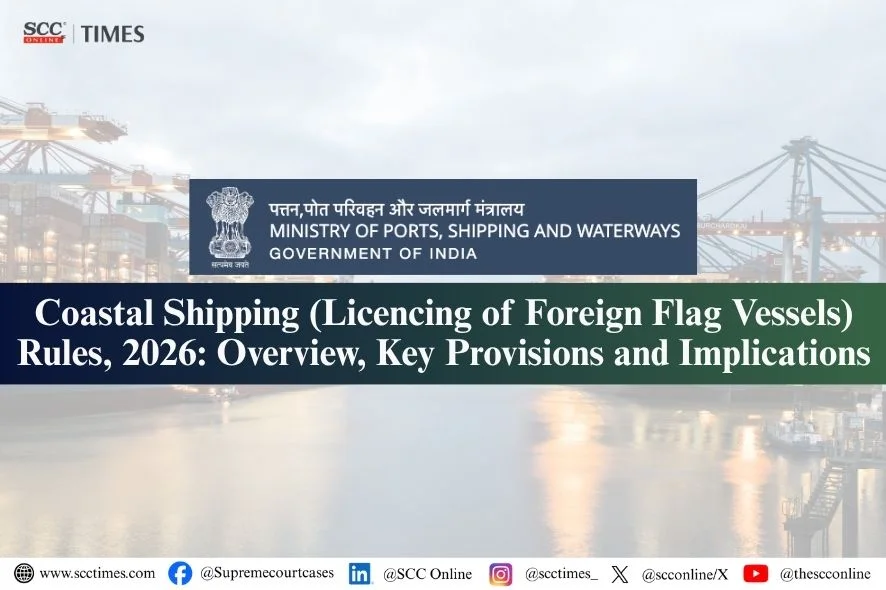
On 14 October 2026, Ministry of Ports, Shipping and Waterways, notified the Coastal Shipping (Licencing of Foreign Vessels) Rules, 2026, framed under the powers conferred by sub-section (1) and clauses (a), (b), (c), (d), (i), (j), (k), (l), (m), (n), (o) and (q) of sub-section (2) of section 39 of the Coastal Shipping Act, 2025.
These Rules establish the framework for licensing foreign-flag vessels engaged in Indian coastal trade and certain international trade operations involving Indian charterers.
Key highlights:
1. Applicability
-
These Rules apply to foreign-flag vessels in India’s coasting trade and vessels chartered by entities under Section 11(1) of the Coastal Shipping Act, 2025.
-
A licensing framework for foreign vessels has been established under the Rules.
2. Definitions Introduced
-
Rule 3 introduces key definitions for the purposes of the Rules, including “EXIM Trade” and “Foreign Flag Vessel.”
-
The term “port” has been assigned the meaning given under the Coastal Shipping Act, 2025.
-
“Appellate Authority” means the authority designated under the Indian Ports Act, 2025 for hearing appeals under these Rules.
3. Types and categories of licence
-
Rule 4 recognises the following licence types:
-
Voyage Charter;
-
Time Charter; and
-
Contract of Affreightment.
-
-
Licences may be issued under different categories, including:
-
Export;
-
Import;
-
Coastal;
-
Worldwide; and
-
Offshore operations.
-
4. Application and time limit
-
Under Rule 4(3), the applications must be submitted to the Director-General as per the First Schedule, at least 72 hours before the laycan date.
-
The Second Schedule prescribes a late fee of ₹50,000.
5. Licence fees and payment
-
Fees are prescribed in the Second Schedule and paid through Bharatkosh portal.
-
Additional charges may apply for late applications and licence modifications.
-
The Rules prescribe an additional levy on charterers of offshore vessels that are not classed with the Indian Register of Shipping and are more than 25 years old.
6. Document verification and licence issuance
-
Applicants must declare compliance with the Act and its Rules.
-
Documents may cover Right of First Refusal, CoA Guidelines, vessel age, quality standards and Indian crew placement.
-
The Director-General issues the licence after verification and may impose additional conditions.
7. Extension and modification
-
Extensions may be requested for delayed voyages; no NOC is required for extension applications under Rule 7(1).
-
Modifications require an application through the e-Samudra portal and payment of applicable fees.
8. Mandatory licence for port clearance
-
A valid licence must be presented for port clearance by the licensee or vessel’s agent.
-
Applies to foreign-flag vessels engaged in coasting or chartered for EXIM trade.
9. Compounding of offences
-
Applications for compounding must be made to the designated compounding officer in the prescribed format under the Fourth Schedule.
-
The compounding officer may accept or reject applications; rejection requires a hearing opportunity and written reasons.
-
The amounts payable are determined under the Fourth Schedule.
10. Appeals against penalties
-
Appeals against penalty orders must be filed with the Director-General within 30 days of receiving the order.
-
Appeals must follow the Fifth Schedule and include the penalty order.
-
Filing is permitted in person, through an authorised representative or advocate, by speed post or electronically.
11. Foreign-Flag Vessel Compliance
-
Where a foreign-flag vessel is detained under the Act, the relevant consular office of the vessel’s flag State must be informed.
-
The Rules also prescribe a separate procedure for notifying consular offices regarding proceedings initiated against licensees, agents or operators of foreign-flag vessels.
12. Schedules and their contents
-
First: Licence applications and supporting documents.
-
Second: Licence fees and late fees.
-
Third: Licence format.
-
Fourth: Compounding applications and amounts.
-
Fifth: Appeals and procedures.
-
Sixth: Notices regarding detention of foreign-flag vessels.
-
Seventh: Notices regarding proceedings against licensees or agents.
Overall significance
-
The Coastal Shipping (Licensing of Foreign Vessels) Rules, 2026 establish licensing requirements for foreign vessels engaged in Indian coastal and EXIM trade.
-
Prescribe application deadlines, fees, and document verification procedures.
-
Ensure compliance with Indian crew placement and Right of First Refusal (RoFR) guidelines.
-
Mandate a valid licence for port clearance.
-
Provide procedures for compounding offences and appealing against penalties.
The Rules apply to foreign-flag vessels participating in coastal trade and to specified vessels chartered by Indian citizens, NRIs, OCIs and eligible entities for international voyages.
Read Also:
Salient Features of the Draft Inland Vessels Bill, 2016
[Coastal Shipping (Licencing of Foreign Flag Vessels) Rules, 2026, dated 14-10-2026]