An analysis of Singapore International Commercial Court’s refusal to set aside an award of US $490 million passed in absence of any mining or accrual of profits
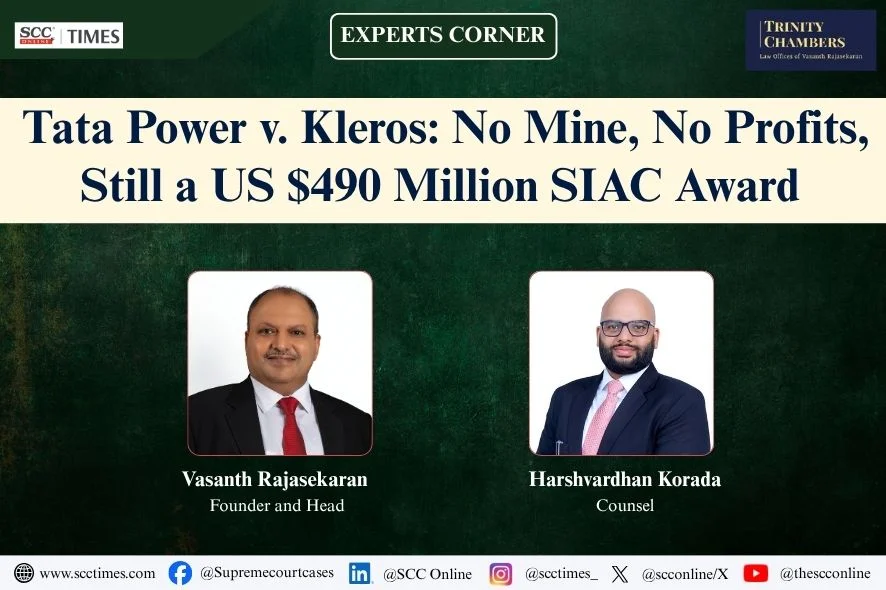
The Singapore International Commercial Court (SICC) has dismissed Tata Power’s challenges to a US $490.32 million loss of chance award arising from a coal mining venture that was never developed. The court held that the Tribunal had implicitly determined causation, remoteness and mitigation, and that the arbitrators’ connections with the claimant’s third-party funder did not give rise to apparent bias.
In Tata Power Co. Ltd. v. Kleros Capital Partners Ltd.1, the SICC, by its judgment dated 26 August 2026, dismissed three applications arising from an arbitration concerning a proposed investment in a Russian coal mining project. The arbitration had resulted in an award of US $490.32 million in favour of Kleros Capital Partners Limited (Kleros) against the Tata Power Company Limited (Tata Power).
Tata Power sought to set aside the award on the ground that the majority of the Arbitral Tribunal had failed to determine essential issues of causation, remoteness and mitigation which, according to Tata Power, could have materially affected the outcome. It also challenged the impartiality of the majority arbitrators on account of their alleged connections with Kleros’s third-party funder.
The proceedings required the SICC to examine whether the alleged failure to determine essential issues constituted a breach of natural justice and whether the circumstances relied upon by Tata Power established apparent bias. In addressing these questions, the SICC considered the limits of judicial intervention in arbitral proceedings, particularly the distinction between procedural irregularities warranting the setting aside of an award and objections concerning the merits of an arbitral determination.
Background of the dispute
The dispute concerned the Krutogorovo coal deposit in Russia, estimated to contain approximately 1.1 billion tonnes of coal. Kleros, an investment advisory company incorporated in the British Virgin Islands, identified the proposed mining opportunity and approached Tata Power as a potential co-investor. The project was commercially and technically demanding. Apart from investment capital, it required substantial infrastructure, regulatory approvals and government support.
The parties entered into non-disclosure agreements (NDAs) dated 21 September 2013 and 16 September 2014. Although described as confidentiality agreements, they imposed obligations extending beyond the protection of information.
In particular, Tata Power was required not to misuse confidential information, circumvent Kleros’s economic interests or act contrary to the contractual obligation of good faith. These obligations formed the foundation of Kleros’s subsequent claim, which was not simply that information had been disclosed, but that Tata Power had used its position in the commercial relationship to pursue the project while excluding Kleros from the opportunity it had introduced.
Differences arose between the parties over the proposed shareholding and control of the project. Kleros explored the possibility of pursuing the project with alternative investors but was unable to secure a replacement partner. It ultimately did not participate in the mining licence auction conducted in December 2017.
Following the expiry of the NDAs, Tata Power obtained the mining licence through a Russian subsidiary in January 2018. However, the project was never developed, and Tata Power eventually considered it commercially unviable and surrendered the licence in 2022.
The fact that the mine was never developed did not resolve Kleros’s claim. Kleros maintained that Tata Power’s earlier conduct had deprived it of a genuine opportunity to explore the investment independently or with other partners, and that the lost opportunity was capable of monetary assessment.
In November 2020, Kleros commenced two separate arbitrations against Tata Power, one under each NDA, pursuant to the Singapore International Arbitration Centre Arbitration Rules, 2016 (SIAC Rules, 2016). The two arbitrations were subsequently combined into a single proceeding, which was divided into two phases. In the first phase, the Arbitral Tribunal (Tribunal) was required to determine whether Tata Power had breached its contractual obligations under the NDAs. The second phase was reserved for determining whether those breaches had caused Kleros any loss and, if so, the damages payable. By a unanimous award dated 26 September 2023 (liability award), the Tribunal found that Tata Power had misused confidential information, circumvented Kleros and breached its contractual obligation of good faith. The Tribunal also found that Tata Power had concealed its intention to exclude Kleros from the project while pursuing arrangements with third parties. The liability award was not challenged.
The quantum phase raised a different question. Although Tata Power’s contractual breaches had been established, Kleros still had to demonstrate that those breaches had caused it to lose a compensable commercial opportunity. The majority accepted that Kleros had been deprived of a real and substantial chance of developing the project, either independently or with other investors. By an award dated 1 July 2025 (quantum award), it valued the project at approximately US $1.02 billion and assessed Kleros’s lost chance at 60 per cent. On that basis, the chance was worth US $612.9 million if Kleros had developed the project independently, and US $367.74 million if it had held a 60 per cent equity stake alongside a minority partner. The majority awarded the average of the two figures, US $490.32 million.
The dissenting arbitrator, however, disagreed on causation, concluding that the breaches had not deprived Kleros of the opportunity to pursue the project independently or with other investors. The dissenting arbitrator would instead have awarded US $13.5 million as negotiating damages, representing the amount Kleros could have obtained in exchange for releasing Tata Power from its obligations under the NDAs.
Tata Power then brought three applications before the SICC. The first challenged the appointments of the two majority arbitrators on the ground of apparent bias. The second and third sought to set aside the quantum award and the subsequent award on the costs of the arbitration (final award), the challenge to the latter standing or falling with that to the former. A further ground, that the majority had exceeded the scope of the submission to arbitration in quantifying damages, was abandoned. The SICC was therefore principally concerned with the alleged failure to determine essential issues and the challenge to the arbitrators’ impartiality.
Failure to determine an essential issue as a ground for setting aside an award
Tata Power alleged that, notwithstanding the findings of liability, the majority had failed to decide whether the contractual breaches caused Kleros’s loss, whether that loss was too remote and whether Kleros had taken reasonable steps to mitigate it.
Tata Power invoked Section 24(b), International Arbitration Act, 1994 (SG) (IAA), which permits an award to be set aside where a breach of natural justice occurs in connection with its making and prejudices a party’s rights. It also relied on Article 34(2)(a)(iv) of the United Nations Commission on International Trade Law (UNCITRAL) Model Law on International Commercial Arbitration (Model Law), contending that the failure to determine the submitted issues amounted to a departure from the agreed arbitral procedure.
In considering these objections, the SICC referred to CDI v. CDJ2 and Soh Beng Tee & Co. Pte Ltd. v. Fairmount Development Pte Ltd.3, which require an applicant alleging a breach of natural justice to identify the applicable rule, explain the alleged breach, establish its connection with the making of the award and demonstrate prejudice. An infra petita challenge arises where the Tribunal is alleged to have failed to consider or determine an essential issue submitted for its decision. Such a failure must be distinguished from an alleged error in the Tribunal’s reasoning or its determination of the issue.
The SICC referred to the decision in AKN v. ALC4, wherein the Singapore Court of Appeal held that an infra petita challenge requires a “clear and virtually inescapable“ inference that the Tribunal failed to consider an essential issue. Similarly, in DKT v. DKU5 it was further clarified that the enquiry in respect of an infra petita challenge concerns whether the Tribunal considered the issue at all, rather than the correctness or adequacy of its reasoning. An erroneous conclusion or inadequate reasons would therefore not ordinarily establish a breach of natural justice, unless the reasoning is so cursory that it demonstrates a complete failure to consider the issue.
The SICC emphasised that an arbitral award must be read as a whole and in the context of the parties’ submissions. Referring to CDM v. CDP6 and CAJ v. CAI7, it observed that an issue may require determination even if it was not expressly identified in the pleadings or an agreed list of issues. However, a tribunal is not required to address every argument separately. What matters is whether the award demonstrates that the essential issue was considered and determined.
The challenge concerning causation and the lost opportunity
Although Tata Power’s contractual breaches had been established, causation remained in dispute. Tata Power maintained that Kleros lacked the financial resources, technical expertise and governmental support necessary to develop the project, irrespective of those breaches. Before the SICC, Tata Power argued that the majority had failed to determine causation by considering the position that would have arisen had Tata Power complied with the NDAs (the no breach scenario). It also contended that the majority had failed to examine how each contractual breach caused Kleros’s loss.
The SICC first held that the challenge concerning the no breach scenario had been raised beyond the prescribed limitation period. Tata Power’s original application had alleged that the majority overlooked events preceding March 2016 and failed to examine causation separately for each breach. Although its supporting witness statement briefly referred to a “correct counterfactual”, it did not identify any allegedly agreed no breach scenario.
Relying on BTN v. BTP8, the SICC held that Tata Power’s reliance on no breach scenario constituted a new ground raised beyond the three-month limitation period under Article 34(3) of the Model Law. Nevertheless, the SICC examined the arguments on their merits.
The SICC found that, although both parties had accepted the but-for test for causation, they had not agreed upon the precise circumstances to be assumed in the no breach scenario. Kleros consistently argued that, had Tata Power complied with the NDAs, it would have been obliged to inform Kleros of its decision not to pursue the investment and to withdraw from the project, leaving Kleros free to proceed independently or with other investors. Tata Power had not disputed this position during the arbitration.
The SICC further found that the majority had implicitly adopted Kleros’s position. In particular, the majority had accepted evidence that Kleros proceeded on the understanding that Tata Power would honour the NDAs and had rejected Tata Power’s objections concerning Kleros’s ability to develop the project. The SICC also observed that Tata Power had not sought a separate causation analysis for each breach during the arbitration. Accordingly, it held that the majority had considered and determined causation, although its reasoning on the counterfactual could have been expressed more clearly.
The treatment of remoteness and mitigation
On remoteness, Tata Power argued that the majority had identified the applicable legal test without examining whether Kleros’s loss was too remote in relation to the contractual breaches. The SICC rejected this contention, finding that the majority had considered remoteness and foreseeability alongside causation in determining Kleros’s entitlement to loss of chance damages. A separate discussion of remoteness was therefore unnecessary. Any error in applying the test to individual breaches would concern the correctness of the decision, rather than a failure to determine the issue.
On mitigation, Tata Power contended that the majority had adopted the view that mitigation was of little or no legal relevance to a loss of chance claim without giving the parties an opportunity to address that position. Referring to Republic of India v. Vedanta Resources plc9 and Vietnam Oil and Gas Group v. Joint Stock Co. (Power Machines – ZTL, LMZ, Electrosila Energomachexport)10, the SICC observed that a tribunal may reach its own conclusion on the applicable law and is not confined to the legal positions advanced by the parties.
The SICC further found that the majority had, in any event, examined Tata Power’s mitigation defence on its merits. It had rejected Tata Power’s arguments that Kleros could have mitigated its loss by participating in the mining licence auction or acquiring an interest in Tata Power’s Russian subsidiary. The SICC therefore held that mitigation had been considered and determined, without needing to decide whether the majority’s legal conclusion alone would have constituted a breach of the fair hearing rule. Accordingly, the SICC dismissed Tata Power’s infra petita challenge, holding that the majority had considered and determined the issues of causation, remoteness and mitigation. Its corresponding objection concerning non-compliance with the agreed arbitral procedure was also rejected.
Apparent bias and third-party funding
Tata Power separately challenged the impartiality of the two majority arbitrators, alleging that their connections with Omni Bridgeway, the third-party funder financing Kleros’s arbitration, gave rise to an appearance of bias.
Tata Power’s objections changed between the institutional challenge and the proceedings before the SICC. Several objections raised before the Singapore International Arbitration Centre (SIAC) Court were abandoned, while others were raised for the first time in the setting aside proceedings. Tata Power ultimately relied on three allegations. First, the presiding arbitrator had failed to disclose his appointment in another arbitration in which Omni Bridgeway funded one of the parties. Secondly, the other majority arbitrator had similarly failed to disclose his appointment in a separate arbitration involving Omni Bridgeway funding. Thirdly, the presiding arbitrator was said to have a close personal and professional relationship with a member of Omni Bridgeway’s Investment Committee. In support of the third allegation, Tata Power relied on their past membership of the same chambers, their appointments as adjunct professors at the same university and a LinkedIn post by the committee member which, it said, evidenced their friendship.
The SIAC Court had dismissed Tata Power’s institutional challenge. It held that all but one of the objections, which Tata Power later abandoned, had been raised outside the 14-day period prescribed by Rule 15.1, SIAC Rules, 2016, and found no basis for apparent bias. The SICC agreed that the institutional challenge was out of time. It did not, however, decide whether that default prevented Tata Power from pursuing its objections before the court, where it relied instead on the three-month period under Article 34(3) of the Model Law. Assuming in Tata Power’s favour that the objections could be considered, the SICC examined them on their merits.
The SICC applied the objective test recognised in BOI v. BOJ11 and AMZ v. AXX12, namely, whether a reasonable, fair-minded and informed observer, knowing the relevant facts, would entertain a reasonable suspicion or apprehension that a fair determination of the dispute was not possible. The observer is assumed to be neither complacent nor unduly sensitive or suspicious, and the suspicion must rest on objectively ascertainable facts rather than speculation.
The SICC also distinguished an arbitrator’s obligation to disclose potentially relevant circumstances from the separate question of apparent bias. Relying on DLS v. DLT13, it observed that where the circumstances do not establish apparent bias, it is unnecessary to determine whether the arbitrator was nevertheless required to disclose them.
Applying these principles, the SICC rejected the allegations concerning the majority arbitrators’ other appointments. Neither appointment had been made by Omni Bridgeway, any party to the arbitration or their counsel. The other arbitrations involved unrelated parties and disputes. The fact that Omni Bridgeway had also funded parties in those proceedings was therefore insufficient, without more, to establish a reasonable apprehension of bias.
The allegation concerning the presiding arbitrator’s relationship with the member of Omni Bridgeway’s Investment Committee was similarly rejected. The SICC held that past membership of the same chambers and adjunct appointments at the same university did not establish a close personal or professional relationship of the kind relevant to apparent bias. Read fairly and objectively, the LinkedIn post did not suggest that its author was asserting any such relationship with the presiding arbitrator. The presiding arbitrator had also confirmed that he had never communicated with the committee member about Omni Bridgeway’s dealings in this or any other matter, and Tata Power had not disputed that confirmation.
Tata Power further relied on the International Bar Association (IBA) Guidelines on Conflicts of Interest in International Arbitration, particularly the Orange List provision concerning a close personal friendship with a person having a direct economic interest in the award. The SICC held that the provision did not apply to the facts established by the evidence. It also rejected the contention that a third-party funder must invariably be treated as bearing the identity of the funded party for disclosure purposes, since such an approach would require the corporate veil to be pierced in every funded arbitration. Whether a funder should be so treated depends on the circumstances, and in this arbitration the relevant party was Kleros, not Omni Bridgeway.
The SICC also treated the SIAC Court’s reasoned rejection of the challenge as evidence of the views of fair-minded and informed observers, following Aiteo Eastern E&P Co. Ltd. v. Shell Western Supply and Trading Ltd.14 It further noted that Tata Power had brought its institutional challenge only after the draft quantum award had been submitted for scrutiny, had abandoned several of its allegations and had not identified any concrete danger to a fair determination. The challenge to the majority arbitrators was accordingly dismissed.
Comment
The most striking aspect of the dispute is that the proposed coal mining project was never developed, yet Kleros secured an award of US $490.32 million for the loss of a commercial opportunity. Such claims do not necessarily require an underlying venture to have commenced operations, provided that the claimant establishes the loss of a real and substantial opportunity attributable to the contractual breach. The importance of causation is particularly evident from the divergent conclusions reached by the majority and the dissenting arbitrator. Although both agreed that Tata Power had breached the NDAs, the majority awarded US $490.32 million for the lost opportunity, whereas the dissenting arbitrator would have awarded only US $13.5 million as negotiating damages, having found that the breaches did not cause Kleros to lose the opportunity. The difference illustrates how the determination of causation can fundamentally alter both the basis and magnitude of damages.
The SICC acknowledged that the majority’s reasoning on what would have happened had Tata Power complied with the NDAs could have been clearer. Nevertheless, it concluded that the majority had implicitly adopted Kleros’s position, drawing that inference from the evidence considered, the findings recorded and Tata Power’s failure to contest Kleros’s proposed counterfactual during the arbitration. This raises an important question concerning the distinction between identifying a determination implicit in an award and supplying reasoning that the Tribunal itself has not provided.
In Indus Powertech Inc v. Echjay Industries (P) Ltd.15 the English High Court emphasised that an arbitral award must sufficiently disclose whether an essential issue has been determined. Although the SICC found that the majority had addressed causation, the absence of an express explanation of the counterfactual assumes particular significance when that determination forms the foundation of an award of such magnitude. A clearer articulation of the reasoning would have left considerably less room for dispute.
On apparent bias, the judgment reinforces that an arbitrator’s involvement in unrelated proceedings funded by the same third-party funder does not, without more, establish a reasonable apprehension of bias. Nor can a funder automatically be equated with the party it finances. The distinction between disclosure and apparent bias is also reflected in Halliburton Co. v. Chubb Bermuda Insurance Ltd.16, where the United Kingdom Supreme Court found that an arbitrator had breached the duty of disclosure in relation to overlapping appointments, but that the circumstances did not establish apparent bias. In the present case, the SICC found that the other appointments involved unrelated parties and disputes, while the alleged personal and professional connections were insufficient to establish a reasonable apprehension of bias.
For Indian practitioners, the decision is particularly relevant to the enforcement of foreign arbitral awards involving substantial claims for lost commercial opportunities. In Vijay Karia v. Prysmian Cavi E Sistemi SRL17, the Supreme Court of India emphasised that Section 48, Arbitration and Conciliation Act, 1996 does not permit a review of the merits of a foreign award. Accordingly, neither the magnitude of the damages awarded nor the fact that the proposed mining project was never developed would, by itself, justify refusal of enforcement in India. Any resistance to enforcement must fall within the limited statutory grounds, including denial of an opportunity to present one’s case, invalidity of the arbitration agreement, procedural irregularities, non-arbitrability or conflict with the public policy of India. The enforcing court cannot revisit the Tribunal’s assessment of causation or damages merely because a different conclusion may have been possible.
*Founder and Head, Trinity Chambers.
**Counsel, Trinity Chambers.
1. 2026 SGHC(I) 15.
2. (2020) 5 SLR 484; [2020] SGHC 118
3. (2007) 3 SLR(R) 86; [2007] SGCA 28
4. (2015) 3 SLR 488; [2015] SGCA 18
5. (2025) 1 SLR 806.
6. (2021) 2 SLR 235;[2021] SCGA 45
7. (2022) 1 SLR 505; [2021] SGCA 102
8. (2022) 4 SLR 683;[2020] SGCA 105
9. (2021) 2 SLR 354.
10. (2025) 2 SLR 273; [2025] SGCA 50
11. (2018) 2 SLR 1156; [2019] SGCA 30
12. (2016) 1 SLR 549; [2015] SGHC 283
13. 2025 SGHC 61; [2025] SGHC 61
14. 2024 EWHC 1993 (Comm).
15. 2026 EWHC 827 (Comm).
16. (2020) 3 WLR 1474 : 2020 UKSC 48.