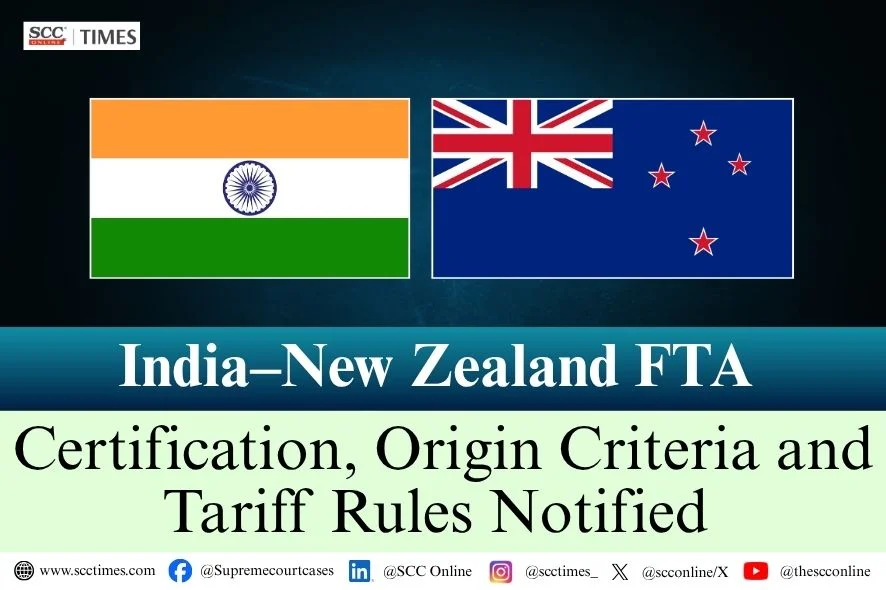
On 12 October 2026, the Ministry of Finance notified the Customs Tariff (Determination of Origin of Goods under the Free Trade Agreement between India and New Zealand) Rules, 2026.
The Rules prescribe criteria for determining the origin of goods, documentation, certification and verification procedures for claiming preferential customs duty benefits under the India—New Zealand Free Trade Agreement.
They promote bilateral trade by ensuring eligible goods receive concessional tariff treatment while preventing misuse through origin verification, record-keeping requirements and penalties.
The Rules have been framed under the powers conferred by Section 5(1) of the Customs Tariff Act, 1975, and will come into force on 20 October 2026.
Key provisions of Customs Tariff (Determination of Origin of Goods under the Free Trade Agreement between India and New Zealand) Rules, 2026:
-
The Rules establish the framework for determining whether a product qualifies as an “originating good” under the India—New Zealand Free Trade Agreement for claiming preferential tariff benefits.
-
Under Rule 3, goods qualify as originating if they are wholly obtained or produced in India, New Zealand, or both, in accordance with Rule 4, or satisfy the applicable product-specific rules (PSRs) under Annexure A.
-
Rule 4 specifies the qualifying categories and conditions, including those applicable to certain goods obtained beyond territorial waters.
-
Where required by the applicable PSR, QVC shall be calculated using either method:
-
Build-down: QVC = [(FOB − Value of Non-originating Materials) / FOB] × 100
-
Build-up: QVC = (Value of Originating Materials / FOB) × 100
-
-
FOB (Free on Board) refers to the value of the goods at the point of export.
-
Valuation and cost records shall comply with applicable customs valuation rules and accounting principles. Under Annexure A, the Build-up threshold is generally 10 percentage points lower than the Build-down threshold, except for HS Chapter 71 goods. The applicable PSR determines the prescribed threshold.
-
Annexure A prescribes PSRs by HS classification, including:
-
WO: Wholly Obtained
-
CC: Change in tariff classification at the two-digit level
-
CTH: Change at the four-digit level
-
CTSH: Change at the six-digit level
-
QVC: Qualifying Value Content requirement
-
-
The Rules also provide for bilateral cumulation, minimal operations, packaging, accessories, spare parts, indirect materials and fungible goods. Subject to specified conditions, de minimis tolerances include 10% for certain non-originating materials in goods under HS Chapters 50—63 and 1% for specified materials in certain goods classified as wholly obtained.
-
Preferential tariff treatment requires a valid Proof of Origin, such as a Certificate of Origin issued by the designated authority or an eligible origin declaration. The Rules govern issuance, including retrospective issuance in specified cases. Importers must declare originating status and hold the prescribed proof, unless an applicable exception or waiver applies.
-
Importers must declare originating status, maintain and produce valid origin documents, provide supporting information when requested, and comply with applicable consignment requirements.
-
Under Rule 25, a post-importation claim for refund of excess duties may generally be made within 12 months of importation, subject to prescribed conditions and any longer period permitted by the importing country’s laws.
-
Exporters, producers, approved exporters, eligible status holders and issuing authorities must retain origin-related records for at least five years, or longer where required by law. Importers should maintain supporting documents to substantiate preferential tariff claims and respond to customs enquiries.
-
Customs authorities may verify origin through information requests, document checks and verification visits. Preferential treatment may be denied for non-compliance or inadequate information, while misrepresentation may result in suspension or penalties under domestic law.
-
Minor clerical errors that do not cast doubt on origin shall not, by themselves, invalidate a Proof of Origin.
-
The Rules also provide for confidentiality, electronic information exchange and Technical Committee cooperation.
-
The Rules contain provisions governing third-country invoicing, permitting preferential tariff treatment even where invoices are issued by entities located in non-Party countries, subject to prescribed conditions.
-
Rule 35 provides for transitional arrangements for qualifying goods under transit or customs control when the Agreement enters into force.
-
The Rules facilitate electronic sharing of origin-related information between authorities of India and New Zealand.
-
The Rules contain the following Annexures:
-
Annexure A prescribes product-specific origin rules;
-
Annexures B prescribes requirements for Certificates of Origin;
-
Annexure C prescribes requirements for origin declarations.
-
Practical implications for businesses
-
The Rules determine originating status but do not independently establish preferential duty rates. Both the applicable tariff commitment and product-specific origin rule must be verified.