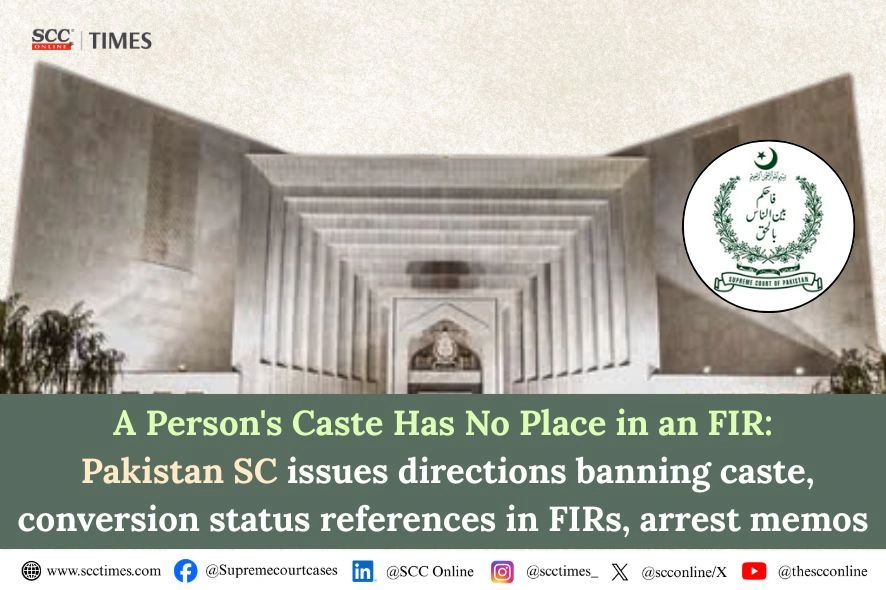
Supreme Court of Pakistan: While considering a case concerning petitioner’s grievance over his conviction and sentencing in a murder case, the three-Judge Bench of Muhammad Hashim Khan Kakar*, Salahuddin Panhwar and Ishtiaq Ibrahim, JJ., came across the practice of mentioning caste identifiers while registering FIRs.
The Court held that the practice of prefixing or suffixing names with caste identifiers in official police records, including FIRs, is in direct opposition to the fundamental principles of the Constitution of Islamic Republic of Pakistan. It was stated that such practices perpetuate a social ill that the Constitution explicitly and unequivocally aims to eradicate. Therefore, to further the constitutional goals of ensuring dignity and equality, the Court issued significant directions to prohibit government institutions from perpetuating distinction forbidden by law.
Background
The petitioner and the co-accused faced trial for murder. Subsequently, the petitioner was convicted under Section 302(b), Pakistan Penal Code, 1860 (PPC) and was sentenced to death with an order to pay ₹200,000 as compensation to the legal heirs of the deceased and in default whereof to undergo 6 months simple imprisonment. Aggrieved, the petitioner challenged his conviction and sentence before the High Court by filing an appeal but it was dismissed. The Lahore High Court maintained the petitioner’s conviction however; his death sentence was reduced to that of life imprisonment.
Aggrieved, the petitioner approached the Supreme Court.
Court’s Assessment
Perusing the facts of the case and analysis done by the courts below, the Court took note of the mitigating circumstances and decided to reduce the petitioner’s sentence of life imprisonment to that of 15 years’ imprisonment.
The Court however took grim note of the fact that the complainant was identified in the FIR as “Nau-Muslim Sheikh”, written in Urdu. The Court pointed out that under Islam, no differentiation in status, dignity or faith is recognised based on the person’s conversion or the timing thereof. Once a person embraces Islam, he/she stands equal in status and respect with other Muslims.
The Court also clarified that the distinction between “Sheikh” and “Nau-Muslim Sheikh” does not disclose any legal or religious basis. However, the use of any qualifying expression that marks a convert as “new” or otherwise distinct, neither has sanction in Islamic teachings, nor in law. The Court stated that any term merely identifying the caste or social origin to which a person belongs and, in themselves, carry nothing inherently reprehensible. Such terms however become objectionable when they are used to demean, stigmatise, or portray a person as belonging to an inferior social status.
The Court pointed out that the term “Nau Muslim Sheikh” (similar expressions such as “Dhobi”, “Naahi”, “Jamadar”, “Bhang” or “Dam” which are occasionally used in police records) appeared to be a derogatory or coded reference that implies a stigmatised or lower caste status. “This term is frequently associated with occupational or social hierarchies that persist in certain segments of society, despite constitutional prohibitions.” These terms are intended to indicate that an individual is a member of a particular community or caste, frequently one that has been historically marginalized.
Relying on Articles 25 and 33 of the Constitution of Islamic Republic of Pakistan, the Court stated that these provisions unambiguously deny any form of social hierarchy or stigma based on birth, representing the collective consciousness of the nation. Unless it is statutorily pertinent for the offense itself, there is no legitimate forensic, investigative, or legal purpose to mentioning a person’s caste in a FIR. Conversely, it institutionalizes discrimination, perpetuates stigma, violates the dignity of human beings, and undermines the rule of law.
Citing Pakistan’s obligations under international law, the Court stated that the normative inconsistency in the enforcement of fundamental rights, and domestic practices that stigmatize individuals through official nomenclature are incompatible with these obligations.
The Court dishearteningly noted that terms like “bhangi”, “chura”, “morassi”, “jamadar”, “dam”, and “musalli” are no longer used to define a caste but are instead used as derogatory remarks against the members of that particular caste.
“We are apprehensive about a society that relies on cleanliness for survival, yet dehumanizes those who make it possible. Those who clean society’s waste is described as “dirty”, and those who make cities liveable are regarded as lives that are inherently less deserving of respect.”
Directions Issued
Therefore, furthering the constitutional objective to uphold the values of equality, dignity and non-discrimination and to ensure that State institutions do not perpetuate distinction forbidden by law, the Court issued the following directions:
-
All Inspectors General of Police across the provinces and Islamabad Capital Territory shall ensure that no reference to caste, tribe, biradari, conversion status or any classificatory or derogatory expression is mentioned in the names of complainant, accused persons, victims or witnesses in FIRs, arrest memos, recovery memos, investigation reports, challans or any other police records;
-
Any departure from this rule shall be permissible only where the investigating officer, for bona fide investigative reasons directly connected with the offence and recorded in writing, believes such identification to be strictly necessary;
-
The Registrar of the Court shall transmit copies of this judgement to all Inspectors General of Police of all the provinces and Islamabad Capital Territory as well as to the respective Home Secretaries/Chief Commissioner for immediate compliance and circulation to all field formations.
[Arshad v. State, Jail Petition No. 183/2019, decided on 26-1-2026]
*Judgment authored by Justice Muhammad Hashim Khan Kakar
Advocates who appeared in this case:
Mr. Shoukat Hayat, ASC for the petitioners
Ms. Mamoona, DPG for the State
Mr. Muhammad Qasim Najam and Ms. Tayyaba Munir, Law Clerks