Disclaimer: This has been reported after the availability of the order of the Court and not on media reports so as to give an accurate report to our readers.
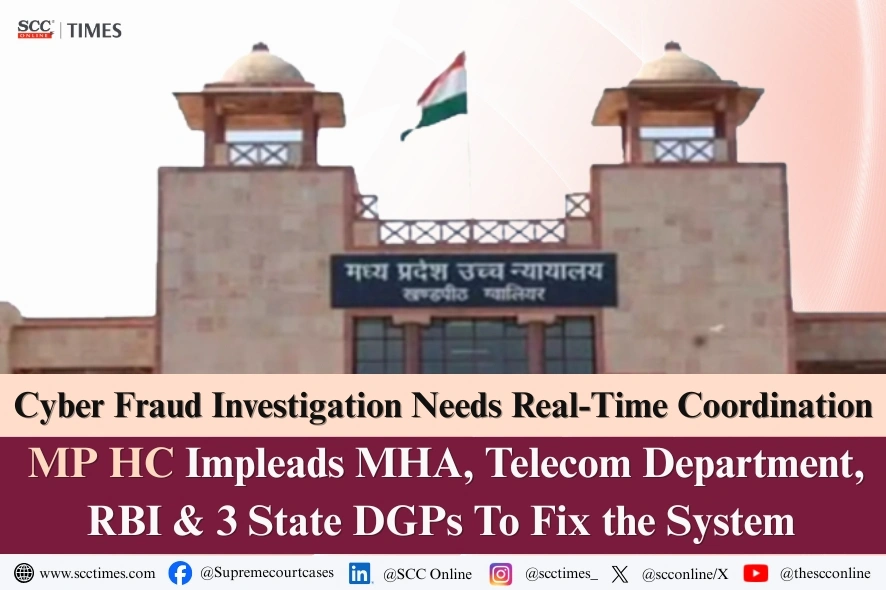
Madhya Pradesh High Court: In a cyber fraud case wherein, a retired Punjab National Bank manager was scammed out of ₹6.24 lakhs, the Single Judge Bench of Himanshu Joshi, J., held that there was an urgent necessity for establishing and streamlining a coordinated mechanism involving investigating agencies, banking institutions, telecom authorities and intermediary platforms so that real-time information may be exchanged. Immediate action may be taken to trace offenders and preserve electronic evidence. Accordingly, the Court directed the petitioner to implead the Union of India through the Ministry of Home Affairs, the Union of India through the Department of Telecommunications, and the Reserve Bank of India in the present proceedings.
The Court remarked,
“Unless information gathering, technical analysis, and field investigation are integrated under a dedicated and coordinated investigative framework, the object of prompt detection and recovery is likely to be defeated.”
Background
The petitioner, a retired manager of Punjab National Bank, became a victim of a fraud whereby an amount of ₹6.24 lakhs was siphoned off from her bank account through unauthorised IMPS transactions. The petitioner was aggrieved by the fact that despite registration of the FIR and lapse of considerable time, the investigation did not conclude, and no final police report was filed before the competent Magistrate.
Proceedings
During the proceedings, the Court noted that the investigation progress did not inspire confidence. The status report revealed that the investigating agency had been able to gather substantial information regarding the accused persons, including the accounts into which the defrauded amount was transferred and the locations from where the fraudulent transactions appear to have originated. Despite possessing such information, the investigating agency was unable to apprehend the accused persons. The Court further noted that even after 1 year of the FIR being registered, the investigation had not culminated in the filing of the final police report.
Noting the aforesaid, the Court held that the status report did not satisfy this Court that sustained and continuous efforts were being made to apprehend the accused persons. Accordingly, the Court directed that the investigation shall be monitored to ensure that the investigation proceeds effectively and in accordance with law.
The Court further opined that prima facie, the issue raised transcended the individual grievance of the petitioner and involved a larger question concerning the adequacy of the existing institutional mechanism for investigation of cyber fraud cases. Since the relief sought may entail consideration of policy and administrative measures relating to the constitution of a dedicated or permanent Special Investigation Team (SIT) or any other specialised mechanism for investigation of cyber fraud cases within the State, the Court deemed it fit to obtain the response of the State Government through the competent administrative authority.
In compliance with the previous order dated 29 June 2026, the Superintendent of Police (SP), Jabalpur, along with the Station House Officer (SHO), Police Station Gorabazar, and the investigating officer (IO), were personally present before the Court.
The SP submitted that immediately upon receipt of the complaint from the complainant, the matter was forwarded to the Cyber Cell for initiating necessary action. In cases involving cyber fraud, the Cyber Cell is required to obtain information from the respective nodal agencies of different banks. Since every bank has its own designated nodal agency situated at different locations, considerable time is consumed in procuring the requisite information. According to him, ordinarily 3 to 5 days are consumed merely in receiving preliminary responses from such nodal agencies.
The SP further submitted that in several cases, the investigation also requires assistance from police authorities of other States where the suspected transactions or accused persons are located.
The Court was also informed that cyber fraudsters are increasingly operating through so-called “mule” or “null” bank accounts opened in the names of innocent persons and are using encrypted communication platforms such as Telegram for coordinating their activities. For identifying the actual perpetrators, the investigating agency is required to approach the concerned intermediary for obtaining IP logs, subscriber details, and other technical information, which again consumes considerable time. Consequently, by the time the necessary information is received from different stakeholders, the accused persons are often able to change their locations, dissipate the proceeds of crime and erase the electronic trail, thereby frustrating the investigation.
Analysis
At the outset, the Court noted that it was apparent from the submissions that timely cooperation from police authorities of other States was not always forthcoming, thereby causing further delay in the investigation.
The Court remarked that investigation of cyber fraud offences stands on an altogether different footing from conventional criminal investigations. Cyber fraud is a crime where every second is significant. Prompt reporting by the victim, immediate freezing of accounts by banks, real-time sharing of information by financial institutions, expeditious response by telecom service providers and social media/intermediary platforms, prompt action by investigating agencies and seamless coordination amongst police authorities of different States are all indispensable for an effective investigation.
“Delay at any stage of the process directly benefits the offenders, who exploit the technological advantages available to them for concealing their identity and siphoning the proceeds of crime beyond the reach of law enforcement agencies.”
The Court further found that the existing mechanism, whereby information is sought through multiple agencies and forwarded from one authority to another before any effective field action is undertaken, results in avoidable delay. Such procedural movement of files and requests enables the perpetrators to remain several steps ahead of the investigating agencies. Unless information gathering, technical analysis, and field investigation are integrated under a dedicated and coordinated investigative framework, the object of prompt detection and recovery is likely to be defeated.
Noting the aforesaid, the Court held that there was an urgent necessity for establishing and streamlining a coordinated mechanism involving investigating agencies, banking institutions, telecom authorities and intermediary platforms so that real-time information may be exchanged and immediate action may be taken for tracing offenders and preserving electronic evidence.
Since the issues involved transcended the facts of the present case and concern the larger framework governing investigation of cyber crimes, the Court stated that the assistance of the Union of India and the Reserve Bank of India would be necessary for effective adjudication of the issues involved. Accordingly, the Court directed the petitioner to implead the Union of India through the Ministry of Home Affairs, the Union of India through the Department of Telecommunications, and the Reserve Bank of India in the present proceedings.
Regarding the submission that the present location of the principal suspect was Assam, the Court allowed the petitioner’s prayer to implead the Director General of Police (DGP), Assam. The Court directed the State to ensure service of notice upon the DGPs of West Bengal, Jharkhand, and Assam.
The Court further directed the petitioner to furnish copies of the petition and a copy of this order to the counsels representing the Union of India and Reserve Bank of India for enabling them to obtain necessary instructions and assist this Court on the next date of hearing.
Considering the nature of issues involved and the necessity of ensuring effective inter-State coordination in the investigation, the Court directed that the DGPs of West Bengal, Jharkhand, and Assam shall remain personally present before this Court on the next date of hearing, along with complete status reports indicating the action taken by their respective departments in relation to the investigation. The newly impleaded respondents as well as the existing respondents may file their respective replies, if they so desire, before the next date of hearing.
The matter was listed for 21 July 2026.
[Chaitali Mittra v. Superintendent of Police, WP No. 29570 of 2025, decided on 14-7-2026]
Advocates who appeared in this case:
For the petitioner: Kabeer Paul
For the respondent: Shreyas Dubey, Additional Advocate General Swapnil Ganguly, Government Advocate Priyanka Mishra, Government Advocate Vijendra Singh