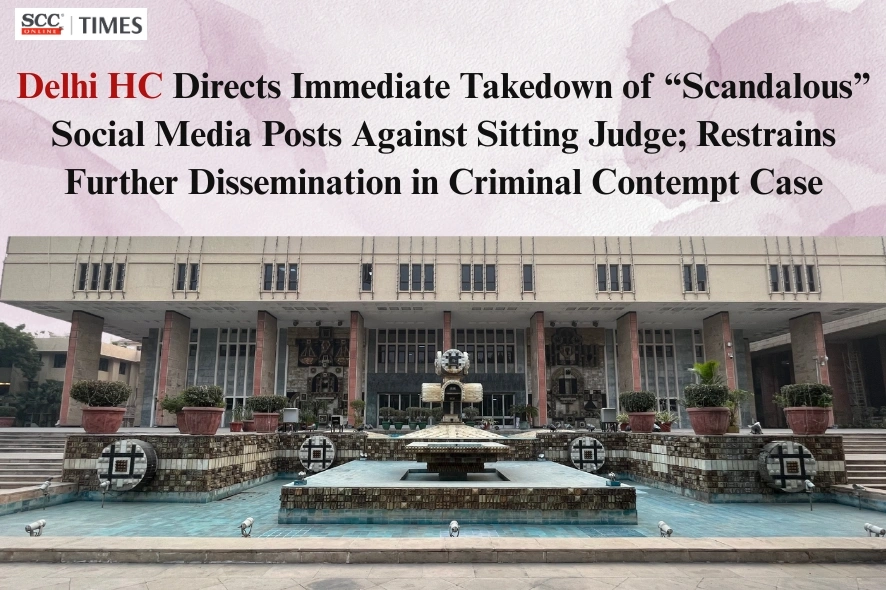
Delhi High Court: In a criminal contempt petition filed under Article 215 of the Constitution read with Sections 12 and 15, Contempt of Courts Act, 1971, alleging publication and circulation of scandalous social media content targeting a sitting Judge of the Court and the institution of the judiciary, a Division Bench of Neena Bansal Krishna and Madhu Jain, JJ., held that freedom of speech does not extend to publications which prima facie scandalise the Court, undermine public confidence in the administration of justice, or interfere with the independent discharge of judicial functions. Finding the impugned videos and posts to be “absolutely scandalous, contumacious” and a direct interference with the justice delivery system, the Court directed their immediate takedown and restrained further dissemination of the content.
The Court observed that while fair criticism of judicial orders and institutions is permissible, allegations of corruption, collusion, criminality and improper motives against Judges without any lawful basis cannot be equated with legitimate criticism.
Also Read: Gulshan Pahuja contempt case: DHC awards 6 Months Imprisonment |SCC Times
Background
The petitioner instituted a criminal contempt petition under Article 215 of the Constitution read with Sections 12 and 15, Contempt of Courts Act, 1971, alleging that the respondents had engaged in a deliberate campaign to scandalise the judiciary and interfere with the administration of justice. It was alleged that Respondent 1 had uploaded, circulated and promoted videos and social media posts on platforms such as Instagram, Facebook, YouTube and X (formerly Twitter), making serious allegations of corruption, collusion, criminality, murder, quid pro quo and other improper motives against a sitting Judge of the Delhi High Court in relation to judicial proceedings and orders.
According to the petitioner, the impugned content was false, scandalous and contemptuous in nature, intended to lower the authority of the Court and erode public confidence in the justice delivery system. The petitioner further contended that the material remained widely accessible and capable of being reposted and amplified across digital platforms, thereby causing continuing harm to the institution of the judiciary.
Along with the contempt petition, an application was filed seeking urgent interim directions for removal and takedown of the impugned content, restraint against further publication, preservation of metadata and disclosure of publication details. It was also alleged that Respondent 1 had used the impugned content to promote a web series and related material, indicating a sustained effort to scandalise the judiciary. The intermediary platforms were impleaded to secure effective compliance with directions concerning takedown, preservation of records and disclosure of relevant account and publication details.
Analysis
The Court observed that while any restraint on publication engages the constitutional guarantee of free speech and must be exercised with caution, freedom of speech does not extend to publications which prima facie scandalise the Court, undermine public confidence in the administration of justice, or interfere with the independent discharge of judicial functions. Referring to Morgan Stanley Mutual Fund v. Kartick Das, (1994) 4 SCC 225, Bloomberg Television Production Services India (P) Ltd. v. Zee Entertainment Enterprises Ltd. and Amish Devgan v. Union of India, (2021) 1 SCC 1, the Court reiterated that ex parte restraint orders are exceptional and may be granted where the material is ex facie malicious or palpably false and immediate intervention is warranted. The Court emphasised that fair criticism of judicial orders and institutions is permissible, but allegations attributing corruption, collusion, criminality or improper motives to Judges without any lawful basis stand on an altogether different footing and cannot be equated with legitimate criticism.
Examining the impugned material in light of these principles, the Court held that the videos allegedly uploaded by Respondent 1, containing allegations of corruption and collusion between sitting Judges and government agencies and labelling a person as a habitual offender and murderer, were “absolutely scandalous, contumacious” and constituted a direct interference in the justice delivery system. The Court observed that while social media has undeniable benefits, it cannot be used as an instrument to undermine institutions, interfere with the independence of the judiciary or malign constitutional functionaries. The Court further underscored that intermediaries cannot remain silent spectators and, in view of Section 79(3)(b), Information Technology Act, 2000, are under an obligation to expeditiously remove or disable access to unlawful content once it comes to their knowledge.
Decision
Accordingly, taking note of the undertakings furnished by the intermediary platforms, the Court restrained Respondents 1 to 5 and all persons acting on their behalf from uploading, publishing, hosting, circulating, sharing or otherwise disseminating the subject videos or any identical, mirrored, modified, edited, clipped, reproduced, re-uploaded or substantially similar content. The Court directed the intermediary platforms to forthwith take down, remove, disable access to and block the URLs containing the impugned material and the accounts/handles of Respondent 1 within 24 hours, and further directed them to furnish subscriber information, IP logs and registration details relating to the accounts concerned in a sealed cover. Notice was issued to Respondents 1 and 4, and the matter was directed to be listed before the Roster Bench on 9 July 2026.
Also Read: Contempt of Court | SCC Times
[Delhi High Court Bar Assn. v. Kapil Kakar, 2026 SCC OnLine Del 4631, decided on 8-6-2026]
Advocates who appeared in this case:
For the Petitioner: N. Hariharan, Rakesh Tiku, Sacchin Puri, Sr. Advocates withKunal Malhotra, Nitesh Mehra, Vidhi Gupta, Karan Shankar Mani and Vikash Kumar, Advocates
For the Respondents: Vivek Reddy, Sr. Advocate, Chetan Sharma, ASG with Varun Pathak, Amee Rana, Akhil Shandilya, Vishwajeet Deshmukh, Pival Peddireddi, Rohan Ahuja, Ankit Tripathi, Aishwarya Debadarshini, Abhishek K. Singh, Saksham Chaturvedi, Advocates