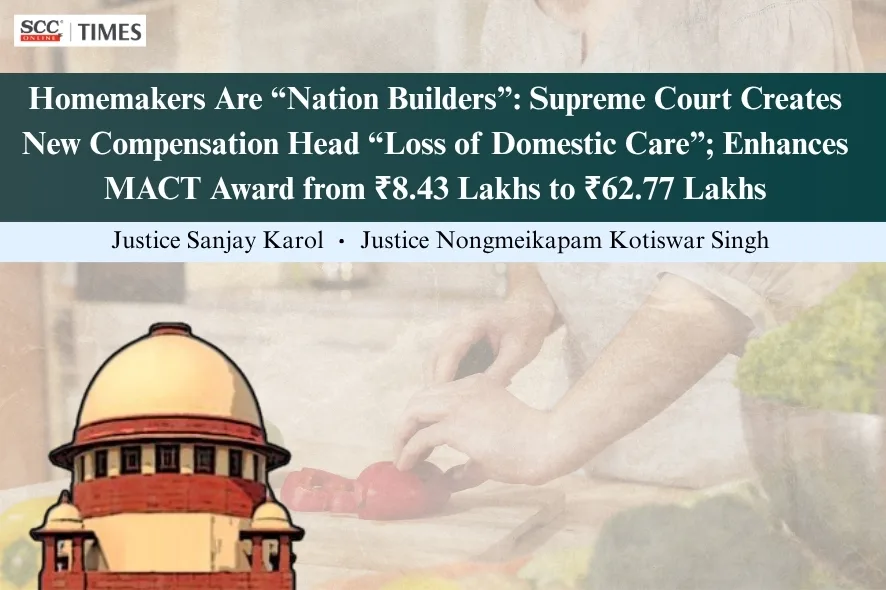
Supreme Court: In an appeal arising from a motor accident claim concerning the death of a homemaker in a road accident wherein the Court was confronted with 2 issues of considerable significance, 1) the extraordinary delay of two-and-a-half decades in the adjudication of a compensation claim; and 2) the proper valuation of the contribution made by a homemaker to her family and society. Recognising Homemakers as “Nation Builders”, the Division Bench of Sanjay Karol* and Nongmeikapam Kotiswar Singh, JJ., enhanced the compensation from ₹8,43,400 awarded by the High Court to ₹62,77,900, together with the same interest regime prescribed by the High Court.
The Court introduced a new compensatory head titled “loss of domestic care” towards the “homemaker’s contribution towards smooth functioning of the household, the loss of maternal support for children and loss of spousal support/the support and care of their child who is an adult, for the parents of the deceased”, fixed at ₹30,000 per month subject to periodic enhancement payable at her death. The Court also issued comprehensive directions to be followed while deciding motor accident claims.
Brief Facts
The deceased, wife of the claimant, died in a motor vehicle accident while travelling from Sirsa to Fatehabad. The accident occurred due to the rash and negligent driving of Respondent 1, a fact not disputed before any forum. Her legal heirs filed compensation claim petition before the Motor Accident Claims Tribunal, Sirsa (MACT).
By award dated 18 December 2003, the MACT granted compensation of only ₹2,42,000. Dissatisfied with the quantum, the claimants preferred an appeal before the Punjab and Haryana High Court. The appeal remained pending for nearly 20 years and was ultimately decided on 11 December 2024. The High Court enhanced compensation to ₹8,43,400 with interest at 7.5 per cent per annum from the date of filing of the claim petition. It further provided for enhanced rates of interest in case of delayed payment. Still dissatisfied, the claimants approached the Supreme Court seeking further enhancement.
The Supreme Court noted that the prolonged pendency itself warranted examination and therefore called for the records of the courts below.
Issues for Determination
-
The impact of extraordinary delay in adjudication of motor accident claims, particularly those arising under beneficial legislation.
-
The proper method of valuing and compensating the contribution of a homemaker, whose labour and services are ordinarily invisible in monetary calculations.
Also Read: Loss of Amenities Cannot be Ignored: Karnataka HC Enhances Motor Accident Compensation
Analysis
At the outset, the Court questioned why an appeal filed in 2004 remained pending until 2011 and further why reconstruction and disposal consumed another fourteen years thereafter.
It observed that although it is never possible to fully compensate for the loss a family member, the purpose of “just and fair” compensation is to place claimants, as far as possible, in a position approximating the one that would have existed had the accident not occurred. Delay of 20 years only compounds the suffering of victims and their families.
In General: Inordinate Delay
The Court observed that long delays are not confined to the present case but have become a recurring feature in motor accident compensation litigation throughout the country. Such claims arise either from death or serious injury and are prosecuted under beneficial legislation. The Court opined that these matters ordinarily ought not to remain pending in High Courts beyond 4 years except in exceptional circumstances such as heavy arrears or vacancies.
Justice Sanjay Karol referred to more than 100 motor accident compensation appeals decided by benches of which he was a part and noted that the data painted an “unhappy picture” revealing an alarming delay across jurisdictions, with numerous appeals remaining pending for periods ranging from 5 to 18 years before High Courts. Nearly 50 per cent of the cases reflected pendency beyond 4 years.
The Court opined that while Courts alone were not responsible, but “Courts must remain vigilant with regard to the pendency of such cases”. Adjournments should be granted only for genuine reasons. Excessive delay substantially increases interest liability and often results in interest amounts constituting a significant proportion of the award itself, demonstrating the need for systemic correction.
Home-Maker: A Nation Builder & An Economic Entity
The Court observed that describing a homemaker as “dependent” on earning family members is fundamentally ironic because the functioning of the household depends substantially on the homemaker. The earning members themselves rely upon the homemaker’s labour and management. Despite this reality, society has failed to adequately acknowledge such contribution.
“Efforts have been made across fields to some success but yet undeniably the road is still long.”
The Court referred to the observation of economist Sir Cecil Pigou in The Economics of Welfare that if a man marries his housekeeper or cook, the national dividend diminishes because previously remunerated labour becomes unpaid household labour and noted that this observation highlights the persistent economic invisibility of domestic work.
The Court noted that women’s unpaid caregiving work is estimated to contribute 15—17 per cent of India’s GDP, yet it remains unpaid and unrecognised. It recognised that homemakers contribute through household management, child-rearing, caregiving, emotional support, and creation of social capital. Their work enables other members of the family to participate productively in economic activity. Consequently, their labour has both direct and indirect economic significance.
The Court described mothers as the first teachers of children and the primary transmitters of values, culture, discipline, behavioural norms, and social relationships. It asserted that homemakers shape human capital. Every successful professional, worker, politician, artist, entrepreneur or public servant is, in some measure, the product of the care, guidance and support provided by a homemaker. Their contribution extends far beyond biological reproduction and reaches into the social, emotional and economic foundations of society.
The Court described homemakers as the “potters” who shape households and families, laying the foundation stones for national development. They were therefore appropriately characterised as “Nation Builders”.
“It is high time now that the invisible is made visible or the veil is pierced to make what can be partially seen come out in the open. The ‘homemakers’, to put it directly, actually are the ‘nation builders’ and they ought to be recognised as such.”
Judicial Framework
The Court reviewed earlier judicial developments recognising the economic value of homemakers.
In Lata Wadhwa v. State of Bihar, (2001) 8 SCC 197, the Court assessed the compensation for deceased housewives aged between 34 and 59 years at ₹3000 per month; Arun Kumar Agrawal v. National Insurance Co. Ltd., (2010) 9 SCC 218, wherein it was observed that the services rendered by a wife and mother could never be equated with those of a paid servant and their contribution was unique, irreplaceable and incapable of precise monetary assessment; in Rajendra Singh v. National Insurance Co. Ltd., (2020) 7 SCC 256, the decision of Arun Kumar Agrawal was followed in determining notional income for homemakers; Kirti v. Oriental Insurance Co. Ltd., (2021) 2 SCC 166, wherein the Court recognised the painstaking and time-consuming labour performed by homemakers in transforming 4 walls of a house to a lively and fulfilling home and Arvind Kumar Pandey v. Girish Pandey, (2025) 2 SCC 145, wherein it was held that the contribution of a homemaker is of a very high order and virtually impossible to assess fully in monetary terms.
Quantifying the Contribution of a Nation Builder
The Court observed that every aspect of a family’s daily life is shaped by the homemaker’s acknowledged and unacknowledged efforts. It acknowledged that assessing compensation solely by reference to notional income fixed decades earlier would grossly undervalue the contribution of homemakers.
The Court identified 3 major dimensions of loss caused by the death of a homemaker:
-
Loss of Household Management: A homemaker ensures the smooth functioning of the household through domestic labour, planning, supervision, caregiving and management. Even if some chores are increasingly outsourced in urban centres, the responsibility continues to rest substantially upon the homemaker.
-
Loss of Maternal Support: Children lose not merely affection and companionship but also guidance, life skills, emotional support, discipline, and nurturing that shape them into productive citizens. This loss has both emotional and economic dimensions.
-
Loss of Spousal Support: The husband loses a life partner upon whom he depends for management of family life, childcare, social obligations and emotional stability. The Court noted that even in patriarchal settings the practical dependency upon a homemaker is profound.
The Court further observed that the loss is also experienced by the homemaker’s parents and in-laws who often depend upon her companionship, care and support. Such losses cannot be adequately captured by strict arithmetic.
“When the efforts of the homemaker towards the husband and children are taken on the whole it cannot be disputed that although her labour be at emotional or physical is within the four walls of the home, its impact is much wider. In enabling the direct contribution today of their husbands and tomorrow of their children, they are the building blocks for the nation’s road to holistic progress.”
Loss of Domestic Care: An Additional Head
The Court found that compensation calculated solely through conventional notions of notional income inevitably undervalues homemakers. Accordingly, it created a new compensatory head called “Loss of Domestic Care” for “the homemaker’s contribution towards smooth functioning of the household, the loss of maternal support for children and loss of spousal support/the support and care of their child who is an adult, for the parents of the deceased”.
The Court directed that in cases involving the death of a homemaker:
1. A composite amount of ₹30,000 per month shall be treated as compensation under the head “Loss of Domestic Care”.
2. The amount shall operate as a stand-in minimum monthly income where the homemaker has no proven monetary earnings.
3. The amount shall be revised upward by 10 per cent cumulatively every 3 years.
4. Where the homemaker also has independent earnings, compensation under this head shall be in addition to proved income.
5. The amount is intended to account for household management; maternal support for children; and spousal or parental support rendered by the homemaker.
The Court clarified that consortium primarily compensates emotional loss, whereas “Loss of Domestic Care” recognises the homemaker’s economic and managerial contribution within the household.
Application to the Present Facts
In the present case, the Court found that the asserted income of ₹3000 per month from knitting and stitching lacked evidentiary support. Accordingly, it treated the case as one involving a homemaker without proven monetary income and applied the newly created “Loss of Domestic Care” head as the monthly income benchmark.
The compensation was recalculated as follows:
|
Head |
Amount |
|
Loss of Domestic Care/Monthly Income |
₹30,000 |
|
Annual Income |
₹3,60,000 |
|
Future Prospects (40%) |
₹1,44,000 |
|
Annual Income with Future Prospects |
₹5,04,000 |
|
Multiplier 16 |
₹80,64,000 |
|
Less 1/4 Personal Expenses |
₹20,16,000 |
|
Loss of Dependency |
₹60,48,000 |
|
Loss of Consortium (₹48,400 × 4) |
₹1,93,600 |
|
Loss of Estate |
₹18,150 |
|
Funeral Expenses |
₹18,150 |
|
Total Compensation |
₹62,77,900 |
The Court directed the insurance company to satisfy the award with interest rates and conditions as awarded and stipulated by the High Court without any change.
Directions
The Court issued comprehensive directions:
-
Documentary Requirements in MACT Claims: Claim petitions claiming specific heads of compensation should be accompanied by appropriate proof, including:
(i) official proof of age (excluding Aadhaar card);
(ii) disability certificates and functional disability opinions where relevant;
(iii) salary slips, income tax returns or employer certificates for income claims;
(iv) authenticated medical bills;
(v) affidavits regarding attendant charges where claimed.
-
Directions to High Courts: Chief Justices of all High Courts were requested to ensure that MACT appeals pending for more than 4 years are listed according to age, with the oldest matters receiving priority. High Courts were requested to consider whether the number of Benches dealing with MACT matters requires enhancement.
-
Directions to Tribunals: Tribunals were directed to seriously consider adopting the summary procedure contemplated by Section 169, Motor Vehicles Act, 1988 and to record reasons where such procedure is not adopted.
-
Compensation Directions: The newly recognised head of Loss of Domestic Care must be applied in appropriate cases involving deceased homemakers. The conventional heads of compensation under National Insurance Co. Ltd. v. Pranay Sethi, (2017) 16 SCC 680, i.e. loss of consortium, loss of estate and funeral expenses, must be applied with 10 per cent enhancement every three years and strictly followed.
-
Homemaker to be Recognised as “Nation Builder”: The Court expressed the hope that the terms “housewife” and “homemaker” would hereafter be used to as “Nation Builder”.
Decision
The Court allowed the appeal, enhanced the compensation from ₹8,43,400 awarded by the High Court to ₹62,77,900, together with the same interest regime prescribed by the High Court.
[Shishu Pal v. Surjeet, 2026 SCC OnLine SC 1114, decided on 11-6-2026]
*Judgment by Justice Sanjay Karol
Advocates who appeared in this case:
Ms. Aanchal Jain, AOR with Mr. Karan Dewan, Adv. and Mr. Kartik Yadav, Adv., Counsel for the Appellants
Mr. Ranjan Kumar Pandey, AOR, Mr. Amit Kumar Singh, with Mr. K.K. Bhat, Adv., Ms. K. Enatoli Sema, Adv., Ms. Chubalemla Chang, Adv. and Mr. Prang Newmai, Adv., Counsel for the Respondents