


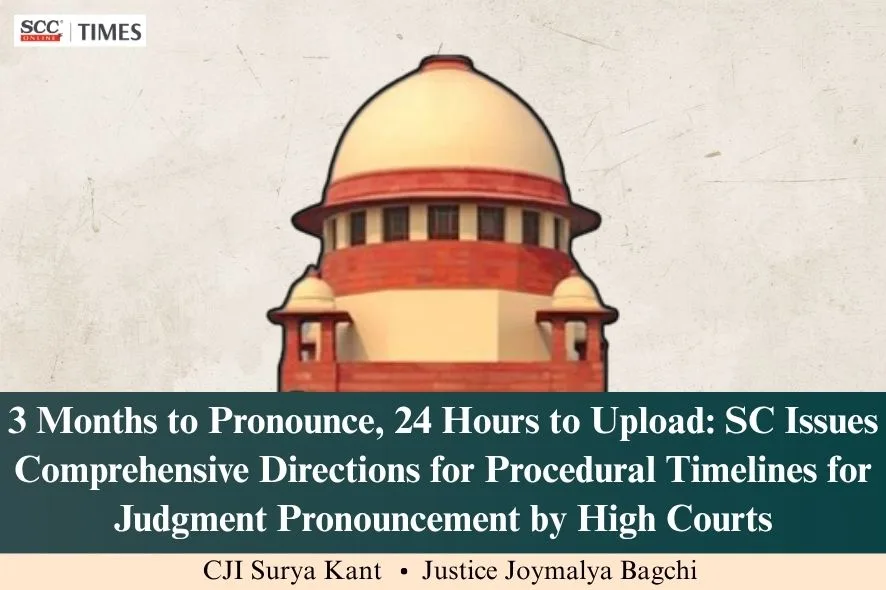
Supreme Court: While considering these proceedings which raised a common issue related to pronouncement of reserved judgments pending for indefinite periods before certain High Courts, the Bench of Surya Kant, CJI* and Joymalya Bagchi, J., issued comprehensive directions vis-a-vis procedural timelines for pronouncement of judgments/ orders, ensuring accountability and transparency.
The Court directed that in a matter where the judgment is reserved, the High Court shall endeavour to pronounce a reasoned judgment promptly, within a maximum period of 3 months from the date of reserving such judgment.
Also read: Supreme Court proposes framing of mandatory guidelines for expeditious appraisal of criminal appeals
Background
Three petitioners were convicted by the trial courts in Jharkhand under Section 302, Penal Code, 1860 (IPC) and other related offences and were sentenced to life imprisonment in 2012 and 2014. The fourth petitioner however was convicted under Sections 376 and 346 IPC and sentenced to life imprisonment in 2018. Each of the petitioners had already served over a decade in actual custody (including the period of incarceration pending trial) when they sought to prefer criminal appeals before Jharkhand High Court, where arguments were heard, and judgments were reserved in their appeals, seemingly, between January and June 2022.
Owing to the undue delay in pronouncing the reserved judgments, the petitioners have approached the Supreme Court, seeking appropriate directions to the High Court to pronounce the same expeditiously.
During the course of hearing, the Supreme Court enlarged the scope of these proceedings, the Court further directed High Courts throughout the country to submit reports disclosing cases in which judgments had been reserved on or before 31 January 2025 and remained unpronounced, along with Bench-wise particulars.
The Court further learnt of another issue regarding the delay in uploading judgments/orders to the respective High Court websites for matters where the operative part of the said judgment/order had already been pronounced in open court.
Court’s Assessment
Perusing the material on record, the suggestions received from several High Courts in response to the draft guidelines circulated by the Amicus Curiae, the Court opined that the present case warranted the intervention of the Court for formulation of uniform guidelines to address delays in pronouncing reserved judgments across all High Courts in the country. The Court thereafter went on to peruse the set of recommendations made by the Amicus Curiae which were intended to address the concerns
The Court also recorded their appreciation for the Amicus Curiae for painstakingly collating, verifying, and analysing data received from various High Courts, as well as proposing guidelines for uniform application.
“It goes without saying that we cannot turn a Nelson’s Eye to the human dimension of this problem, and it must be noted that each delayed judgment in that compilation represents a litigant whose case has been heard but whose fate hangs in the balance.” The Court emphasised that right to life and personal liberty guaranteed under Article 21 of the Constitution is not confined to the expeditious conduct of a trial. It extends to every stage of the proceeding and is as much violated by such delay in pronouncing a reserved judgment as by a denial of the right to be heard.
The Court explained that the interval between the hearing and the pronouncement also affects the quality of the adjudication, as a judgment bears the imprint of the arguments that preceded it, and it reflects them most faithfully when it follows them closely. “Courts are institutions of trust, and the regularity with which they speak after reserving judgment is part of what sustains that trust. Such regularity in pronouncement is neither a procedural nicety nor a matter of administrative convenience. It is the condition on which citizens’ confidence in the justice delivery system rests.”
Directions issued
Procedural Timelines re Pronouncement of Judgments/Orders
Timelines
-
High Courts shall endeavour to pronounce a reasoned judgment promptly, within a maximum period of 3 months from the date of reserving such judgment.
-
The High Courts shall display extra promptitude in pronouncing judgments and orders in matters of personal liberty, e.g. regular bail, anticipatory bail, criminal appeals (where the convict is in custody), death references, etc.
-
As soon as the bail application is heard, the order should preferably be pronounced and uploaded on the same day. In the event the order is reserved, it is expected to be pronounced on the next day and uploaded to the website.
-
Orders granting regular bail, suspending sentence, or acquitting a convict in custody should be communicated to the jail authorities and the Trial Court on the date it is pronounced.
-
Consequent upon the outcome of serial number (4) above, the undertrial/convict must be released on the same day or, at most, on the next day, unless they are required to be taken in custody in another case, or there is a delay in complying with the bail conditions, etc.
-
The compliance with the order must be reported by the Trial Court to the Bench of the High Court that passed the order.
-
In the event the judgment in a criminal appeal/death reference is reserved, and the appellant is in custody, the clarifications, if any, required by the Bench from the advocates be sought within 7 days of the date of reserving the judgment.
-
In all other matters, the clarifications, if any, should be sought not beyond 1 month of the date of reserving the judgment.
-
Where, after hearing the parties, the Bench is of the opinion that any delay in pronouncement of a reasoned judgment will cause irreparable loss to the parties and urgent orders are required, the operative part may be pronounced in Court, and the reasoned judgment be uploaded within 7 days or a maximum of 15 days, if practical difficulties are faced by the High Court. Such cases may include habeas corpus matters, criminal appeals resulting in the acquittal of a convict in custody, matters relating to demolition/eviction, matters relating to admission to educational institutions, or other urgent cases.
-
A reasoned judgment pronounced in open court should be uploaded on the High Court website within 24 hours.
Accountability
-
Chief Justices of the High Courts, on the administrative side, are requested to make necessary changes to the High Court website, where at the end of every month, an automated email is sent to the Chief Justice of the High Court, specifying all the reserved judgments pending in that month, along with a copy of the email to the Bench that has reserved the judgment.
-
Chief Justice of the High Court may also circulate the statement of the cases, in which the judgments have not been pronounced within 2 months from the date of reserving such judgment, amongst the Judges of the High Court for their information. The communication shall be conveyed as confidential and in a sealed cover.
-
In the event the reserved judgment is not delivered within 3 months, the Registrar General shall place the matters before the Chief Justice for orders, and the Chief Justice shall bring it to the notice of the concerned Bench for pronouncing the judgment within 2 weeks thereafter.
-
In the event the reserved judgment is still not delivered within the extended period of 2 weeks, the Chief Justice should assign the case to another Bench with a notification to the advocates and the parties. The new Bench to which the matter is assigned shall obviously rehear the case and pronounce the judgment promptly.
-
Where the operative part of the judgment has been pronounced in open court, and the reasoned judgment is not uploaded within 15 days, the Registrar General shall place the matters before the Chief Justice for orders, and the Chief Justice shall bring it to the notice of the Bench concerned for uploading the reasoned judgment within the next 3 days.
Remedies
-
In case the judgment is not pronounced upon the expiry of 3 months from the date of reserving, any party to the lis shall be entitled to file an application in the High Court with a prayer for early judgment.
1.1 Such an application shall be listed before the concerned Bench within two days, excluding the intervening holidays.
1.2 The Registry shall inform the Chief Justice of the High Court of all such applications filed.
1.3 If the judgment, for any reason, is not pronounced within a period of 3 and a half months from the date of reserving, any party to the lis shall be entitled to move an application before the Chief Justice of the High Court with a prayer to withdraw the said case and make it over to any other Bench for fresh hearing.
-
In case the reasoned judgment is not uploaded upon the expiry of 15 days from the date of pronouncement of the operative part, any party to the lis is permitted to file an application in the High Court with a prayer for early judgment.
2.1 Such an application shall be listed before the concerned Bench within two days, excluding the intervening holidays.
2.2 The Registry shall inform the Chief Justice of the High Court of all such applications filed.
2.3 If the reasoned judgment, for any reason, is not uploaded within 1 month from the date of pronouncement of the operative part, any party to the lis shall be entitled to move an application before the Chief Justice of the High Court with a prayer to withdraw the said case and make it over to any other Bench for fresh hearing.
Measures to Increase Transparency
Format of Judgments/Orders
-
The certified copy of the judgment should mention the date of reserving the judgment, the date of pronouncing the judgment, and the date of uploading the judgment.
-
Where the operative part of the judgment has already been delivered, the date of pronouncing the operative part shall be the date of pronouncement, and the date on which the reasoned judgment is uploaded will be the date of uploading.
Updates to the High Court Website
-
After the conclusion of final hearing, the date of reserving judgment must be reflected against the case status on the High Court website.
-
If only the operative part of the judgment is delivered, the case status on the High Court website must reflect accordingly.
-
When the reasoned judgment is uploaded on the website, an automated intimation through email/SMS be sent to the advocates representing the parties.
Additionally, the Registrars General of the High Courts were directed to place these guidelines before the Chief Justices of their respective High Courts so that appropriate steps are taken to incorporate necessary amendments into the High Court Rules and their official websites.
Concluding remarks
Acknowledging the burden of the High Courts, the Court stated that the directions set out herein are intended to ensure that proceedings before the High Courts culminate in the pronouncement of judgments within a defined and reasonable timeframe. These measures have been issued in the confidence that a structured framework will assist the High Courts in the consistent discharge of their constitutional responsibilities, while preserving the quality and deliberative character of judicial decision-making. “We have every reason to believe that the High Courts will give effect to these directions fully and faithfully.”
[Pila Pahan v. State of Jharkhand, 2026 SCC OnLine SC 1012, decided on 29-5-2026]
*Judgment by CJI Surya Kant
Advocates who appeared in this case :
For Petitioner(s): Mr. Aalok Kumar, Adv. Ms. Vanya Gupta, AOR Ms. Fauzia Shakil, AOR Ms. Tasmiya Taleha, Adv. Ms. Mallika Aggarwal, Adv.
For Respondent(s): Ms. Pallavi Langar, AOR Mr. P.S Sudheer, Adv. Mr. Sujeet Kumar Chaubey, Adv. Mr. Ajit Kumar Sinha, Sr. Adv. Mr. Ambhoj Kumar Sinha, AOR Ms. Neeti Bhardwaj, Adv. Mr. Ashwarya Sinha, AOR Mr. Sankalp Mahindru, Adv. Mr. Aditya Malhotra, Adv. Mr. Govind Rishi, Adv. Mr. Amit Sharma, AOR Mr. Dipesh Sinha, Adv. Ms. Pallavi Barua, Adv. Ms. Aparna Singh, Adv. Mr. Gopal Jha, AOR Mr. Sawan Datta, Adv. Mr. Nimish Arjaria, Adv. Mr. Shreyash Bhardwaj, Adv. Ms. Shireesha Sharma, Adv. Mr. Umesh Kumar Yadav, Adv. Mrs. Vandana Gupta, Adv. Mr. Rahul Gupta, AOR Mr. B. Shravanth Shanker, AOR Ms. Prerna Robin, Adv. Ms. Grahita Agarwal, Adv. Mr. B. Yeshwanth Raj, Adv. Mr. P. I. Jose, AOR Mr. Anupam Mishra, Adv. Mr. Chakma Purnojyoti, Adv. Mr. Ravi Raghunath, AOR Mr. Namanjeet Singh Bhatia, Adv. Mr. Sahil Tagotra, AOR Ms. Shreya Kasera, Adv. Ms. K. V. Bharathi Upadhyaya, AOR Ms. Pritama, Adv. Ms. Shaivani Gupta, Adv. Dr. Sunita, Adv. Mr. Sufyan Hasan, Adv. Ms. Hema Malik, Adv. Mr. Bipin Vinayak Chandan, Adv. Mr. Deepayan Mandal, AOR Mr. Mridul Bansal, Adv. Mr. Naman Varma, Adv. Mr. Aryan Ahmed, Adv. Mr. Sanjai Kumar Pathak, AOR Mrs. Shashi Pathak, Adv. Mr. Arvind Kumar Tripathi, Adv. Mr. Robin Kumar, Adv. Ms. Shweta Jayshankar Dwivedi, Adv. Mr. Apoorv Kurup, Sr. Adv. Ms. Nidhi Mittal, AOR Mr. Gurjas Singh Narula, Adv. Mr. Ahanthem Henry, Adv. Mr. Ahanthem Rohen Singh, Adv. Mr. Mohan Singh, Adv. Mr. Aniket Rajput, Adv. Ms. Khoisnam Nirmala Devi, Adv. Mr. Yeshu Mehta, Adv. Mr. Tanay Hegde, Adv. Mr. Kumar Mihir, AOR Mr. Arjun Garg, AOR Ms. Amruta Arjun Garg, Adv. Ms. Arushi Kulshrestha, Adv. Mr. Saaransh Shukla, Adv. Ms. Muskan Bensla, Adv. Ms. Mrinmoyee Das, Adv. Mr. Kunal Chatterji, AOR Ms. Maitrayee Banerjee, Adv. Mr. Rohit Bansal, Adv. Mr. Varij Nayan Mishra, Adv.





Beautiful judgment
An indefinite pause on a verdict is a slow-motion violation of personal liberty.