


Disclaimer: This has been reported after the availability of the order of the Court and not on media reports so as to give an accurate report to our readers.
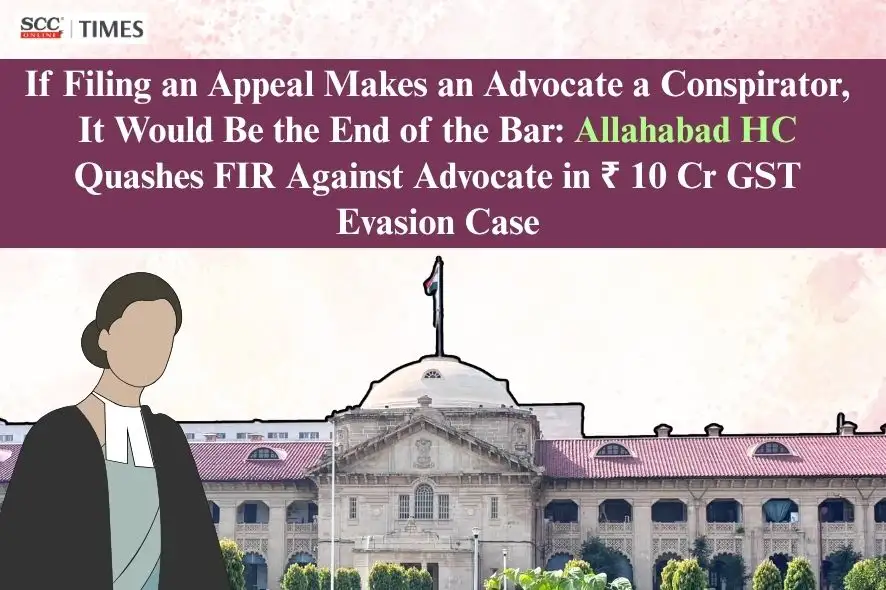
Allahabad High Court: In a writ petition filed by an advocate against an FIR filed against him by the Deputy Commissioner, GST, Sector-1, Rampur (Deputy Commissioner) for filing statutory appeals alleging him to be a co-conspirator in his client’s tax evasion, the Division Bench of J.J. Munir and Tarun Saxena, JJ., allowed the petition, thereby quashing the criminal proceedings, holding that they violated all known principles of criminal liability. The Court held that an advocate cannot prosecuted for professional act because if an advocate is to be held in conspiracy with his client for doing a professional act, like preferring an appeal, it would be the end of the very existence of the Bar and the right of an advocate to practice under the Advocates Act, 1961.
The Court observed that,
“If, for doing a professional act, like preferring an appeal, an Advocate is to be held in conspiracy with his client, it would be the end of the very existence of the Bar and the right of an Advocate to practice under the Advocates Act.”
Background
The petitioner, an advocate and Advocate-on-Record, was hired by his client, proprietor of a firm called MH Enterprises, to file a statutory appeal under Section 107, Goods and Services Tax Act, 2017 (GST Act), questioning orders dated 16 April 2025 passed by the Deputy Commissioner, GST, Sector-1, Rampur (Deputy Commissioner), under Section 74, State Goods and Services Tax Act, 2017 (SGST Act), assessing a sum of around ₹ 10 crores as tax, interest and penalty for the financial years 2021-2024 against his firm.
On 15 August 2025, the advocate, as per his client’s instructions, filed two online statutory appeals before the appellate authority-3 under Section 107 GST Act regarding two identical orders dated 18 April 2025 passed by the Deputy Commissioner. After filing the appeals, on 22 September, the client was served notice from the appellate authority wherein it was said that the pre-deposit of 10 per cent of the disputed tax from his electronic credit ledger, utilising input tax credit for filing a statutory appeal, could not be accepted as a statutory pre-deposit for the purpose. He was, therefore, directed to clarify the maintainability of the appeal within two days.
The advocate was unable to attend the appellate authority’s hearing due to other commitments, and the client could not arrange an adjournment. Thus, the appellate authority dismissed the statutory appeal on the ground of maintainability, with the remark that pre-deposit of 10 per cent of the disputed tax made by the assessee from his electronic ledger, utilising input tax credit, was not acceptable as a valid tender.
Thereafter, the Deputy Commissioner, instead of proceeding to recover the assessed amount, lodged the impugned FIR against the client and nominated the advocate for allegedly making a pre-deposit of 10 per cent of the disputed tax out of the electronic credit ledger by utilising input tax credit, which, according to him, was an illegal course adopted by the client in appealing his order. It was also alleged in the FIR that the client committed GST evasion in conspiracy with the advocate, causing financial loss to the State exchequer.
Aggrieved, the advocate filed the present petition seeking quashing of the FIR, charge-sheet, and cognizance order pending against him under Sections 61(2), 318(4), 336(3), 338, and 340(2), Nyaya Sanhita, 2023.
He contended that payment of a pre-deposit of 10 per cent of the disputed tax by utilisation of the input tax credit and electronic credit ledger of any assessee is permissible under CBIC-20001/2/2022- GST dated 6 July 2022, as well as the Supreme Court’s decision in Union of India v. Yasho Industries Ltd., (2025) 143 GSTR 561.
Analysis and Decision
After careful consideration, the Court noted that the impugned FIR, which led to the police report and the order of cognizance, violated all known principles of criminal liability. The Court stated that an advocate, by his profession, is authorised to represent his client, who may have a case of any kind. An advocate is authorised to defend men charged with murder, rape, terror offences, and it is his/her duty to defend them. “If, for doing a professional act, like preferring an appeal, an advocate is to be held in conspiracy with his client, it would be the end of the very existence of the Bar and the right of an advocate to practice under the Advocates Act, 1961.”
The Court added that it would, indirectly also, deprive the citizens of their right to the much-valued right to legal assistance, because a person who practices the profession of law before defending his client, would be thinking about his own defence, which he would be thinking about, before he files a vakalatnama and takes steps on behalf of his client. The Court remarked,
“This kind of situation, which hits at the roots of the principles enshrined under Articles 14 and 21 of the Constitution, cannot be permitted to happen. An advocate has to work fearlessly and discharge his professional duties, just as an officer of the State is entitled to discharge his duties.”
In the present case, the Court stated that even if the Deputy Commissioner believed that pre-deposit of the disputed tax could not be debited to the electronic ledger out of the input tax credit, the professional decision of the advocate to do so did not, in any way, make him a conspirator with the assessee. It was purely a professional act done in the course of filing an appeal and not at all something related to his client’s business. It was based on a particular view of the law, whether right, wrong, or utterly wrong.
In the circumstances, the Court held that the impugned FIR, the charge-sheet, and the cognizance order could not be sustained and allowed the writ petition. The Court also directed the Chief Judicial Magistrate, Rampur, to make an entry in red ink in the General Diary of Police Station Kotwali, District Rampur, that the proceedings of the present case have been quashed insofar as it relates to the advocate, under orders of this Court.
[Samarpan Jain v. State of U.P., 2026 SCC OnLine All 8585, decided on 21-5-2026]
Advocates who appeared in this case :
For the petitioner: Senior Advocate Sushil Shukla and Advocate Sharad Sharma
For the respondent: Additional Advocate General Anoop Trivedi, Additional Government Advocate Sadhna Singh, and Additional Government Advocate Shashi Shekhar Tiwari



Yes. Adv. has not violated S126 of the Indian Evidence Act. as the Client has not done any further crime after engaging the Adv. so Adv. is not liable.