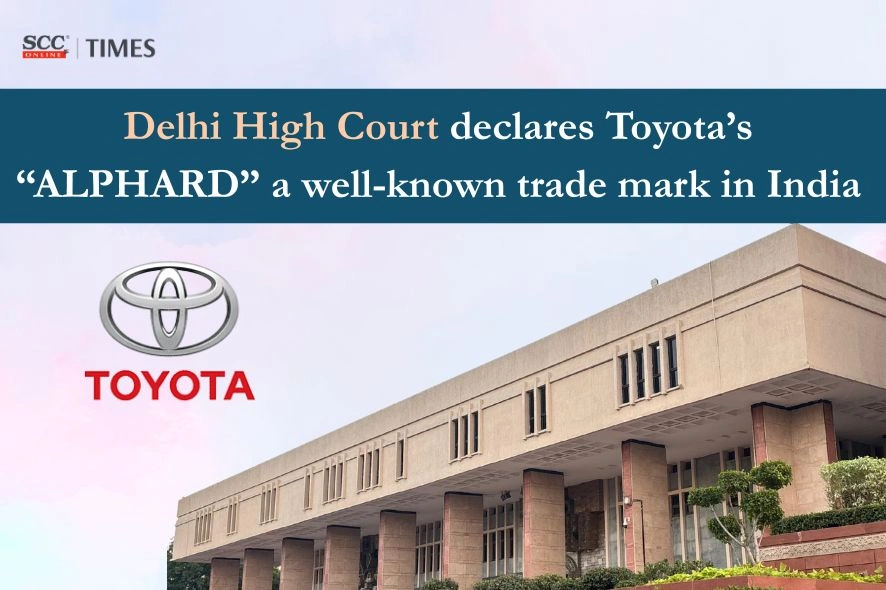
Delhi High Court: In a Letters Patent Appeal arising from the dismissal of rectification petitions under Section 57, Trade Marks Act, 1999 (TMA), concerning the trade mark “ALPHARD”, the Division Bench of C. Hari Shankar and Om Prakash Shukla*, JJ., reversed the decision of the Single Judge and held that Toyota had successfully established prior adoption, transborder reputation, and spillover goodwill of the mark in India prior to Respondent 1’s registration.
The Court further held that the mark “ALPHARD” had acquired the status of a well-known trade mark in India and that Respondent 1’s adoption of an identical mark in relation to allied and cognate goods lacked bona fides and was likely to cause confusion. Consequently, the Court declared the impugned registrations invalid and directed their removal from the Register of Trade Marks.
Background
The appeal arose from a dispute concerning the trade mark “ALPHARD” and the competing claims of prior global adoption, transborder reputation, and territorial use. The appellant, Toyota Jidosha Kabushiki Kaisha, a Japanese multinational automobile manufacturer, claimed to have adopted the mark “ALPHARD” in 1986 and commercially launched it in 2002 in relation to a luxury multipurpose vehicle (MUV). Toyota asserted that the mark had acquired substantial global goodwill and reputation through extensive international sales, promotional activities, and consumer recognition across multiple jurisdictions.
Toyota further contended that although the ALPHARD vehicle had not been formally launched in India, the vehicles were available in the Indian market through direct imports by private purchasers and automobile enthusiasts since 2008. It was claimed that the mark had acquired spillover reputation and goodwill in India through Toyota’s global presence, online exposure, and cross-border dissemination of information.
Respondent 1, Tech Square Engineering Pvt. Ltd., applied for registration of the mark “ALPHARD” in India in 2015 on a “proposed to be used” basis under Classes 9, 12, and 27. Upon learning of these registrations, Toyota initiated rectification proceedings under Section 57 TMA, seeking removal of the impugned marks from the Register. Toyota alleged that the Respondent had dishonestly adopted a mark identical to its well-known trade mark in relation to allied and cognate goods, despite Toyota’s prior adoption and transborder reputation.
The rectification petitions were initially filed before the Intellectual Property Appellate Board (IPAB). Following the abolition of the IPAB, the matters were transferred to the Delhi High Court. By judgment dated 3 February, 2023, the Single Judge dismissed the petitions, holding that Toyota had failed to establish sufficient use or reputation of the mark “ALPHARD” within India prior to the Respondent 1’s adoption and registration of the mark. Aggrieved by the decision, Toyota preferred the present Letters Patent Appeal challenging the impugned judgment.
Analysis and Decision
The Court reiterated the limited scope of interference in an intra-court appeal against the judgment of a Single Judge and observed that appellate interference would ordinarily arise only in cases involving manifest error, perversity, or grave injustice. The Court then proceeded to examine the statutory framework governing rectification of trade marks under Sections 47 and 57 TMA. It noted that Section 57 functions as a corrective mechanism enabling the Court to remove marks that were either wrongly registered or wrongly remaining on the Register. The Court further clarified that whether a mark was wrongly remaining on the Register had to be examined in light of Sections 9 and 11 TMA, particularly where prior rights and conflicting trade marks were involved.
The Court held that the present dispute squarely fell within the ambit of Section 11 TMA which deals with relative grounds for refusal of registration. Since Toyota did not possess a prior Indian registration for the mark “ALPHARD,” the primary issue was whether the mark had acquired the status of a “well-known” trade mark in India through transborder reputation and spillover goodwill. Referring to Section 11(6) to (10) TMA, the Court observed that the relevant inquiry was not whether the mark enjoyed mass public recognition, but whether it had acquired recognition amongst the relevant section of consumers dealing with such goods and services.
In this context, the Court undertook an extensive analysis of the reputation associated with the mark “ALPHARD”. It noted that Toyota had adopted the mark globally in 1986 and commercially launched the ALPHARD luxury multipurpose vehicle in 2002. The Court found that the mark had gained significant international recognition through extensive global use, promotion, and registrations across jurisdictions. The central controversy, therefore, was not one of prior adoption, which was undisputed, but whether such reputation had translated into actionable goodwill within India prior to the Respondent 1’s adoption in 2015.
The Court disagreed with the Single Judge’s conclusion that absence of formal commercial sales in India was fatal to Toyota’s claim. It held that such an approach failed to appreciate the nature of the goods in question, namely, luxury automobiles, where market presence and reputation cannot be assessed on the same standard as mass-market consumer goods. The Court emphasised that in niche luxury markets, consumer awareness is often driven by brand visibility, international reputation, aspirational value, and limited market circulation rather than large-scale sales. Consequently, the evidentiary threshold for establishing goodwill in such cases differs from ordinary commercial products.
A significant factor considered by the Court was the evidence showing that ALPHARD vehicles had been independently imported into India by private purchasers and automobile enthusiasts even prior to the respondent’s registration. The Court treated these unsolicited imports as compelling evidence of the mark’s reputation and recognition within India. It observed that voluntary importation of high-value luxury vehicles was not accidental or incidental but reflected conscious consumer awareness and demand for the brand. According to the Court, there could be “no more compelling proof” of goodwill than the market itself demonstrating recognition of the mark through independent imports without any formal commercial launch by the proprietor.
The Court further held that Toyota had produced substantial material demonstrating the existence of spillover reputation in India prior to the respondent’s applications. The evidence included international promotional materials, worldwide registrations, media references, and documentation relating to imports of ALPHARD vehicles into India. While some of the material related to global use, the Court observed that in cases involving internationally reputed luxury brands, such evidence was relevant to determine whether the mark had acquired recognition among the relevant consumer segment in India. The Court clarified that the doctrine of transborder reputation did not require extensive sales within India but required proof that the mark had made a substantial impression on the relevant Indian market.
The Court also revisited the principles laid down in Toyota Prius and clarified that the decision did not reject the doctrine of transborder reputation. Rather, Prius turned on the specific factual finding that the claimant had failed to establish sufficient recognition and commercial presence in India at the relevant time. In contrast, the Court found that the mark “ALPHARD” had crossed the threshold from mere foreign reputation to actionable recognition within India. The relevant section of Indian consumers in the luxury automobile segment was found to associate the mark with Toyota even before Respondent 1’s adoption.
On the issue of dishonest adoption, the Court found Respondent 1’s explanation regarding the origin of the mark unconvincing. Respondent 1 had offered inconsistent explanations, at one stage claiming coinage of the mark and at another attributing it to an astronomical or dictionary reference. The Court held that adoption of an identical mark in relation to allied and cognate goods, against the backdrop of Toyota’s international reputation, raised serious doubts regarding the bona fides of the adoption. Given the identity of the marks and the overlap in the nature of goods, the likelihood of confusion and association with Toyota was held to be inevitable.
Accordingly, the Court concluded that Respondent 1’s registrations were contrary to Section 11, TMA and constituted marks wrongly remaining on the Register under Section 57(2). The Court specifically held that “ALPHARD” qualified as a well-known trade mark in India at the time of Respondent 1’s applications. The appeal was therefore allowed. The Registrar of Trade Marks was directed to carry out the rectification forthwith.
[Toyota Jidosha Kabushiki Kaisha v. Tech Square Engg. (P) Ltd., 2026 SCC OnLine Del 2617, decided on 4-5-2026]
*Judgment authored by: Justice Om Prakash Shukla
Advocates who appeared in this case:
For the Petitioner: Sandeep Sethi, Senior Advocate, Peeyoosh Kalra, Gaurav Mukerjee, Amol Dixit, Suyash Malhotra, Krisna Gambhir, Shreya Sethi, Advocates
For the Respondent: Rukhmini Bobde, CGSC, Kapil Wadhwa, Anish Jandial, Jatin Dhamija, Vinayak Aren, Aishwarya Nigam, Advocates
Buy Trade Marks Act, 1999 HERE