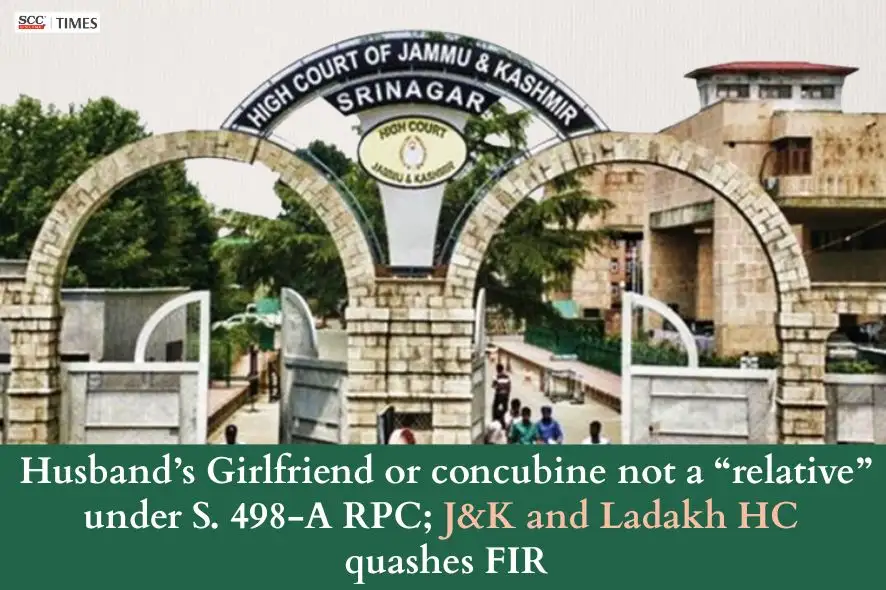
Jammu & Kashmir and Ladakh High Court: While considering petitions seeking quashment of charges under Sections 498-A and 506, Jammu and Kashmir State Ranbir Penal Code, 1989 (RPC), arising out of a matrimonial dispute, a Single Judge Bench of Shahzad Azeem, J., held that the allegations of cruelty, harassment or dowry demand were wholesale and omnibus and the continuation of such proceedings would amount to abuse of the process of law. The Court further held that a woman alleged to be a girlfriend or concubine does not fall within the definition of “relative” under Section 498-A RPC and cannot be prosecuted thereunder. Accordingly, the Court quashed the FIR, charge-sheet and the order framing charges.
Read Also: Bom HC: Dowry remarks, ignoring affair, advice to tolerate abuse not cruelty
Background
The marriage between the spouses was solemnised on 21 September 2016 and, within a short period, a matrimonial discord arose. The wife lodged a complaint on 15 November 2017, alleging that she was subjected to mental and physical harassment, cruelty, demand of dowry and criminal intimidation at the hands of her husband and his family members. She further alleged that her husband had developed illicit relations with another woman (girlfriend) and had intentions to solemnise marriage with her. Based on the complaint, an FIR was registered and a charge-sheet was filed, pursuant to which the trial court framed charges under Sections 498-A and 506, Ranbir Penal Code, 1989 (RPC). Aggrieved thereby, the petitions were filed under Section 561-A, Jammu & Kashmir Criminal Procedure Code, 1989 (J&K CrPC) seeking quashment of the entire criminal proceedings.
The accused person’s counsel submitted that the wife had married by cheating and blackmailing the husband and had obtained his signs on a blank paper and later demanded Rs 20 lakhs, for which a petition was already filed under Section 12(1)(c), Jammu and Kashmir Hindu Marriage Act, 1980 (J&K HMA) seeking annulment of marriage. It was also stated that the husband had also filed a complaint under Sections 420/506 RPC against the wife on 8 December 2016. Thus, it was contended that the criminal proceedings by the wife were nothing but a counterblast to the prior proceedings initiated by the husband. They also alleged that the police neither conducted any preliminary enquiry nor verified the veracity of the allegations. They argued that the allegations against them were general, vague and omnibus in nature, made only to wreck the vengeance. Further, the girlfriend’s counsel vehemently argued that she was neither a relative of the husband nor was she residing with the parties, therefore, she could not be charged under Sections 498-A and 506 RPC.
On the other hand, the State, while filing replies, merely narrated the sequence of events without demonstrating how the ingredients of Sections 498-A and 506 RPC are satisfied. The wife denied the averments made in the petition, submitted that the husband had developed illicit relations which led to the FIR but later entered into a compromise, and admitted the pendency of the petition under Section 12(1)(c) J&K HMA.
Analysis
The Court opined that the wife’s complaint dated 15 November 2017 was germane to all the subsequent criminal proceedings against the accused persons. The Court observed that the material on record, including statements recorded under Section 161 J&K CrPC, revealed that the allegations were wholesale and omnibus in nature. The Court noted that no specific incident of cruelty, harassment or dowry demand had been stated with particulars or date, time, place or manner of occurrence. The Court emphasised that it is well settled that the husband’s entire family cannot be roped in based on vague and general allegations of cruelty and demand of dowry and that such tendency deserves to be discouraged.
The Court relied on Dara Lakshmi Narayana v. State of Telangana, (2025) 3 SCC 735, wherein it was observed that there is a growing tendency to misuse Section 498-A IPC (pari materia with Section 498-A RPC) as a tool for personal vendetta and that with vague and generalised allegations should not be allowed to sustain criminal proceedings.
The Court noted that the husband’s girlfriend was neither related to him by blood, marriage or adoption, nor was she residing in the matrimonial home or subjected the wife to harassment or intimidation. The Court relied on U. Suvetha v. State, (2009) 6 SCC 757, wherein it was held that
“By no stretch of imagination, a girlfriend or even a concubine in an etymological sense would be a ‘relative’. The world ‘relative’ brings within its purview a status. Such a status must be conferred either by blood or marriage or adoption. If no marriage has taken place, the question of one being relative of another would not arise.”
The Court referred to State of Haryana v. Bhajan Lal, 1992 Supp (1) SCC 335, wherein it was held that inherent powers may be exercised where the allegations made in the FIR or complaint are so absurd and inherently improbable that no prudent person can ever reach a just conclusion that there is sufficient ground for proceeding against the accused or where criminal proceedings are manifestly attended with mala fides and instituted with an ulterior motive to wreak vengeance on the accused and with a view to spite him due to private and personal grudge.
Decision
The Court observed that the criminal proceedings were manifestly attended with mala fide and came to be instituted with an ulterior motive to wreck vengeance and that their continuation would amount to abuse of the process of law and defeat the ends of justice. Accordingly, while allowing the petitions, the Court quashed the FIR, charge-sheet and the order framing charges under Sections 498-A and 506 RPC.
[Mela Ram v. State (UT of J&K), 2026 SCC OnLine J&K 237, decided on 16-4-2026]
Advocates who appeared in this case:
For the Petitioners: A.K Sharma, Ajay Kumar, Advocates.
For the Respondents: Sumeet Bhatia, GA, Ashish Sharma, Advocate.