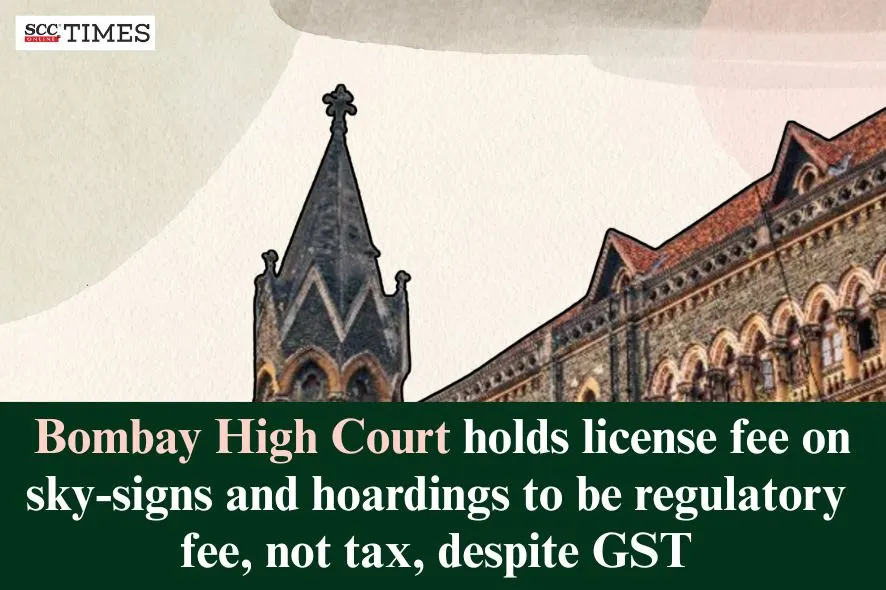
Bombay High Court: While deciding a batch of petitions challenging the levy of license fees on sky-signs and hoardings under Section 244 read with Section 386(2) of the Maharashtra Municipal Corporation Act, 1949 (‘MMC Act’), the Division Bench of G. S. Kulkarni* and Advait M. Sethna, JJ., held that the levy constituted a regulatory fee and not a tax. The Court observed that despite the deletion of Entry 55 of List II by the 101st Constitutional Amendment Act, 2016 (‘Constitutional Amendment Act’) and the introduction of the Goods and Services Tax (‘GST’) regime, municipal corporations remain competent to impose such fees for regulation and control of sky-signs and hoardings.
Background:
The dispute arose from the levy of license fees by municipal corporations on sky-signs and hoardings under Section 244 read with Section 386(2) of the MMC Act. Outdoor advertisers had to obtain licenses for hoardings, kiosks, billboards, and sky-signs. While fees were initially nominal, they were later steeply increased, leading to complaints that the levy was exorbitant, arbitrary, and in reality, a tax without authority of law. Petitioners argued that such charges placed unreasonable restrictions on their right to carry on business under Article 19(1)(g) of the Constitution. They said that administrative costs like printing licenses or inspections could not justify such high rates, and that retrospective fixation of Rs 222 per sq. ft. per annum from 2013 was arbitrary and contrary to earlier resolutions and court directions.
Petitioners also pointed out that the Bombay Provincial Municipal Corporation (Control of Advertisement and Hoarding) Rules, 2003 (‘2003 Rules’) empowered the Commissioner to fix fees, but only reasonably. Resolution No. 417 of 2010 increased fees by 20 per cent for three years, while Resolution No. 479 of 2011 introduced a zonal tender system that was later suspended by the State Government. Despite this suspension, the corporation continued demanding higher fees, issuing challans at Rs 222 per sq. ft. per annum, which advertisers paid “under protest.” In 2018, Resolution No. 667 retrospectively approved this rate from April 2013.
The controversy deepened after the 101st Constitutional Amendment Act deleted Entry 55 of List II, removing the power of States to levy advertisement tax and bringing advertisements under GST. Petitioners argued that municipal corporations had no authority to levy such fees after GST. They also challenged the 2021 “scrutiny fee” of Rs 5,000 per application per year, introduced without approval of the Standing Committee or General Body.
Analysis and Decision:
The Court emphasised that in contemporary times, the landscape of sky-signs and hoardings has undergone a profound transformation. It is no longer painted metal boards, but outdoor advertisements are now characterized by dynamic high resolution electronic screens, allowing unprecedented campaign flexibility. Multiple advertisements on a single hoarding throughout the day have become the new norm.
The Court noted that such transformation has induced significant changes in regulatory control and safety mandates, owing to the increasing scale and complexity of sky-sign and hoarding structures. The Court further observed that these changes include special norms and conditions on structural stability requiring reports from certified engineers, a meticulous licensing regime, visual and traffic safety norms requiring varying luminance and size ratios depending on the location of the sky-signs, the drivers’ safety perspective, environmental and social impact, the burden on the city’s energy consumption, carbon footprints, visual clutter, and light pollution.
The Court observed that the control and regulation of sky-signs and hoardings in modern times is a significant challenge for municipal bodies, who are caught between balancing high technological advancements while discharging their civic obligations, coupled with the onerous responsibility of safeguarding and preserving public interest.
The Court highlighted that Sections 244 and 245 of the MMC Act are not provisions for generating revenue, but only to regulate the skyline of the city and the levy of license fees is not a tax but a regulatory fee, and strict quid pro quo is not necessary. The Court further noted that the omission of Entry 55 in List II by the 101st Constitutional Amendment Act affected taxes on advertisements, but not the fees contemplated under Section 244 and Section 245 of the MMC Act, and the levy of such fees continues to be valid.
The Court emphasised that retrospective approval of rates by the General Body was not invalid, since the proceedings for approval had been pending and the levy was in continuation of earlier decisions. The Court observed that the contention of arbitrary and exorbitant fees could not be accepted, as municipal corporations are empowered under the 2003 Rules to fix rates from time to time.
The Court held that the petitioners’ challenge to the levy of license fees was untenable, noting that the regulation and control of sky-signs and hoardings necessarily involve substantive consideration of public interest, safety, environment, and urban aesthetics. The Court further observed that licensing is not a routine exercise but requires planning, vision, and dynamic application of the MMC Act in light of contemporary needs, ensuring robust applicability of the Constitutional vision while balancing the rights of advertisers with societal welfare.
[Manoj Madhav Limaye v. State of Maharashtra, 2025 SCC OnLine Bom 5058, decided on 10-12-2025]
*Judgment authored by: Justice G. S. Kulkarni
Advocates who appeared in this case:
For the Petitioners: Sanjeev M. Gorwadkar, Senior Advocate, Mohommed Hussain B., i/b. Mr. Javed Patel, Girish S. Godbole, Senior Advocate, Sumit S. Kothari, Rashmin Khandekar a/w. Pranav Nair, Ajay Panicker i/b. Ajay Law Associates, Aditya P. Shirke
For the Respondents: Birendra Saraf, Advocate General with A.I. Patel, Additional Govt. Pleader a/w. M.P. Thakur, AGP, Madhavi Tavanandi, Abhijit P. Kulkarni with Krushna Jaybhay