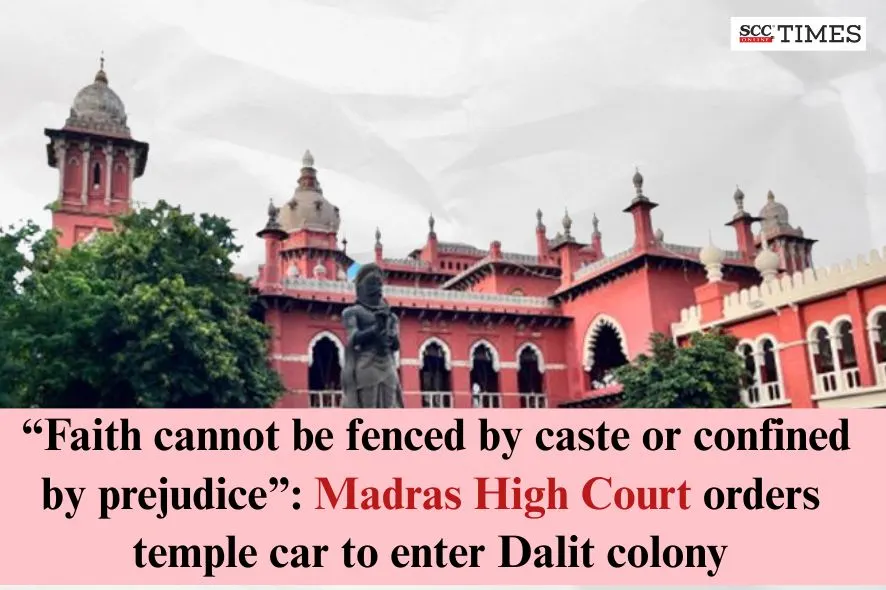
Madras High Court: In a petition filed by a Scheduled Caste resident of Puthagaram village, seeking directions to allow his community to worship at the Muthukolakkiamman Temple and to ensure that the temple chariot, during its trial and main runs, passes through the Dalit Colony, a Single Judge Bench of P.B. Balaji, J., while allowing the petition emphasised that no one can dictate terms as to who is entitled to stand before the deity and worship and who cannot. The petitioner had alleged historical exclusion by caste Hindus and failure of authorities to uphold constitutional protections despite repeated complaints and peace committee interventions.
The Court observed that faith cannot be fenced by caste or creed, and divinity cannot be confined by human prejudice, since God does not reside in certain streets alone, and no street is unworthy of the chariot or the god it carries. God never discriminates, and therefore, discrimination cannot be wrapped in the sanctity of tradition.
Background:
In September 2025, the Temple Car Festival was announced, but members of the Scheduled Caste community were allegedly prevented from participating. The petitioner alleged that despite the temple being under the control of the Hindu Religious and Charitable Endowment Department (‘HR and CE’), caste Hindus continued to resist entry and worship by Dalit community members, violating constitutional guarantees of equality and religious freedom.
This led to multiple representations to the District Administration and a Peace Committee Meeting, where Respondents 6 to 8, claiming to represent the Upper Caste community, opposed the inclusion of Dalits in the festival. The petitioner contended that such exclusion persisted despite constitutional protections and repeated appeals to authorities, leaving him no option but to approach the Court.
The District Collector of Kancheepuram filed a status report on 12-09-2025, stating there was no prohibition against Scheduled Caste individuals entering the temple or participating in the festival. Further the Respondent 9, representing the Tamil Nadu Untouchability Eradication Front (‘TNUEF’), supported the petitioner’s claims and highlighted oppressive practices by caste Hindus in the village.
Consequently, Respondents 6 to 8 argued that the Temple Car procession route remained unchanged for decades and altering it to include the Dalit Colony would lead to complications. They denied allegations of caste-based exclusion and claimed that Scheduled Caste and Tribe members were already involved in the festival through traditional offerings.
Analysis and Decision:
The Court emphasised that Article 17 of the Constitution abolished untouchability not just in physical form but in true letter and spirit. Therefore, none can dictate terms as to who is entitled to stand before the deity and worship and who cannot. The Court noted that all respondents stated in unison that there was no bar for any person belonging to any community to enter the Temple and worship the deity. Thus, the Court found no difficulty in recording the stand of the respondents, which sufficiently addressed the grievance and apprehension of the petitioner regarding one part of the prayer.
The Court noted that, with the filing of the report by the District Collector, Kancheepuram, the integrated route, including extensions from the existing route, was certainly possible. The District Collector only suggested that certain repairs or alterations be carried out to give effect to the integrated route, which was also feasible. The Court acknowledged the private respondents’ contention that the existing route was followed for several decades and that any change might lead to similar requests from others in the village.
The Court observed that the petitioner, representing the Dalit community of Puthagaram Village, approached the authorities with a request for the Temple Car procession to enter their Colony. Pursuant to directions of the Court, officials confirmed that integrating the route to include the Dalit Colony was very much possible. The Court noted that societal evolution demands adaptation, and resisting change by citing settled custom, tradition, and practice cannot be a valid defence. The petitioner’s request was not selfish but espoused the cause of the Dalit Colony residents. The Court rejected the submission that this would open a Pandora’s box, noting that the change was approved only after feasibility was confirmed by the District Collector.
The Court, thus, allowed the petition with the following directions: (i) The stand of the respondents that there was no bar for the petitioner and his community to worship at the Muthukollakkiamman Temple was recorded, and Respondents 1 to 5 should ensure no discrimination is practiced. (ii) The status report of the District Collector was accepted, and the Temple Car should follow the proposed integrated route during both trial and main runs. Further, the official respondents should ensure peaceful conduct of the festival, with the Inspector of Police providing adequate police protection.
Accordingly, the connected miscellaneous petitions were closed with no costs.
[Selvaraj v. Collector, 2025 SCC OnLine Mad 9757, decided on 07-11-2025]
Advocates who appeared in this case:
For the Petitioner: S. Kumaraswamy, D. Parventhan
For the Respondent: M. Murali, Government Advocate, L. Baskaran, Government Advocate N. R. R. Arun Natarajan, Special Government Pleader, G. Karthikeyan, Senior Counsel, A. Jagadeeswari R. Thirumoorthi
Buy Constitution of India HERE