Decentralising Mineral Rights: A Step Towards Federalism or Regulatory Chaos?
by Atish Chakraborty* and Shaurya Kapoor**
Continue reading
by Atish Chakraborty* and Shaurya Kapoor**
Continue reading
by C. George Thomas* and Ansh Mittal**
Continue reading
“There being no agency and no service rendered by the respondents-assessees herein as an agent to the Government of Sikkim, service tax is not leviable.”
Continue reading
“In the context of matrimonial disputes, emotions run high, and as such in the complaints filed alleging harassment or domestic violence, there may be a tendency to implicate other members of the family who do not come to the rescue of the complainant or remain mute spectators to any alleged incident of harassment, which in our view cannot by itself constitute a criminal act without there being specific acts attributed to them.”
Continue reading
by Siddharth R. Gupta* and Uddaish Palya**
Continue reading
Top criminal cases on quashing of proceedings, arrest, bail, acquittal, and more.
Continue reading
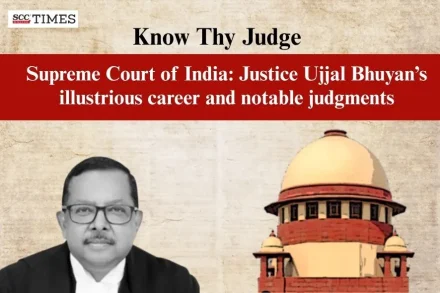
Key rulings and landmark decisions from January 2025 shaping the legal landscape, including the spotlight on Supreme Court Judges from our ‘Know Thy Judges’ Feature.
Continue reading
Given the lack of consensus between the Judges, the Court exercising its power under Article 142 directed the appellant to perform the funeral rites and bury his deceased father at the burial ground at another village.
Continue reading
“A remark such as asking the deceased to not be alive if she cannot live without marrying her lover will also not gain the status of abetment. There needs to be a positive act that creates an environment where the deceased is pushed to an edge in order to sustain the charge of Section 306 IPC.”
Continue reading
Atul Subhash’ mother approached the Supreme Court seeking custody of her four-year-old grandson filing a habeas corpus petition.
Continue reading
Journal of Legal Studies is National Law University, Delhi’s annual student-edited, peer-reviewed law journal.
Continue reading
There was a feud between two groups of the family which resulted in an armed clash between the groups and culminated in the filing of separate complaints by the respective groups. The High Court set aside the conviction and sentence under Sections 307, 148, and 149 of the IPC but affirmed his conviction under Sections 326, 325, 452, and 323 of the IPC.
Continue reading
The instant case revolved around proving the execution of a Will, wherein the Court found that evidence presented by the Will’s propounder and scribe, did not inspire confidence.
Continue reading
“The right to sue under Article 113 of the Limitation Act accrues when there is an accrual of rights asserted in the suit and an unequivocal threat by the defendant to infringe the right asserted by the plaintiff in the suit.”
Continue reading
Puja has been accused of cheating and wrongly availing Other Backward Classes (‘OBC’) and disability quota benefit under the Persons with Benchmark Disabilities (‘PwBD’) category in the sub-category of visual impairment.
Continue reading
“A written complaint by a public servant before the Court takes cognizance is sine qua non, absence of which would vitiate such cognizance being taken for any offence punishable under Section 186 of the IPC.”
Continue reading
2024 was a year of pathbreaking verdicts on several issues such as Electoral Bonds, Citizenship Act, Tax/Royalty on Mines, Minority Institutions etc. Some major issues saw unanimous and near unanimous verdicts by the Supreme Court; however, there were notable Dissenting Opinions in 2024 which shed light on several key legal concepts.
Continue reading
In 2024, the Supreme Court of India delivered a series of landmark judgments that reshaped key legal and constitutional landscapes. Among the most significant were the AMU verdict; Mineral rights; Unilateral appointment of arbitrators; Constitutional validity of UP Board of Madarsa Education Act, 2004; State’s power to regulate industrial alcohol; Interpretation of Section 6A of the Citizenship Act. Together, these judgments not only enriched India’s legal discourse but also had a profound impact on various sectors ranging from education and industry to constitutional governance.
Continue reading
The Supreme Court’s 2024 decisions have marked a significant turning point in the country’s legal and constitutional framework. Key rulings delivered by Constitutional Benches on Electoral bonds, private property, royalty as tax, AMU’s minority status, sub-classification within reserved categories, etc. have left an impact on fundamental rights, political transparency and tax regime, shaping India’s socio-political landscape, influencing both public policy and the broader democratic process.
Continue reading
The wife claimed that her husband’s net worth is Rs 5000 crores, but the Court decided to grant permanent alimony of Rs. 12 crores noting that the wife in the instant case has sought equalisation of status not just with the husband but also with his ex-wife and opined that this cannot be an acceptable approach.
Continue reading