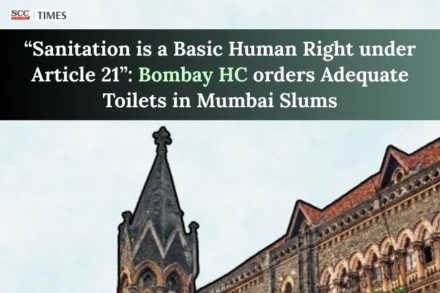
“Sanitation is a Basic Human Right under Article 21”: Bombay HC orders Adequate Toilets in Mumbai Slums
“Making adequate provisions for toilets / sanitation facilities concerns the basic human rights under Article 21 of the Constitution/”
While the media enjoys freedom of speech and expression, but such right is not absolute and stands correspondingly delimited by the right of an individual to dignity and reputation.
Read about MeitY’s SOP mandating a 24-hour deadline to remove non-consensual intimate imagery online, empowering victims to reclaim their digital dignity.
“Any attempt to stigmatize or marginalize an entire class of persons offends the guarantee of equality before law under Article 14 and freedom of expression with reasonable restrictions under Article 19(2).”
“Beggars’ homes cannot be conceived as quasi-penal facilities. Their role must be restorative, not retributive — places of recovery, skill-building, and reintegration into society”.
“It is, thus, high time that the State formulates a uniform policy to deal with the burial/cremation/shamshan/any kind of public place utilised for the purpose of performing post-death rituals.”
“The concerned Court has treated the DNA test as a frolicsome act and ordered as a matter of course. Right to privacy and dignity is lost sight of.”
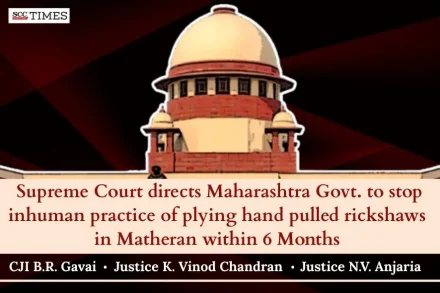
The Court opined that continuing such an inhuman practice even after 78 years of the country getting its freedom and after 75 years of the Constitution being enacted and promising social and economic justice to its citizens, would be betraying the promise given by the people of India to themselves.
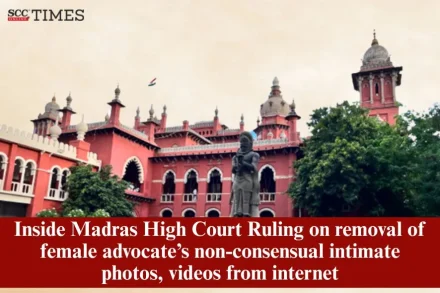
“The distribution and transmission of the video reached such an extent that the advocate was subjected to scrutiny about the video and its contents by various individuals including her clients and peers in the same profession.”
The instant writ petition seeks Court direction to prevent the continued circulation of obscene video, involving petitioner 1’s daughter and petitioner 2’s husband on Instagram, without their consent.
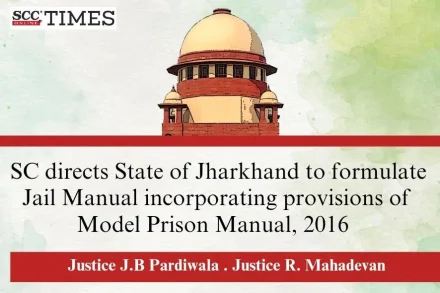
Reiterating the call for prison reforms, the Court said that reforms are necessary for creating a better environment and prison culture to ensure the prisoners enjoy their right to dignified life under Article 21 of the Constitution.
“Courts should not be places, where basic needs, such as sanitation, are overlooked and neglected. The absence of adequate washroom facilities undermines equality and poses a barrier to the fair administration of justice”.
The Court pointed out that small excesses like overtaking the vehicle of one’s senior at a railway crossing may be an incident of indiscipline in defense services, but the balance and proportion that needs to be maintained between such an infraction and its punishment will always be at the core of good governance.
“The legislative intent through Section 509 is to deter an action capable of shocking the sense of decency of a woman. The manner in which the offender shocks such sense of a woman is not restricted to oral abuse or gesture alone, but also include statements, speeches, exclamations, notes, all of which could be in a text form relayed whether physically or electronically.”
Mere erasure of the name of the petitioner in the cause title, does not mean that he is entitled to seek such erasure from the police records. “The direction would be only to enable the internet to forget, like the humans forget. If it is allowed to stay on record, the internet will never permit the humans to forget”.
A PIL on the implementation of the Prohibition of Employment as Manual Scavengers and their Rehabilitation Act, 2013 is pending before the Supreme Court.
“Constitutional morality impacts upon any law which deprives the LGBT individuals of their entitlement to a full and equal citizenship. LGBT individuals living under threats of conformity grounded in cultural morality have been denied basic human existence. Constitutional morality does not permit such discrimination and must supersede cultural morality.”
Holding that commission of rape on a woman’s dead body would not attract Ss. 375 and 377, Penal Code, 1860, the Court pointed out that its high time for the Central Government to consider amending S. 377 or introduce a specific provision to address necrophilia, sadism.
Rajasthan High Court referred to the three types of genders as per Rigveda in Hindu mythology, consideration of the third gender in the modern society, and said that these people are struggling to be a part of the civil society.
To hold that conducting virginity test on a woman who is victim of sexual assault and on a woman who may be an accused of an offence will be on different footing or that the earlier will be unconstitutional and the later constitutional, will be a perverse finding and against the intent of the Constitution of India and Article 21. However, this should not mean to be taken to be a shield for the detainee from legitimate interrogation by police as per the procedure established by law.