2024 SCC Vol. 7 Part 3
Constitution of India — Arts. 141 and 142 — What is binding — “Law declared by Supreme Court” — Doctrine of merger
With respect to the offence under Section 304, the duration of imprisonment can only be ascertained at the conclusion of trial, and the period of investigation for that offence shall only be 60 days and not 90 days, unless the facts of a case undisputedly indicate an intention of the accused to cause death or bodily injury likely to cause death.
The Court pointed out that the object of the Karnataka Stamp Act, 1957 is not to exclude evidence or to enable parties to avoid obligations on technical grounds. Rather, the object is to obtain revenue even from such instruments which are at the first instance unstamped or insufficiently stamped.
If negligence can be attributed to the appellant, then necessarily the delay which has not been condoned by the Tribunal and affirmed by the High Court deserves to be accepted. However, if no fault can be laid at the doors of the appellant and cause shown is sufficient then we are of the view that both the Tribunal and the High Court were in error in not adopting a liberal approach”.
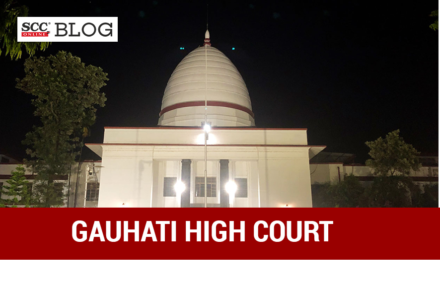
On 15-03-2024, the Chief Justice issued a Notification regarding adoption of Practice Directions for Criminal Appeals/Revisions or Criminal Petitions filed under the POCSO Act in Gauhati High Court and the Outlying Benches.
Penal Code, 1860 — S. 302 or 304 Pt. II r/w S. 300 Exceptions 1 & 4 — Murder or culpable homicide:
Uttarakhand SCDRC sets aside the impugned order of DCDRC passed in a consumer complaint as its President was not part of the proceedings, thereby disregarding the mandate in S. 36 of Consumer Protection Act, 2019.
The Supreme Court deprecated the practice of depositions of material witnesses not being placed on record.
The High Court observed that the object of Courts is to decide the rights of the parties and not to punish them for mistakes which are made in the conduct of the cases.
Issuance of process is a serious matter and should reflect application of mind on the part of the Magistrate, though it is not incumbent upon the Magistrate to explicitly state the reasons for issuance of process.
Gauhati High Court was faced with a peculiar case where “petitioner” had followed every rule in the book to file a well-planned petition; however, in reality the petitioner did not exist!
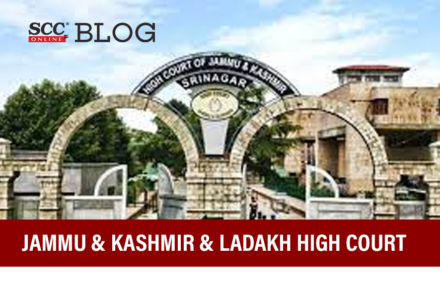
The Jammu and Kashmir and Ladakh High Court stated that revisionary power under Juvenile Justice Act vests only with the High Court
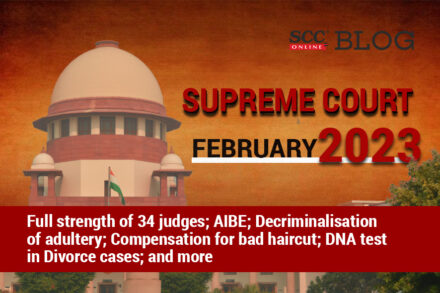
This roundup revisits the analyses of Supreme Court’s judgments/orders on validity of AIBE; ex-communication of Dawoodi Bohras; decriminalisation of adultery; permissibility of DNA test of children to prove allegations of adultery; and more. It also covers reports on the career trajectory & important decisions of Justice Surya Kant and Justice Dipankar Dutta and the newly appointed 7 judges of the Supreme Court; Explainers on important law points; and Cases Reported in SCC Weekly in the month of February.
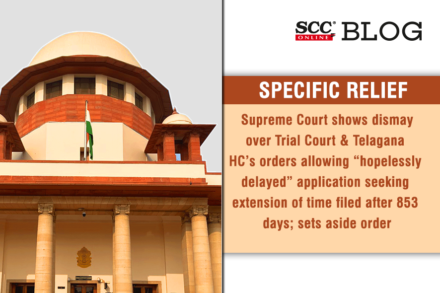
The Supreme Court was unimpressed with the explanation given by the plaintiff for the delay of 853 days that he initially fell sick with Jaundice and was later confined to house with High Blood Pressure, Diabetes and other diseases. The petition had extension of time to deposit the balance sale consideration of Rs. 15,00,000/-.
The Supreme Court observed that such settlement is nothing but a compounding of the offence and hence, the Court cannot override such compounding and impose its will.
The observation of the Supreme Court came in a case where the deposition of the prosecutrix was recorded by the trial court in English language though she had deposed in her vernacular language.
It was observed that judicial discipline required that once the conviction was confirmed by the Supreme Court that too after hearing the accused, the High Court should not have thereafter made any comment on the merits of the case.
The Karnataka High Court strictly admonished the petitioner for abusing every jurisdiction of law but refused to impose exemplary costs as the same would only increase the agony of the petitioner, whose marriage was annulled albeit with consent.
Supreme Court observed that the persons from marginalised sections of the society already face severe discrimination due to a lack of social capital, and a new disability more often than not compounds to such discrimination.
The Delhi High Court observed that a law student shall not represent a party or provide legal counsel in any legal proceeding before a court of law before being properly enrolled by a bar council and being admitted to the bar.