Delhi HC protects personality rights of Telugu actor Akira Nandan; halts release of AI film using his identity
Defendant 1 had created and circulated AI-morphed content of the plaintiff including a movie titled ‘AI Love Story’

Bringing you the Best Analytical Legal News


Defendant 1 had created and circulated AI-morphed content of the plaintiff including a movie titled ‘AI Love Story’
Blanket freezing of accounts of persons who are neither accused nor suspects is arbitrary, disproportionate and violative of Articles 19(1)(g) and 21 of the Constitution of India.
“A mere statement that the disease of a lifestyle disorder cannot be a sufficient reason to deny the grant of Disability Pension unless the Medical Board has duly examined and recorded the particulars relevant to the individual concerned.”
“Once, a vacancy under the reserved category does not exist, the candidate cannot be considered against the reserved category vacancy, which, in fact, does not exist.”

“By way of judicial review, policy decisions of the State should not be interfered with unless they are grossly arbitrary or irrational as there is a need to maintain separation of powers.”
“Where a child is repeatedly exposed to fear or hostility towards one parent, such an environment can adversely affect the child’s welfare.”
“An unqualified application of Section 19… would defeat the object of the provision, and open the door to forum shopping, libel tourism, and luxury litigation.”
“Insisting upon continuation of a marriage which exists only in law, and not in substance, would amount to compelling the parties to endure a relationship devoid of any matrimonial foundation, thereby causing avoidable hardship rather than advancing the object of the statute.”
“Disparagement through misleading and/or abusive statements, constitutes an unlawful interference in other party’s commercial goodwill and is actionable in law.”
“There ought to be free space for movement of the public. Beautification and development of the area is also required, so that the passengers and tourists can enjoy a comfortable experience while visiting a bus stand or the nearby railway station.”

“Since the trademarks of the plaintiff are registered, the balance of convenience is tilted in favour of the plaintiff and in case, ex-parte ad-interim injunction is not granted, the reputation and goodwill of the petitioner may be injured.”
In a resolution dated 28-01-2026, the Executive Committee of the Delhi High Court Bar Association (“DHCBA”) resolved to firmly oppose any initiative to enhance the pecuniary jurisdiction of the District Courts from the present value of Rs. 2 to 20 Crores.
The petitioner argued that his disability details should be removed from online records under the right to be forgotten, claiming the disclosure caused stigma, discrimination, and violation of his privacy and dignity.
“The balance of convenience lies in favour of the Plaintiff, and if the Defendants are not restrained, the Plaintiff would suffer irreparable injury which cannot be adequately compensated in terms of money.”
“The social circumstances and the economic status of the family may have compelled the Prosecutrix and her mother to give contradictory statements or to turn hostile. However, in such cases the Court cannot completely ignore the scientific evidence which has come on record.”

“The mark ‘TIGER’ is publici juris and common to trade and is not uniquely identifiable with a particular goods or services of the Plaintiff.”
“Bar Association is a body of private individual lawyers and in normal discharge of its functions, it does not perform any function which can be said to be a public function”
“There are multiple complaints of over-charging, service quality, hygiene, food quality, etc. against the appellant, which presents a troubling state of affairs as regards the on-board catering services being offered by the appellant on the subject train.”
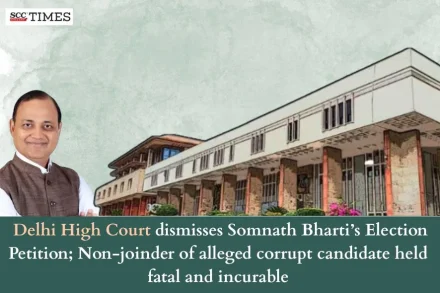
“If the ROPA itself mandates that non-joinder of a necessary party leads to dismissal of an election petition, the Court cannot use CPC provisions to cure that defect.”
“This amendment shall come into force from the date of its publication in the gazette.”