Bail Denied to Judicial Officer Accused of Stealing from a Judge’s Residence: Here’s What the Patiala Court Said
“The offence alleged strikes at the integrity, expected from a public servant more particularly a judicial officer.”
The Court noted that “reasons to believe” are mandatory to be recorded; however, they need not be supplied along with the arrest memo to the accused, unlike the “grounds of arrest”, which must be supplied.
“The filing of a charge-sheet, taking of cognizance, or issuance of summons does not terminate protection unless special reasons are recorded.”
An arrest by a police officer is a mere statutory discretion which facilitates him to conduct proper investigation, in the form of collection of evidence and, therefore, shall not be termed as mandatory.
“With anguish and pain, this Court observes here that the learned Magistrate as well as learned Additional District & Sessions Judge failed to exercise their discretion in right perspective and in a very casual manner, decided the bail applications, placed before them.”
“Considering that the accused did not make any defamatory statement himself, and in recognition of his role as a journalist hosting a live TV show, the Court emphasised the importance of protecting journalistic freedom to safeguard the right to free speech”
The NHRC noted that the allegations against Professor Mahmudabad disclosed, prima facie, that his human rights and liberty were violated.
“The issuance of non bailable warrants must not be exercised in a mechanical manner. It must be adopted sparingly and only upon recording cogent reasons that reflect the necessity of such a stringent course.”
Once a person is arrested, his right to liberty under Article 21 is curtailed. When such an important fundamental right is curtailed, it is necessary that the person concerned must understand on what grounds he has been arrested.
A quick legal roundup to cover important stories from all High Courts this week.
“When an accused is in custody under PMLA irrespective of the case for which he is under custody, any statement under section 50 of PMLA to the same investigating agency is inadmissible against the maker.”
“The arrest should be rational, fair and as per law and shall not be merely based upon guilt of accused established from inadmissible evidence.”
From the arrest panchnama it is evident that the information is given to his wife on the cell number provided by petitioner-accused and apart from that there are no grounds of arrest mentioned in the arrest surrender form.
Madras High Court disposed of the habeas corpus petition after reviewing the State’s submissions, which indicated that the arrested individuals had been released on 08-10-2024, due to the Judicial Magistrate’s refusal to accept their remand.
The moment petitioner was intercepted by the Immigration officers around 10:00 pm, on 13-08-2024, allegedly based on a Look Out Circular, he was deprived of his liberty and he ceased to be free.
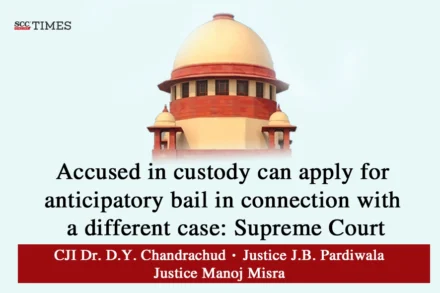
“When procedural law doesn’t preclude the investigating agency from arresting a person in relation to a different offence while he is already under custody in some previous offence, the accused too cannot be precluded of his statutory right to apply for anticipatory bail only on the ground that he is in custody in relation to a different offence.”
Giving the Government 8 weeks’ time to frame such guidelines, the Court laid down certain steps that must be followed whenever a person is to be summoned under S. 35, BNSS.
The Right to Life and Personal Liberty is the most sacrosanct fundamental right guaranteed under Articles 20, 21 and 22 of the Constitution of India. Any attempt to encroach upon this fundamental right has been frowned upon by this Court in a catena of decisions
Hemant Soren had resigned from the post of Chief Minister of Jharkhand on January 31, 2024.
The Court stated that the allegations against the police officers are serious, and the latter need to respond to them.