Dubai Arbitration Week 2026, organised by the Dubai International Arbitration Centre (DIAC), is being held from 9 to 13 November 2026. The week-long event brings together leading stakeholders from the international arbitration community for dialogue, knowledge exchange and networking opportunities, providing a platform to discuss developments shaping international arbitration and dispute resolution.
As part of Day 2 of the event, a session titled “Key Changes Under Proposed 2026 Reforms to the DIFC Arbitration Law and New DIFC Mediation Law” was held on 10 November 2026. The session examined the proposed amendments to the Dubai International Financial Centre (DIFC) Arbitration Law and the introduction of a new standalone DIFC Mediation Law, with particular focus on strengthening arbitral procedure, enhancing the powers of tribunals, and improving the enforceability of arbitral and mediated outcomes.
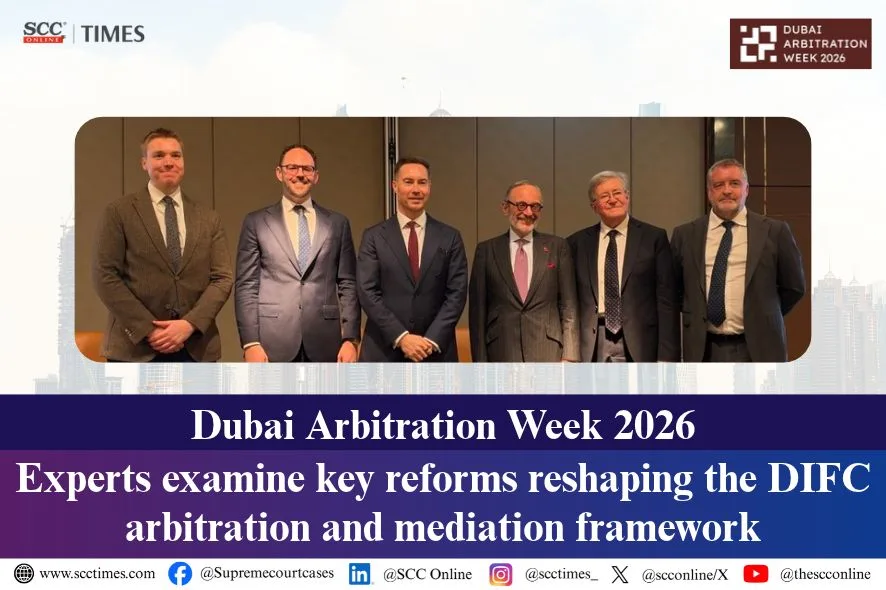
The session was moderated by Graham Lovett, Member of the DIAC Arbitration Court and Partner at Akin (Dubai), and featured:
-
Chief Justice Wayne Martin, Chief Justice, Dubai International Financial Centre Courts (Perth)
-
Justice Michael Black, Judge, Dubai International Financial Centre Courts (London)
-
Robert Stephen, Registrar, Dubai International Arbitration Centre (Dubai)
-
Shane Jury, Partner, Akin (Dubai)
-
Michael Stewart, Counsel, Akin (Dubai)

[In the picture from left to right: Michael Stewart, Shane Jury, Robert Stephen, Justice Michael Black and Chief Justice Wayne Martin]
The DIFC Courts’ approach to arbitration
Opening the discussion on the approach of the DIFC Courts towards arbitration, Chief Justice Wayne Martin expressed a preference for describing the Courts as “arbitration supportive” rather than “arbitration friendly”. He explained that the latter expression could suggest that courts might be unduly lenient in enforcing the law relating to arbitration. Emphasising the statutory boundaries of judicial intervention, he observed that courts must intervene where the law requires them to do so, while otherwise supporting the arbitral process. He described this approach as one of “minimal intervention, maximum support”.
He also highlighted the significance of arbitration in the DIFC Courts’ caseload. The Courts dealt with 54 arbitration cases in 2025, while 45 cases had been recorded by the time of the session in 2026. These matters accounted for approximately one-third of the Court of First Instance’s caseload. He explained that around half of the arbitration matters concerned recognition and enforcement of awards, while the remaining cases largely involved applications for interim or injunctive relief and applications to set aside awards.
Referring to the Courts’ approach to setting aside arbitral awards, Chief Justice Martin emphasised that procedural fairness remains an essential safeguard. He referred to two recent decisions in which awards had been set aside after a party was denied a reasonable opportunity to present its case. These included the DIFC Court of Appeal’s decision in Oheo Bank v Parker1, which set aside parts of an arbitral award, and Justice Mark Pelling’s decision in Princeton v Persephone2, which set aside the award in its entirety.
Key amendments to the DIFC Arbitration Law
Chief Justice Martin identified the reduction of the time limit for challenging an arbitral award as one of the most significant changes under the proposed law. Under the existing framework, an application to set aside an award must be brought within three months of receipt of the award. The proposed law reduces this period to 30 days. He cautioned that this deadline would not be extendable, unlike ordinary appeal periods in many jurisdictions, and emphasised the consequences of failing to act within the prescribed time. As he stated, “No ifs, no buts, no maybes.”
He further explained that the proposed law would change the default rule governing the law applicable to an arbitration agreement. Unless the parties expressly indicate otherwise, the law of the arbitral seat would govern the arbitration agreement. He considered this a more sensible approach, particularly where the parties choose an arbitral seat governed by a law different from the substantive law of their contract.
The proposed amendments also address several aspects of institutional arbitration, including consolidation of proceedings, joinder of parties, security for costs, summary determinations and third-party funding. The law would additionally provide for applications for interim relief without prior notice to the other party and strengthen the statutory basis for emergency arbitration.
Justice Michael Black, who was closely involved in drafting the proposed amendments, explained that the original DIFC Arbitration Law had been developed to establish an internationally recognisable legal framework for arbitration in the DIFC. The drafting drew on the UNCITRAL Model Law, with the objective of creating a framework that would be familiar to international users and aligned with accepted international standards.
He placed the proposed reforms in the context of developments in the wider UAE arbitration framework, including the enactment of the UAE Federal Arbitration Law in 2018. He noted that the federal legislation had introduced provisions dealing with matters such as separability, joinder of parties, remote hearings and the time limit for challenging arbitral awards. The proposed DIFC reforms sought to incorporate relevant developments and update the existing framework to meet contemporary arbitration requirements.
Among the significant proposed changes, Justice Black highlighted the strengthening of confidentiality protections. The proposed law would extend confidentiality to the existence of arbitral proceedings itself. It would also provide greater protection to arbitrators by restricting the circumstances in which they could be ordered to pay costs in challenge proceedings, permitting such orders only where they had acted in bad faith.
The proposed law would further provide default powers to order security for costs, consolidate proceedings and join parties. It would also enable tribunals to issue peremptory orders and provide a statutory basis for the enforcement of emergency arbitrators’ decisions and interim measures. He explained that these provisions were intended to support the institutional arbitration framework while preserving party autonomy, as the default provisions could be varied by agreement or the applicable institutional rules.
Another important development concerns disclosure of third-party funding. The proposed law would expressly require disclosure of third-party funding arrangements. The amendments would also introduce provisions addressing improper conduct by parties and their legal representatives, as well as default remedies available to arbitral tribunals.
Justice Black further noted that the proposed law would leave the established grounds for challenging and enforcing arbitral awards unchanged. He considered these grounds to reflect internationally accepted standards and did not consider them an area requiring legislative alteration.
Stronger case management and procedural discipline
Discussing the practical impact of the proposed amendments, Shane Jury identified summary determinations, peremptory orders and sanctions for improper conduct as provisions likely to make the greatest difference to the time and cost involved in arbitration.
Under the proposed law, tribunals would be expressly empowered to make summary determinations where a claim, issue or defence had no real prospect of success. Shane Jury explained that this would allow tribunals to dispose of unmeritorious claims or defences without requiring parties to proceed through a full evidentiary hearing, thereby avoiding unnecessary time and expense.
He also highlighted the proposed provisions on peremptory orders, which would give tribunals stronger powers to secure compliance with procedural directions. Where a party failed to comply with an order without sufficient cause, the tribunal could issue a peremptory order and impose consequences for continued non-compliance. These could include excluding evidence, drawing adverse inferences, making an award on the evidence available and imposing costs consequences. The DIFC Courts would also be able to enforce such orders, with non-compliance potentially attracting contempt proceedings.
The proposed law would further empower tribunals to impose sanctions on parties and their legal representatives for conduct intended to improperly jeopardise or obstruct the integrity of the proceedings or the finality and enforceability of an award. Shane Jury explained that the provision was aimed at intentional and improper conduct, such as late document dumps, repeated requests for adjournments and applications without proper foundation, rather than merely weak but arguable submissions.
Addressing concerns about what is commonly described as “due process paranoia”, Shane Jury observed that tribunals can sometimes hesitate to make firm procedural decisions out of concern that their decisions may subsequently be challenged. He considered that the express statutory recognition of summary determinations, peremptory orders and sanctions would give tribunals greater confidence in managing proceedings. He also referred to the DIFC Courts’ approach to set-aside applications, which distinguishes genuine denial of a reasonable opportunity to present a case from unmeritorious procedural challenges.
Alignment with DIAC Rules and the legislative consultation
Robert Stephen explained that the DIAC Arbitration Rules 2022 had informed the drafting of the proposed DIFC Arbitration Law. He considered the closer alignment between the law of the seat and institutional rules to be one of the most immediate benefits for users of DIAC.
He explained that the DIAC Rules had been drafted to accommodate different arbitral seats, but certain procedural measures could not operate effectively where the applicable law did not provide the necessary statutory authority. The proposed amendments would address this gap, particularly in relation to interim relief without prior notice and the enforcement of interim measures.
He also highlighted the proposed recognition and enforceability of emergency arbitrators’ decisions. DIAC had introduced an emergency arbitrator procedure under its 2022 Rules, and the Centre received approximately five to six applications under this mechanism each year. Providing express statutory recognition to emergency arbitrators and enabling enforcement of their decisions through the Courts would, in his view, strengthen the practical value of the procedure.
Robert Stephen added that DIAC would review its existing Rules as they approached five years of operation. The proposed DIFC Arbitration Law could provide useful guidance for that exercise, particularly in relation to summary decisions and confidentiality. He emphasised that arbitration institutions must periodically review their rules to ensure that they remain responsive to developments in the market and the needs of users.
Discussing the drafting and consultation process, Michael Stewart explained that the proposed reforms had undergone a comparative review of legislation and institutional rules in several leading arbitral jurisdictions, including England and Wales, Singapore, Hong Kong, Australia, the UAE Federal Arbitration Law and the Abu Dhabi Global Market regulations. The review also considered institutional rules such as those of DIAC, the London Court of International Arbitration and the International Chamber of Commerce.
He described the approach as drawing on useful developments from different jurisdictions to create a modern and forward-looking framework for the DIFC. One proposal that was ultimately excluded was the possibility of appealing arbitral awards on questions of law, similar to Section 69 of the English Arbitration Act 1996. Michael Stewart explained that although such a provision could provide recourse where an award contained a serious error of law, it could also undermine finality, encourage unmeritorious challenges and be used to delay enforcement. He considered the provision less suitable for the DIFC, where arbitrations frequently involve a variety of substantive governing laws, unlike the predominantly English-law context of many London-seated arbitrations.
The consultation process also raised questions about the use of artificial intelligence in legal submissions. Michael Stewart observed that some consultation responses relied heavily on AI-generated content, which could appear convincing at first but often lacked accuracy or substantive depth upon closer examination. He noted that the drafting team nevertheless had to examine such submissions with the same rigour as other responses. The discussion highlighted the need for care and scrutiny when using AI in legal research, drafting and formal submissions.
Introduction of a standalone DIFC Mediation Law
The session also considered the proposed decision to introduce a standalone DIFC Mediation Law separately from the Arbitration Law. Chief Justice Martin welcomed the separate legislation, observing that it would send a clear message about the importance of mediation as a serious dispute resolution mechanism.
He highlighted that the proposed law would provide a mechanism through which an agreed outcome of mediation could be embodied as a judgment of the DIFC Courts. In the event of a breach of the settlement, the judgment could be enforced through the Courts without requiring the parties to initiate separate proceedings to establish the enforceability of the settlement agreement. He described this as a significant development and a mechanism comparable, in its effect within the DIFC, to the framework under the Singapore Convention on Mediation. He considered that the availability of such a mechanism would provide parties with an added incentive to consider mediation in their dispute resolution arrangements.
Robert Stephen also discussed the development of DIAC’s mediation services. He explained that the introduction of DIAC’s mediation rules in October 2023 had helped fill a gap in the available institutional mediation framework. The Centre recorded its first mediation under the new rules in November 2023, followed by eight mediations in 2025. By the time of the session, DIAC had recorded 11 mediation matters in 2026.
He noted that the growing use of the mediation rules indicated increasing acceptance of the service among parties. The rules were also designed to be familiar to users of administered mediation at other institutions, making them accessible and straightforward to apply.

The discussion highlighted the proposed legislative changes as an effort to strengthen the DIFC’s position as an international dispute resolution hub. While the Arbitration Law reforms seek to provide tribunals with stronger procedural powers, improve efficiency and bring greater certainty to arbitral proceedings, the standalone Mediation Law seeks to strengthen the enforceability of mediated settlements and encourage wider use of mediation.
SCC Times is the Official Information & Documentation Partner for Dubai Arbitration Week 2026. Stay tuned for comprehensive coverage, key insights and highlights from the event!
1. [2025] DIFC CA 006, DIFC Court of Appeal, decided on 24 April 2026
2. ARB 015/2026 and ARB 027/2026, DIFC Court of First Instance, decided on 14 August 2026