The increasing complexity of international commercial disputes, particularly where arbitration intersects with parallel court proceedings, competing injunctions and cross-border enforcement actions, came under discussion at the DIAC Symposium, organised as part of Dubai Arbitration Week 2026.
The panel examined a fundamental question confronting parties to international disputes: how can the contractual choice of arbitration be protected when multiple national jurisdictions seek to exercise authority over the same dispute? The discussion covered anti-suit and anti-enforcement measures, parallel proceedings, sanctions-related litigation, the Russian Lugovoy Law, evolving European regulations and the practical difficulties of enforcing arbitral awards across jurisdictions.

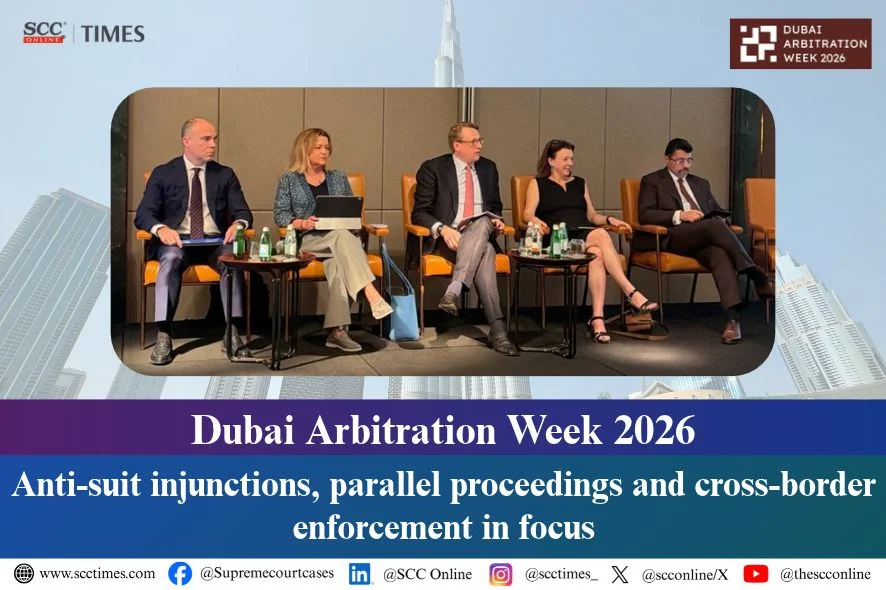
[In Picture (Left to Right): Dr Maxim Petchenko, Head of Legal Directorate, Gazprom Export LLC, St Petersburg; Julia Zagonek, Founding Partner, Alyff, Dubai; Boris Telyatnikov, Partner, PCB Byrne LLP, London; Zoe O’Sullivan KC, Barrister, Serle Court, London and Prof Dr Mohamed Abdel Wahab, Founding Partner, Zulficar Partners, Cairo]
Moderated by Vladimir V Talanov, Partner, EPAM Law, Moscow, the panel featured Dr Maxim Petchenko, Head of Legal Directorate, Gazprom Export LLC, St Petersburg; Prof Dr Mohamed Abdel Wahab, Founding Partner, Zulficar Partners, Cairo; Zoe O’Sullivan KC, Barrister, Serle Court, London; Julia Zagonek, Founding Partner, Alyff, Dubai; and Boris Telyatnikov, Partner, PCB Byrne LLP, London.
The growing problem of parallel proceedings and interim relief
Opening the discussion, Vladimir V Talanov highlighted how sanctions and the proliferation of parallel proceedings had transformed international arbitration. Referring to the 2025 Queen Mary University of London—White & Case International Arbitration Survey, he noted that 18% of respondents identified sanctions-related difficulties, particularly obtaining interim relief enforceable across jurisdictions, as a significant concern.
He also observed that developments over the preceding year, including new European legislation, had renewed attention on the Russian Lugovoy Law and the protection of arbitration agreements. Against this background, he questioned whether there was an internationally recognised standard governing anti-suit injunctions issued by arbitral tribunals.

[In Picture: Vladimir V Talanov]
Referring to Article 17A of the UNCITRAL Model Law, Vladimir asked whether anti-suit relief should be assessed under the same principles as conventional interim measures, particularly since certain ICC tribunal decisions appeared to apply a different threshold.
The tribunal’s mandate, proportionality and the status quo
Responding, Dr Mohamed Abdel Wahab cautioned against importing common law reasoning into international arbitration merely because anti-suit injunctions originated in common law jurisdictions. He referred to a Dubai Court of Cassation decision recognising the authority of a Dubai-seated tribunal to restrain a party from pursuing parallel court proceedings. He also recalled an Egyptian arbitration in which a tribunal issued an anti-arbitration injunction against another tribunal constituted in relation to a counterclaim under the same contract. The courts ultimately allowed both proceedings to continue, leaving their respective outcomes to determine the position.
Dr Abdel identified several considerations governing a tribunal’s decision to grant anti-suit relief. Firstly, it must establish its jurisdiction and mandate. In commercial arbitration, this authority is principally contractual, whereas investment arbitration may derive jurisdiction from treaties, legislation or other applicable instruments. Secondly, the tribunal must examine whether the foreign proceedings are inconsistent with the arbitration agreement and adversely affect the arbitration. Thirdly, it must consider the sequence and progress of proceedings and whether the parallel litigation aggravates the dispute or alters the status quo.

[In Picture: Dr Mohamed Abdel Wahab]
He emphasised that proceedings arising from the same commercial relationship do not necessarily involve arbitrable issues. The tribunal must therefore examine the actual relief sought before the foreign court rather than assume that every dispute connected with the contract falls within the arbitration agreement.
A breach of the arbitration agreement, he explained, is fundamental but does not automatically justify an injunction. The tribunal must assess whether the proceedings compromise the integrity of the arbitration or prejudice its decision-making process, followed by a proportionality assessment balancing the prejudice to both parties. In appropriate circumstances, staying foreign proceedings may be more proportionate than requiring their termination, as it preserves the parties’ positions while allowing the tribunal to determine the dispute.
He cautioned tribunals against entering a race with national courts to deliver the first decision, emphasising the need for judicial deference and respect for national court jurisdiction.
Recognition of arbitral tribunals’ powers in Dubai
The discussion turned to a Dubai Court of Cassation’s decision where Zoe O’Sullivan KC welcomed the ruling as an important arbitration-friendly development, recognising a Dubai-seated tribunal’s power to restrain a party from pursuing onshore court proceedings in breach of an arbitration agreement.

[In Picture: Zoe O’Sullivan KC]
Two aspects were particularly significant: granting such relief did not violate constitutionally guaranteed rights of access to courts, and the authority to discharge or modify the tribunal’s own order rested with the tribunal itself.
However, Zoe cautioned that the approach had not consistently filtered down to first-instance courts. Parties continued to institute onshore proceedings despite arbitration clauses, sometimes arguing that additional parties were involved or that all issues should be resolved in one forum.
She referred to Article 8(1) of the UAE Arbitration Law, 2018 which requires courts to dismiss proceedings brought in breach of an arbitration agreement unless the agreement is found to be null or unenforceable. The difficulty arose where courts postponed determining the agreement’s validity and appointed experts who proceeded to examine the merits. Respondents were consequently placed in a difficult position: participation could be treated as submission to the court’s jurisdiction, while non-participation could result in an adverse decision. The discussion thus highlighted the gap between appellate recognition of arbitration-friendly principles and their implementation in everyday judicial practice.
The English approach and the practical effectiveness of relief
Boris Telyatnikov explained that English jurisprudence on anti-suit injunctions was well developed. Two considerations were particularly important: whether the application was made promptly and whether the injunction would make a practical difference. An application made after foreign proceedings had substantially progressed could weigh against relief.

[In Picture: Boris Telyatnikov]
The English court must also establish jurisdiction, which may arise where the arbitration is seated in England, the respondent falls within the court’s personal jurisdiction, or the arbitration agreement is governed by English law. The last situation can involve more complicated jurisdictional questions.
Julia Zagonek observed that tribunals’ historical reluctance to interfere with proceedings before national courts had diminished considerably. Institutional rules increasingly recognised their authority to grant interim relief, while European jurisprudence and sanctions-related disputes demonstrated that tribunals could act swiftly, sometimes issuing orders within days.

[In Picture: Julia Zagonek]
Referring to the English Supreme Court’s judgment in the Prestige litigation, Julia highlighted the contractual foundation of anti-suit relief: the parties’ promise not to litigate outside the forum they selected. Since enforcing contractual obligations is central to a tribunal’s function, she questioned whether the traditional reluctance to grant such relief remained justified.
The more pressing concern, however, was whether an injunction would achieve anything. If the opposing party ignored the order without meaningful consequences, its practical value could be limited. It could also provoke a counter-injunction from a foreign court, complicating subsequent enforcement.
Practical considerations when seeking anti-suit relief
Julia recommended that counsel seek targeted relief directed at specific steps in the foreign proceedings rather than an unnecessarily broad prohibition. Applications should also seek a declaration that the foreign proceedings breach the arbitration agreement and consider reserving a claim for damages if the opposing party disregards the tribunal’s order.
Illustrating the potential value of monetary relief, she referred to the Prestige litigation, where an injunction granted in one arbitration was set aside, but monetary relief survived through the Supreme Court proceedings. In a separate arbitration concerning Spain, the tribunal declined to grant an injunction but awarded monetary relief. She suggested that counsel consider declaratory and monetary remedies at the outset rather than commencing a separate arbitration years later to recover losses.
She also stressed the need to demonstrate that foreign claims concern substantially the same dispute, facts, losses and monetary claims. Parties may frame their claims as tortious, statutory, criminal or direct actions, or proceed against affiliates, to argue that they fall outside the arbitration clause. Counsel should address these claims individually.
An application should be supported by concrete evidence, including the next procedural steps and scheduled dates, listed hearings, pending attachment applications, applicable default timetables, the applicant’s promptness in objecting, any submission or reservation of rights before the foreign court, and whether a stay was sought before anti-suit relief. Such evidence, she observed, is more persuasive than simply describing proceedings as vexatious or abusive.
Dr Abdel offered an important qualification to the recommendation to seek damages. Since the availability of an adequate monetary remedy is relevant to interim relief, expressly seeking damages may suggest that compensation is sufficient and undermine the need for an injunction. He emphasised that anti-suit relief ultimately enforces the negative contractual promise to arbitrate exclusively before the chosen tribunal, referring to AES v Kamenogorsk1.
Boris added that disobedience of a tribunal’s peremptory order could adversely affect a party’s position in the arbitration, whereas disobedience of a national court order could also attract contempt proceedings. He referred to the English Court of Appeal’s decision in Tecnimont2, which confirmed the availability of orders under Section 42 of the English Arbitration Act 1996 to support compliance with peremptory tribunal orders.
Parallel proceedings and the risk of procedural abuse
Vladimir invited Dr Maxim Petchenko to consider whether anti-suit and anti-enforcement injunctions were increasingly being abused. Maxim acknowledged the growing number of applications but cautioned against automatically characterising every instance of parallel litigation as abusive. Conduct viewed as procedural abuse by one party might be considered a legitimate strategy by another; the tribunal would ordinarily determine whether it amounted to abuse.

[In Picture: Dr Maxim Petchenko]
Drawing on his experience, he described instances in which parties approached national courts during ongoing arbitration, obtained interim relief and attempted to attach assets in another jurisdiction. In one instance, the tribunal directed the opposing party to discontinue parallel proceedings and remain within the arbitration.
Maxim also challenged the perception that such conduct was predominantly associated with Russian parties. He referred to European counterparties who had commenced domestic proceedings despite clear arbitration agreements, sometimes giving inadequate notice of urgent hearings before using the resulting decisions to freeze assets elsewhere. From a client’s perspective, he identified costs orders and the tribunal’s ultimate assessment of the parties’ conduct as important means of discouraging procedural abuse.
The RusChem Alliance litigation and support for foreign-seated arbitrations
The panel then examined the English courts’ willingness to support arbitrations seated outside England. Boris explained that jurisdiction and permission to serve proceedings outside England were central to obtaining anti-suit relief. Where a respondent was located in England, establishing jurisdiction was comparatively straightforward; otherwise, the governing law of the arbitration agreement could become decisive.
The RusChem Alliance3 dispute raised this issue because the main contract was governed by English law, while the ICC arbitration was seated in Paris. The Supreme Court ultimately held that English law governed the arbitration agreement in the circumstances before it.
Boris also highlighted the limited availability of equivalent relief before the French courts. Although French courts could impose an astreinte, a financial penalty for non-compliance, this did not provide the same form of coercive protection as an English anti-suit injunction. The English injunctions were ultimately disregarded, counter-injunctions were issued under the Lugovoy Law, and the claimants subsequently returned to the English courts, which discharged the injunctions.
He referred to amendments to the English Arbitration Act which came into force on 1 August 2025, introducing Section 6A. Where parties have not expressly chosen the law governing their arbitration agreement, the default position is generally the law of the seat, subject to statutory exceptions. This could materially change the outcome in a similar dispute where the main contract is governed by English law but the arbitration is seated elsewhere. The English legal community, he noted, remained divided on whether the same result would follow under the amended framework.
The position of the DIFC Courts
Comparing the English position with that of the DIFC Courts, Zoe explained that, under the law as it stood at the time of the panel, the DIFC Courts could not grant anti-suit injunctions in respect of foreign-seated arbitrations. She referred to Oran v. Oved4, which confined their supervisory jurisdiction to arbitrations seated within the DIFC.
Amendments to the arbitration law were in the legislative pipeline and were expected to extend the relevant jurisdiction to foreign-seated arbitrations. Zoe anticipated that the DIFC Courts would approach the power cautiously, as the English courts do. She described RusChem Alliance as an exceptional case involving an English-law-governed arbitration agreement and limited equivalent relief at the French seat.
The commercial value of an injunction
The panel considered whether an injunction could provide meaningful leverage where the issuing court had no relevant assets within its jurisdiction. Julia cautioned against assessing its value solely by reference to asset location. An injunction might alter the opposing party’s commercial position, constrain its litigation strategy or influence negotiations. Nevertheless, counsel should distinguish genuine protection of the chosen arbitral forum from the use of injunctions merely as instruments of pressure.
Sanctions, the Lugovoy Law and competing legal systems
Returning to the Russian Lugovoy Law and the European response, Maxim discussed successive European sanctions measures and developments concerning Council Regulation (EU) No. 833/2014, particularly Article 11c. He described the new framework as addressing judgments arising from Lugovoy Law proceedings, with implications extending beyond recognition and enforcement within the European Union. Its consequences remained uncertain and were already generating litigation, including proceedings involving the Bank of Russia and Euroclear.
Boris observed that introducing anti-enforcement mechanisms into the European regulatory framework was significant because such instruments had traditionally been associated with common law jurisdictions. Julia added that continental European courts had historically relied on other mechanisms to restrain parties, some of which could be more effective than contempt-based enforcement. The new framework provided a legal basis and a test whose practical operation would depend on judicial interpretation.
Dr Abdel offered a broader perspective, questioning whether the increasing use of domestic legislation to restrict the legal consequences of foreign proceedings represented a shift from the rule of law towards what he described as “rule by law”. He cautioned that the international legal order risked becoming an arena in which more powerful jurisdictions imposed their preferred legal outcomes, potentially creating further jurisdictional conflict.
Participation in proceedings and the questions of consent and estoppel
An important exchange arose when Vladimir described a dispute in which a foreign party had actively participated in Russian court proceedings under the Lugovoy Law, advanced its own claims and sought a decision on the merits. After an unfavourable appellate outcome, it approached an arbitral tribunal seeking anti-suit measures in relation to further domestic proceedings and enforcement.
The arbitrators and the seat were both in the European Union, raising questions about the effect that could be given to the Russian proceedings under the applicable sanctions framework. The tribunal therefore had to consider whether those proceedings could be disregarded despite the party’s active participation.
Dr Abdel suggested that the analysis should focus on whether the party had voluntarily submitted to a court whose jurisdiction it subsequently challenged. Participation without duress or an express reservation of rights could raise questions of consent and estoppel, particularly where the party had advanced its own claims and sought a decision on the merits. An express reservation of objections could, however, lead to a different analysis. Vladimir clarified that the tribunal had not yet delivered its decision and remained at a crossroads.
Addressing the perception that Russian courts automatically grant anti-suit injunctions under the Lugovoy Law, Vladimir referred to statistics presented at the Russian International Arbitration Congress in September 2026. According to the figures cited, 30 out of 38 applications had been successful. He observed that the figures challenged the assumption that such applications were invariably granted and highlighted the importance of distinguishing political perceptions from actual judicial practice.
When an injunction no longer serves its commercial purpose
Returning to the RusChem Alliance litigation, Vladimir asked whether the discharge of previously granted injunctions demonstrated the need to assess their commercial utility. Boris described applications to discharge injunctions after proceedings through three levels of the English court system as highly unusual, particularly since the banks concerned still had substantial assets in Russia at the relevant time.
The litigation had generated considerable legal activity but produced a limited commercial outcome. Boris connected this with Maxim’s earlier observation that injunctions were only one instrument in the broader management of a dispute. He also suggested that the relative exhaustion of Western assets in Russia could make similar situations less common, although further developments could not be ruled out.
Reducing jurisdictional conflict through proportionate relief
Julia stressed that anti-suit injunctions should remain defensive measures to protect the chosen forum, rather than become a competition to obtain the stronger order.
She identified several practical steps. Counsel should first consider seeking a stay from the foreign court before applying for an injunction; refusal may provide useful evidence in support of the subsequent application. A standstill may also be supported by an undertaking to compensate the opposing party for losses if the suspension ultimately proves unjustified.
Orders should be narrow, clear and workable, distinguishing prohibited conduct from permissible procedural steps. They may, for instance, allow a party to seek a stay or withdraw proceedings while requiring notice before further steps are taken. Standstill arrangements are more realistic where both parties have commercial interests outside their home jurisdictions, and less so where domestic law prohibits compliance, penalises participation or where delay benefits one party.
When national courts restrain participation in arbitration
The panel next considered what happens when a domestic court restrains a party from participating in arbitration. Zoe explained that an anti-suit injunction generally operates in personam against the party and does not directly bind the tribunal. A more complicated situation arises where a party ignores a tribunal-issued injunction and continues parallel proceedings abroad.
Dr Abdel distinguished between orders directed at parties and those that also seek to restrain arbitrators. The distinction between commercial and investment arbitration remains relevant, since investment tribunals derive jurisdiction from international legal instruments and may face different questions when domestic courts attempt to intervene.
Referring to Article 32 of UAE Federal Law No. 6 of 2018, he noted that a party’s failure to participate does not ordinarily prevent the tribunal from continuing, provided the non-participation is without justifiable cause or reason. A domestic court order expressly prohibiting participation could make it difficult to treat the absence as unjustified.
The tribunal may then have to consider whether to continue, stay proceedings or adapt the procedure. Moving the seat could be considered in certain circumstances, but only where the applicable law authorises it. The tribunal must also examine whether earlier intervention could have prevented the conflict and consider the likely enforcement jurisdictions. Bilateral treaties may facilitate recognition of foreign judgments, creating a risk of inconsistent outcomes between an award and a domestic court judgment. Where an injunction directly restrains arbitrators, they may have to consider whether to disregard it, resign or continue while accepting the associated legal risks.
Anti-enforcement injunctions and the English courts
The final substantive theme concerned anti-enforcement injunctions. Vladimir referred to an October 2026 Journal of International Arbitration article by Mr Seriki, titled “Anti-Enforcement Injunctions and the English Courts: From Rare Beast to Common Beast”, and noted the growing attention being given to a remedy traditionally associated with common law jurisdictions.
Zoe explained that the English courts’ jurisdiction to grant anti-enforcement injunctions had existed since the 1920s, although the remedy had historically been used rarely. The Lugovoy Law litigation had contributed to renewed consideration of it. Its legal foundation is substantially similar to that of an anti-suit injunction: the contractual right not to be sued to judgment in a forum other than the one chosen by the parties.
However, such relief is more difficult to obtain. Referring to Google LLC v NAO Tsargrad5, Zoe explained that the English courts had clarified that there was no separate requirement of exceptionality. The principal obstacles were judicial comity, given the intervention involved in restraining enforcement of an existing foreign judgment, and delay, particularly where the opposing party had already incurred substantial expense in obtaining that judgment. She also referred to Tecnimont6 and Google v Tsargrad7 as examples where anti-enforcement relief had been granted.
The European regulatory framework and tribunal-issued anti-enforcement relief
Boris discussed developments concerning Article 11c of Regulation (EU) No. 833/2014, explaining that measures introduced in April 2026 and expanded in July 2026 had taken the issue further. Their implications extended beyond recognition or enforcement before EU courts to the treatment of judgments obtained under the Lugovoy Law. He referred to proceedings initiated by the Bank of Russia against the EU Council, raising questions concerning the right to a fair trial, and related proceedings involving Euroclear in Belgium. The consequences remained uncertain.
Dr Abdel questioned whether tribunals should approach anti-enforcement injunctions in the same way as anti-suit injunctions. He distinguished between restraining enforcement within the jurisdiction of the court that issued the judgment and restraining a party from pursuing enforcement elsewhere. In the former situation, he questioned the need for an injunction if the court could itself decline enforcement on applicable grounds. The latter raised more complex questions about the enforcing court’s jurisdiction and the extent to which an injunction might interfere with its authority.
Although such relief would ordinarily operate in personam, concerns remained about due process and a party’s ability to enforce a judgment already obtained. Where the basis is contractual, the tribunal must also consider why the dispute reached the enforcement stage without the issue being addressed earlier. Nevertheless, a tribunal with the requisite jurisdiction and authority could, in an appropriate case, restrain a party from pursuing enforcement to protect the integrity of the arbitration. Such relief would require a sound legal and factual basis, consideration of both parties’ positions and attention to the consequences of delaying enforcement, including the expiry of limitation periods.
From the client’s perspective, Maxim said that parties had voluntarily complied with tribunal-issued anti-suit and anti-enforcement orders in his experience. Where a party refused to comply, however, judicial support became necessary, preferably from the courts at the seat. Recognition or enforcement of a court order outside the seat could prove difficult, depending on the jurisdiction. The effectiveness of relief therefore depended on party conduct, the arbitral seat and the support available from national courts.
Concluding observations
The discussion demonstrated that parallel proceedings, sanctions-related litigation and competing injunctions have made the relationship between arbitral tribunals and national courts increasingly complex. The panellists approached the issues from different perspectives but shared a central concern: the effectiveness of arbitration cannot be measured solely by a tribunal’s ability to issue an award or grant interim relief. It must also be assessed by reference to party conduct, judicial support and the possibility of meaningful enforcement where assets are located.
The Dubai Court of Cassation’s recognition of tribunal-issued anti-suit injunctions, the English courts’ evolving approach to cross-border relief, legislative developments in the UAE and Europe, and the implications of the Lugovoy Law illustrate how rapidly this area of international arbitration continues to develop.
The panel also underscored the importance of procedural discipline: timely objections, carefully framed applications, proportionate relief, appropriate undertakings and a clear understanding of the enforcement landscape can make a decisive difference. Ultimately, the challenge in a multi-forum dispute is not merely to determine which forum has jurisdiction, but to ensure that the parties’ contractual choice of dispute resolution is respected and that any resulting decision can be translated into an effective remedy. Winning an arbitration and securing the fruits of that victory remain distinct challenges when multiple jurisdictions claim authority over the same dispute.
1. AES Ust-Kamenogorsk Hydropower Plant LLP v Ust-Kamenogorsk Hydropower Plant JSC [2013] UKSC 35
2. LLC EuroChem North-West-2 v Tecnimont SpA [2026] EWCA Civ 5)
3. UniCredit Bank GmbH v RusChemAlliance LLC [2024] UKSC 30
4. Oran v. Oved, CA 004/2025
5. Google LLC v. NAO Tsargrad Media, [2025] EWHC 94 (Comm)
6. Tecnimont SpA and MT Russia LLC v. LLC Eurochem North-West-2 [2026] EWHC 255 (Comm)
7. Supra