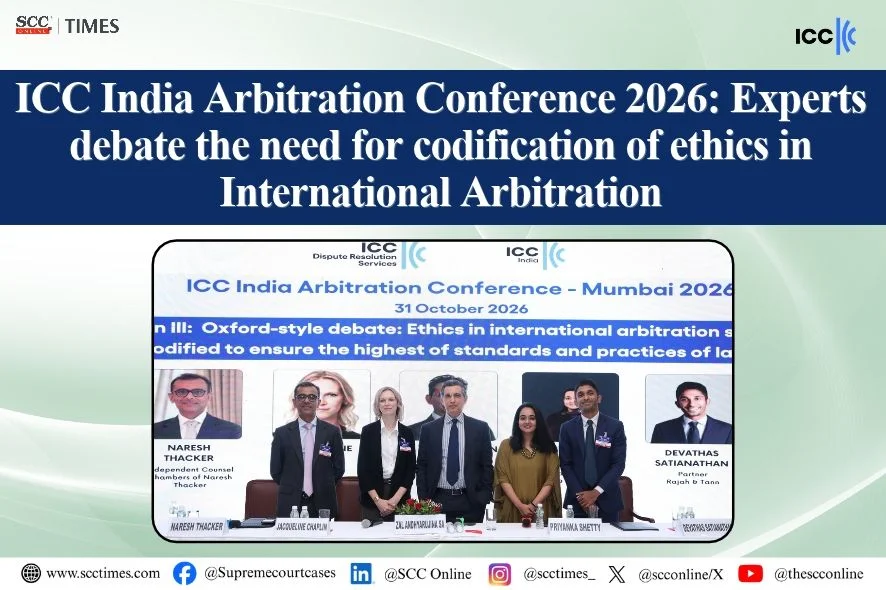
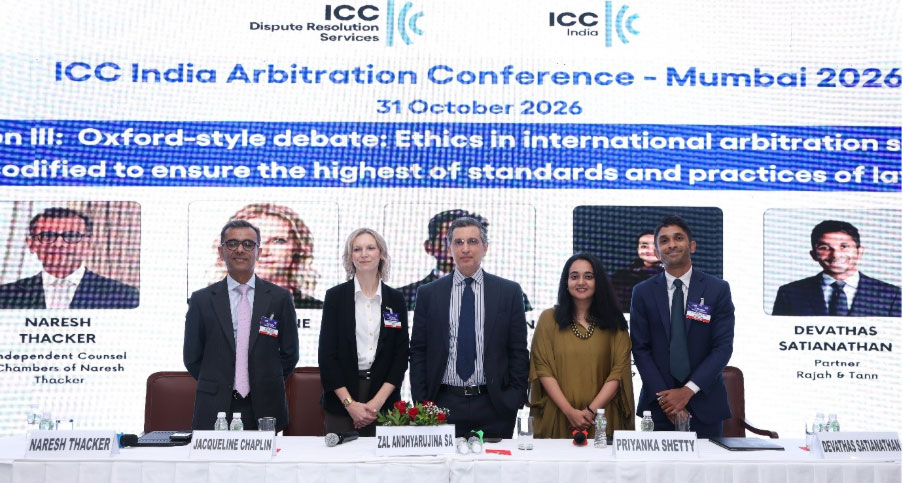
The ICC India Arbitration Conference 2026, held in Mumbai on 31 October 2026, featured an Oxford-style debate on whether ethical standards in international arbitration should be codified to ensure the highest standards of professional conduct. The final session, titled “Ethics in International Arbitration Shall Be Codified to Ensure the Highest of Standards and Practices of Law”, examined whether a common ethical framework was necessary to maintain the legitimacy and trust of international arbitration or whether existing domestic laws, institutional rules and professional guidelines were sufficient.
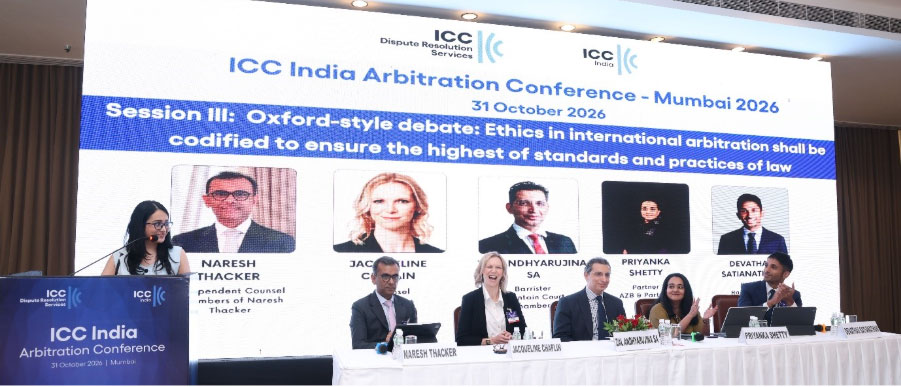
[In picture from left to right: Khushboo Deshmukh, Naresh Thacker, Jacqueline Chaplin, Zal Andhyarujina, Priyanka Shetty and Devathas Satianathan]
Khushboo Deshmukh, Deputy Director, India, ICC Arbitration & ADR, International Chamber of Commerce (ICC), hosted the session and later concluded the event with closing remarks and a vote of thanks. The debate was moderated by Zal Andhyarujina, Senior Advocate and Barrister at Fountain Court Chambers.
The motion was supported by Naresh Thacker, Independent Counsel, Chambers of Naresh Thacker, and Jacqueline Chaplin, Partner at Linklaters, London.
Arguing against the motion were Devathas Satianathan, Partner at Rajah and Tann, Singapore, and Priyanka Shetty, Partner at AZB & Partners, Mumbai.
Framing the debate: Ethical standards and the challenges of international arbitration
Opening the debate, Zal Andhyarujina observed that ethical standards are fundamental to the long-term credibility of legal processes, including international arbitration. He pointed out that international arbitration brings together parties, counsel and arbitrators from different jurisdictions, each operating within distinct professional and cultural traditions.
While practices relating to international arbitration have become increasingly aligned across jurisdictions, he identified professional ethics as an area where significant differences remain. He illustrated this through differences in conflict-of-interest disclosure obligations and the preparation of witnesses. For instance, practices accepted in some common law jurisdictions may be viewed differently in civil law jurisdictions.

He also raised concerns arising from the chambers system, where arbitrators and counsel may belong to the same set of chambers. While some jurisdictions regard chambers as independent practitioners sharing administrative facilities, others may view such arrangements differently. These differences, he noted, have featured in challenges to arbitral proceedings and awards.
Zal Andhyarujina identified two central questions for the debate: whether codification could provide greater certainty and consistency in professional standards, and whether such standards could be practically enforced without undermining the flexibility and procedural autonomy of international arbitration.
For the motion: Codification is necessary to establish a common ethical baseline
Supporting the motion, Naresh Thacker argued that the international arbitration community could no longer rely solely on professional courtesy, tradition and individual integrity to maintain ethical standards. He observed that international arbitration involves tribunals exercising significant decision-making authority over disputes involving multinational corporations and States, yet the professionals participating in these proceedings may not be subject to a common, enforceable ethical framework.
He illustrated the problem through the differing regulatory approaches across jurisdictions. A lawyer appearing before a domestic court may be subject to established professional rules and disciplinary consequences. However, when the same lawyer participates in an international arbitration involving multiple jurisdictions, questions may arise about which professional regulator has authority over the conduct in question.
Referring to India, Naresh Thacker pointed out that foreign lawyers conducting arbitration-related work in India are subject to the applicable professional standards governing legal practitioners in the country. However, where the seat and the applicable regulatory framework are less clearly connected to the professionals involved, the possibility of fragmented oversight remains. He described this as an accountability gap requiring a common framework.
Differences in witness preparation demonstrate the need for consistency
Naresh Thacker also relied on differences in witness preparation practices to demonstrate the practical consequences of divergent professional standards. He explained that common law practitioners may conduct witness preparation sessions, including mock cross-examinations and practice questions, provided that the testimony remains the witness’s own account. He referred to the International Bar Association (IBA) Guidelines on Party Representation in International Arbitration, which recognise certain forms of witness preparation.
However, practices in some civil law jurisdictions may impose greater restrictions on contact between lawyers and witnesses. According to Naresh Thacker, these differences can create an uneven playing field when parties from different legal traditions participate in the same arbitration.
He argued that parties should not have to navigate competing ethical expectations without clarity on which standards govern their conduct. In his view, codification could establish common minimum requirements and promote equality of arms.
Soft-law guidelines require stronger enforceability
Addressing the existing reliance on soft-law instruments, Naresh Thacker argued that guidelines cannot provide sufficient protection where their application depends on party agreement or the discretion of the tribunal. He acknowledged the value of the IBA Guidelines but maintained that their non-binding character limits their effectiveness against practitioners who are unwilling to follow them.
He argued that ethical obligations should not operate as an optional framework that parties can choose to accept or disregard. Instead, codification should provide a baseline that protects honest practitioners, clients and the integrity of arbitral proceedings.
Concluding his argument, Naresh Thacker stated that codification was not intended to impose unnecessary procedural restrictions but to establish minimum standards of transparency and accountability.
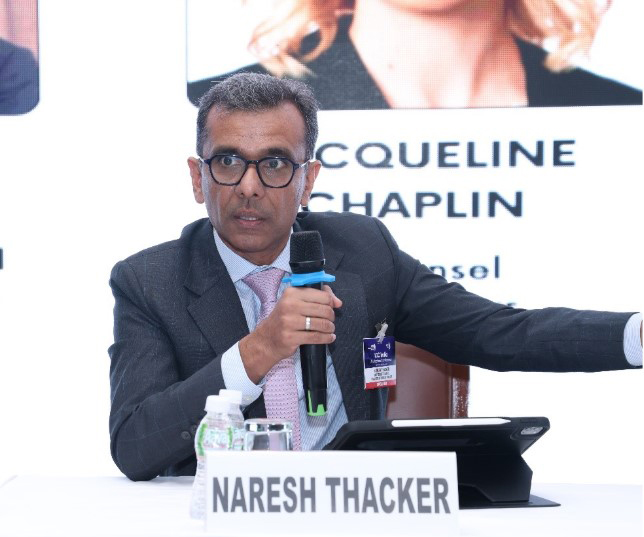
He urged the audience to support “equality of arms and codified rule of law” in international arbitration.
Supporting the practical case for codification, Jacqueline Chaplin argued that the objections concerning enforceability, drafting and differences between legal traditions had been overstated.
She observed that international arbitration currently relies on a combination of professional guidelines, institutional rules and expectations of professional conduct. However, guidelines can be interpreted differently, departed from or ignored. In her view, ethical obligations should be established as enforceable duties rather than being addressed only after a dispute arises.
Referring to the IBA Guidelines on Conflicts of Interest in International Arbitration, Jacqueline Chaplin discussed the classification of conflicts into different categories, including waivable and non-waivable red lists, the orange list and the green list. She argued that the existence of such classifications did not, by itself, provide an enforceable and consistent ethical standard.
She also referred to the IBA Guidelines on Party Representation in International Arbitration, maintaining that while these instruments are valuable, their effectiveness would be strengthened by giving them a more binding character.
Jacqueline Chaplin further argued that existing institutional and international frameworks demonstrated that common standards could be developed across jurisdictions. She referred to ethical guidelines for legal representatives under the London Court of International Arbitration (LCIA) framework and the Code of Conduct for Arbitrators in International Investment Dispute Resolution developed through the United Nations Commission on International Trade Law (UNCITRAL) and the International Centre for Settlement of Investment Disputes (ICSID).
In her view, these developments demonstrated that States and arbitral institutions could agree on common standards despite differences in legal traditions. She argued that similar efforts could be extended to international commercial arbitration, supported by the enforcement mechanisms available through national courts.
Artificial intelligence adds urgency to the case for codification
Jacqueline Chaplin also identified the use of artificial intelligence as an emerging ethical concern. She questioned whether existing guidance was sufficient to address situations where arbitrators might rely on AI-generated material or delegate aspects of their legal reasoning to automated systems.
She argued that the use of AI could create significant risks where an arbitrator relies on unverified material or allows a machine to influence the decision-making process. In her view, existing guidance against delegating adjudicative responsibilities did not provide the same assurance as an enforceable rule.

She cautioned that the profession could no longer focus exclusively on traditional questions of conflicts and professional relationships while overlooking the ethical implications of emerging technologies.
Jacqueline Chaplin concluded that the need for codification had become more pressing with the expansion of AI-assisted legal processes. She maintained that the challenge was not the absence of possible models, but the need for the international arbitration community to translate existing work into an enforceable framework.
Against the motion: Universal codification may undermine the flexibility of international arbitration
Opposing the motion, Devathas Satianathan questioned whether ethical conduct could or should be reduced to a universally applicable code. He began by distinguishing between ethics, which he described as the moral principles and values guiding individual behaviour, and codification, which he understood as imposing a fixed set of rules with universal application.
He identified three characteristics of international arbitration that, in his view, made universal codification inappropriate: party autonomy and procedural flexibility, the diversity of parties and legal traditions, and the distinction between international arbitration and domestic court proceedings.
He argued that international arbitration does not operate on the same basis as domestic courts. It does not follow the conventional doctrine of precedent, nor do arbitrators perform the same law-making function as judges in common law jurisdictions. Accordingly, he questioned whether a uniform ethical code could adequately accommodate the diversity that international arbitration seeks to preserve.
Devathas Satianathan maintained that ethical behaviour should arise from individual judgment and a commitment to professional values rather than merely from compliance with prescribed rules. Drawing on the example of Singapore’s requirement that people return trays at food courts, he argued that a legal obligation may secure compliance without necessarily creating an underlying sense of responsibility.

He cautioned that codification could encourage practitioners to treat compliance with the prescribed minimum as the full extent of their ethical obligations. A code might therefore restrict rather than encourage independent ethical judgment.
As he observed, “Following the law may mean you won’t be a bad person. But following the law doesn’t make you a good person.”
International arbitration requires dialogue rather than uniformity
Devathas Satianathan further argued that codification could undermine the diversity and flexibility that distinguish international arbitration. He maintained that different legal traditions may adopt different approaches without necessarily being ethically wrong within their respective jurisdictions.
In addressing the existing framework, he referred to institutional rules, domestic laws and IBA guidelines as sufficient sources of guidance. He argued that the ICC rules and existing professional standards already provide an adequate foundation for ethical conduct.
In his view, international arbitration derives legitimacy not from imposing uniform rules but from dialogue among participants from different legal and cultural backgrounds. He cautioned that a universal code could impose a single standard on practices that require flexibility and contextual assessment.
Responding to an audience question about whether codification could establish an aspirational standard, Devathas Satianathan raised the concern that a code might establish an inadequate benchmark. Practitioners could begin treating compliance with that minimum as the discharge of their ethical responsibilities, rather than continuing to exercise independent judgment.
He therefore maintained that ethical reflection and professional responsibility should not be replaced by a fixed set of rules.
Priyanka Shetty argued that the motion risked conflating the desirability of ethical conduct with the necessity of creating a universal code. She maintained that supporting integrity, transparency and accountability did not necessarily require a new global regulatory instrument.
She referred to existing legal and institutional safeguards addressing conflicts of interest, disclosure, impartiality and independence. In particular, she pointed to the Arbitration and Conciliation Act, 1996, which incorporates statutory requirements concerning independence and impartiality of arbitrators, alongside institutional rules and international guidelines.
She argued that the question was not whether ethical obligations were necessary, but whether the existing framework had identifiable shortcomings that could not be addressed through targeted reforms.
Priyanka Shetty cautioned that a universal code could expand regulatory control over arbitral proceedings and create uncertainty about the limits of professional and procedural autonomy. She questioned who would determine the scope of such a code and how it would prevent excessive interference with independent decision-making.
Codification may encourage tactical challenges and procedural delays
Priyanka Shetty also warned that introducing further ethical standards could create opportunities for parties to raise additional objections and delay proceedings. She argued that ethical issues could not always be separated from procedural questions, and that an expansive code might provide grounds for tactical challenges.
Instead of adopting a universal code, she proposed three practical measures: identifying demonstrable gaps in existing laws and institutional rules, improving enforcement of current standards, and preserving institutional flexibility and independent judgment.
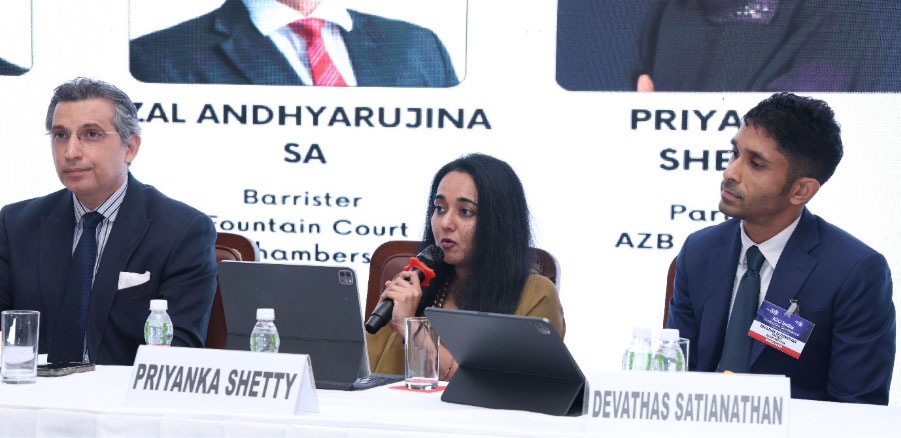
She maintained that any reform should have clear boundaries, predictable consequences and safeguards against abuse. Concluding her argument, she stated,
“More paperwork certainly does not mean more justice, and more codification is not necessarily more legitimacy.”
Audience discussion: Enforceability, tactical challenges and the limits of codification
The audience discussion raised concerns about whether a universal ethical code could address serious threats to the integrity of arbitral proceedings, as well as whether its introduction might increase procedural challenges.
One audience member posed a hypothetical involving threats of criminal complaints against members of an arbitral tribunal and an arbitral institution, resulting in tribunal members resigning. The question examined whether codified ethical standards could provide meaningful protection in circumstances where the legitimacy of the arbitral process itself was under pressure.

The discussion also referred to the decision in Halliburton Co. v Chubb Bermuda Insurance Ltd., [2020] UKSC 48 in the context of disclosure and conflicts of interest and questioned whether existing developments in English arbitration law provided sufficient guidance.

Another audience member questioned whether codification could encourage guerrilla tactics, including additional challenges and satellite litigation, thereby affecting the finality and efficiency of arbitration.
Naresh Thacker responded that codification should be understood as establishing an ethical baseline rather than prescribing an exhaustive set of requirements. Referring to the Arbitration and Conciliation Act, 1996, and its statutory provisions concerning arbitrator independence and impartiality, he argued that a baseline could provide greater certainty without attempting to codify every aspect of ethical conduct.
He also maintained that tactical challenges already arise in the absence of a common baseline and should not, by themselves, prevent the adoption of codified standards.
Jacqueline Chaplin supported this position, observing that the possibility of a poorly drafted code was an argument against inadequate drafting rather than against codification itself. She referred to Section 68 of the English Arbitration Act 1996, which provides a route to challenge an award on the ground of serious irregularity, and stated that most such applications fail.
Rebuttals: Codification as a baseline versus the risk of regulatory overreach
In his rebuttal, Naresh Thacker reiterated that codification did not require an attempt to prescribe every possible ethical obligation. Instead, it could establish minimum standards that practitioners and arbitrators would be expected to observe.
He argued that a common baseline would help prevent ethical obligations from being left entirely to individual discretion or voluntary compliance. He also maintained that codification could evolve over time, with jurisdictions retaining the ability to make their own choices in implementing the framework.
Responding on behalf of the opposition, Devathas Satianathan questioned whether the proposition was advocating a comprehensive universal code or merely a baseline. He argued that if the proposed framework was only a minimum standard, it would not necessarily fulfil the motion’s stated objective of ensuring the highest standards of professional conduct.
Priyanka Shetty reiterated that the existing system was sufficient and questioned whether a new code would prevent a recalcitrant party from obstructing proceedings through procedural challenges. She maintained that existing protections and institutional mechanisms already provide safeguards against such conduct.
Moderator’s closing observations and audience poll
In his closing observations, Zal Andhyarujina identified the fundamental distinction between the two sides as their approach to uniformity and flexibility. He compared Naresh Thacker’s position to a system of clearly defined rules governing conduct, while describing Devathas Satianathan’s approach as one requiring different standards to be calibrated to the circumstances of international arbitration.
He also returned to the use of AI, observing that the ethical questions arising from the technology concern the conduct of the human beings who use it, rather than the machine itself. He considered this an emerging area requiring further reflection by the arbitration community.
Zal Andhyarujina concluded that neither side could be regarded as having established an entirely conclusive answer. The choice ultimately depended on the normative framework that the international arbitration community wished to adopt for the future.
The audience poll conducted at the beginning of the debate recorded 58 votes in favour of the motion, 22 against and 15 undecided. In the final poll, the host announced 41 votes in favour, 55 against and very few undecided participants. The change reflected a shift in audience preference towards the opposition’s position by the conclusion of the debate.
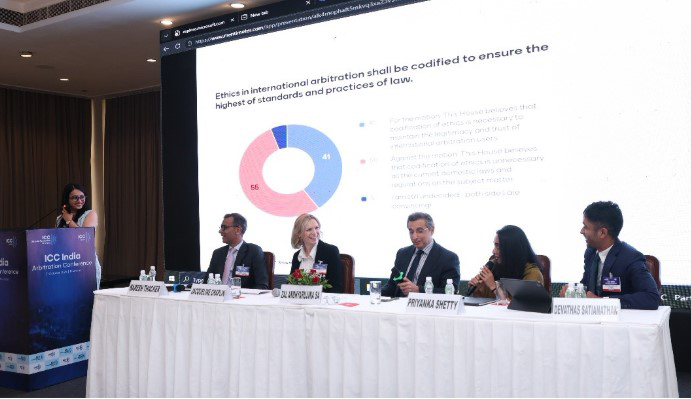
The debate brought into focus the competing considerations underlying the question of ethical codification in international arbitration. While the proposition emphasised enforceability, consistency and accountability, the opposition highlighted the importance of diversity, procedural flexibility and the risks of excessive regulation. The discussion left the audience to consider whether the future of ethical standards in international arbitration lies in a common enforceable framework or in strengthening the existing combination of domestic laws, institutional rules and professional guidelines.
Closing Remarks and Vote of Thanks
The conference concluded by returning to a common thread running through its discussions: the need for international arbitration to adapt to changing legal and commercial realities. In her closing remarks, Khushboo Deshmukh observed that the legal framework must keep pace with the realities of modern assets and cross-border enforcement. Reflecting on the day’s deliberations, including the concluding debate on ethics, credibility and legitimacy, she noted that international arbitration is constantly evolving and that its users must evolve with it.
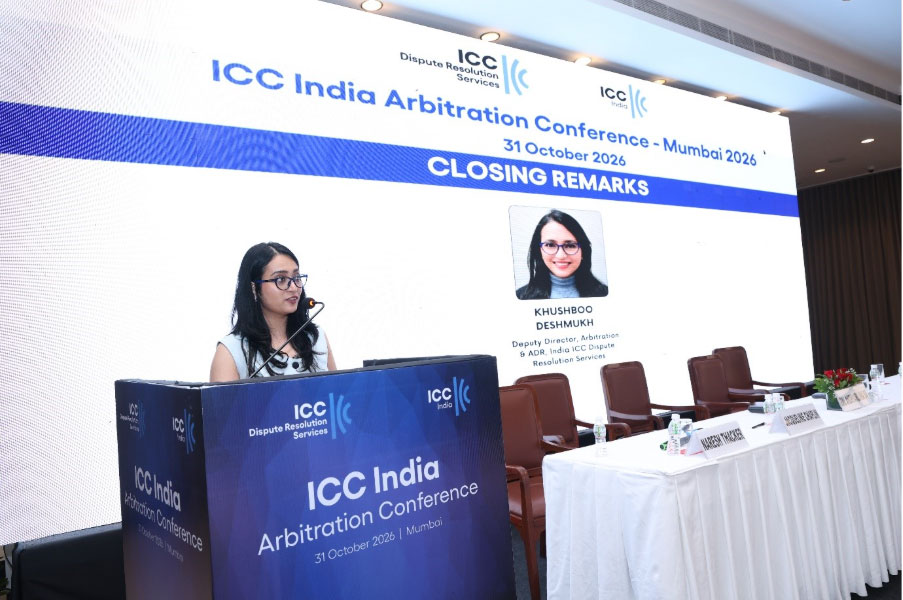
Deshmukh thanked the ICC leadership, moderators, speakers, panellists, sponsors, media partners, volunteers and attendees for their contributions to the conference. She also thanked SCC Times for its support as the conference’s Information and Documentation Partner, alongside the other organisations and teams whose efforts helped make the event possible.
Emphasising that the value of a conference lies in the discussions it generates, she expressed the hope that the conversations would continue beyond the event. She then invited attendees to the ICC India Arbitration Group cocktail reception, marking the conclusion of the formal proceedings of the ICC India Arbitration Conference 2026.
SCC Times is the official Information & Documentation Partner for the event.
Read more reports on the ICC India Arbitration Conference 2026.