


“Democracy survives only when citizens have a right to challenge injustice.”
— Justice Y.V. Chandrachud, Former Chief Justice of India
The election that shook a democracy
Elections are at the heart1 of any democracy. But winning an election is not simply about getting the most votes. An election is truly democratic when every candidate gets a fair chance to compete, and the same rules apply equally to everyone. This principle became a remarkable question in India in 1971, when the country went to the polls for its fifth Lok Sabha election, where Indira Gandhi (then Prime Minister) contested from Rae Bareli constituency against socialist leader Raj Narain. She campaigned heavily and aggressively for herself and her party, and as a result secured a massive victory.2 Raj Narain, who was known for his populist approach, lost the election.
For most politicians, that would have been the end of the story. But Raj Narain chose a completely different path, instead of accepting the outcome and waiting for the next election, he challenged Indira Gandhi’s victory by filing an election petition3 in Allahabad High Court under the Representation of the People Act, 1951.
An election petition is a legal proceeding filed before the High Court to challenge the result of an election to Parliament or a State Legislature on grounds of corrupt practices, electoral malpractice, or non-compliance with the law.4
The Representation of the People Act provides the legal framework for conducting elections in India and sets out the grounds on which an election can be challenged. Section 123 of the Act lists certain corrupt practices which, if proved, can lead to an election being declared void.5
Raj Narain, in his petition claimed that Indira Gandhi had indulged in corrupt practices under Section 123(7), Representation of the People Act and argued that she had used government machinery, including people from armed forces and local police, for her election campaign.6 At the centre of these allegations was Yashpal Kapur, a government servant who, according to Raj Narain, had assisted Indira Gandhi in her election campaign while he was still in government service.7
These were not the questions about whether Indira Gandhi was popular, or whether Raj Narain was a better candidate, rather the real question was whether the election had been conducted in accordance with the law or not.
The person whose election was being challenged was the Prime Minister of India, which raised a question that was difficult to ignore,
Whether a court can actually cancel the election of a sitting Prime Minister?
and if the answer was yes, what would happen to her government?
Raj Narain takes the Prime Minister to court
The case went on for several years. Evidence was examined. Government officials became witnesses and documents relating to election arrangements were presented before the court. And eventually, Indira Gandhi herself was drawn directly into the courtroom battle, turning the case into a significant legal and political threat to the position of the country’s most powerful leader.
Finally, the case that shook8 the Indian politics was approaching its moment of reckoning. On 12 June 1975, Justice Jagmohan Lal Sinha of the Allahabad High Court delivered his judgment. The judgment went against Indira Gandhi. The court dismissed five of the seven charges against her but upheld two9 and held that she was guilty of the electoral malpractice under Section 123(7), Representation of the People Act. It was found that she had obtained the assistance of government officials, including Yashpal Kapur, who had helped her in arranging facilities such as rostrums, loudspeakers, and police deployment, for her election campaign and secondly, she was also charged for exceeding the campaign expenditure limits. Justice Jagmohan Lal Sinha declared her election from Rae Bareli void and also disqualified her from contesting elections for six years under the election law10 then in force.
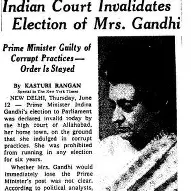
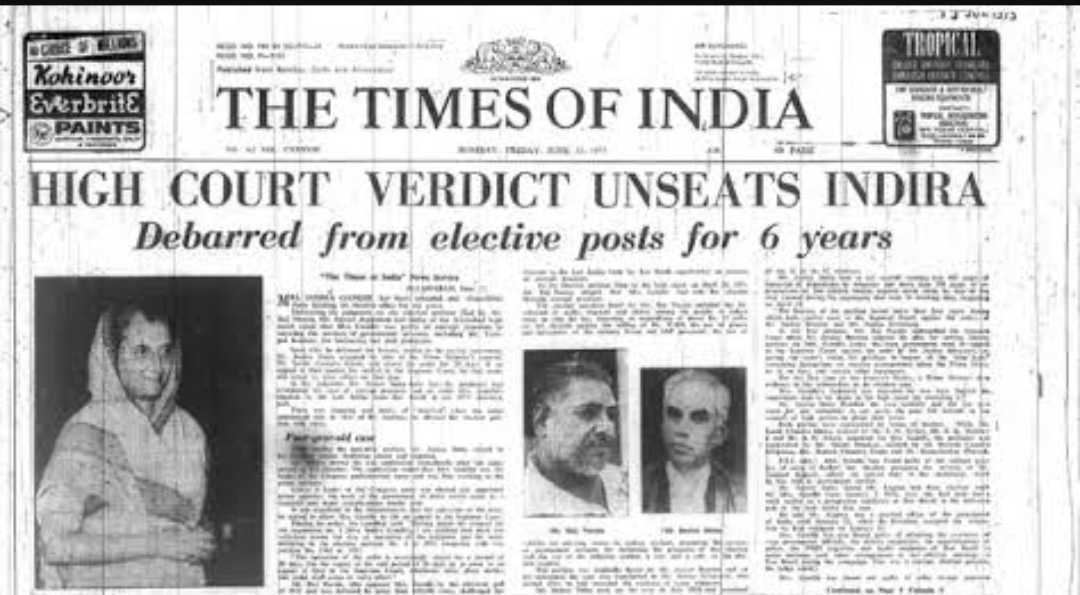
The consequence was unprecedented. For the first time in independent India’s history, a court had invalidated the election of a sitting Prime Minister.12 By 1975, what had begun as a challenge by a defeated candidate in Rae Bareli had suddenly become a constitutional crisis for the entire country. Now, the obvious question was, What happens when the person whose election has been declared invalid, is the Prime Minister of India?
From Rae Bareli to the Supreme Court
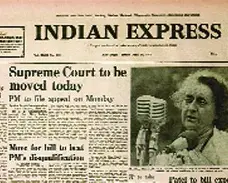
Source: Indian Express
The Allahabad High Court’s judgment had created a political upheaval across the country, but it was not the end of the story. The court granted a 20-day stay13 on its judgment, after Indira Gandhi’s lawyers argued that her removal could leave the country facing a situation of governmental instability.
Indira Gandhi, who had built her image as the Iron Lady of India, was suddenly on the verge of losing her position. On 24 June 1975, she approached the Supreme Court for relief. The case was heard by a Single Judge Vacation Bench of Justice V.R. Krishna Iyer, who granted her a conditional stay.14 He allowed her to continue performing the functions of Prime Minister but her rights as a Member of Parliament were restricted. She was allowed to attend Parliament, but could not vote in the House nor draw the salary and allowances of Member of Parliament. The appeal was still pending before the Supreme Court but the case had now reached a completely different level.15
The very next day, on 25 June 1975, Indira Gandhi advised President Fakhruddin Ali Ahmed to impose a national emergency under Article 352 of the Constitution, on the ground of internal disturbance. This period lasted for about 21 months during which the fundamental rights16 of citizens were restricted, the press was placed under strict censorship, and several opposition leaders were arrested.17
The election dispute had now moved far beyond Rae Bareli. What had started with one election petition had now become a much larger question of national importance. The Allahabad High Court’s judgment reflected that even the highest office in the country was not beyond the reach of the law.
The case also placed the Supreme Court at the heart of a major constitutional dispute. The issue was no longer simply whether election laws had been followed in Rae Bareli, but whether the election to the country’s highest political office could be subjected to the same legal scrutiny as that of any other candidate. This question brought into focus the concept of judicial review, a vital component of India’s democratic system. Through this power, the judiciary has the authority to review and strike down laws or actions that are unconstitutional and prevent the misuse of power.18
But before Supreme Court could deliver its final verdict, Parliament stepped in. The government made changes to the election laws, followed by a constitutional amendment that would directly affect the legal framework surrounding Indira Gandhi’s election.
Parliament enters the battle
Now, the case has completely entered a new phase. Indira Gandhi’s appeal was to be heard on 11 August 1975, however, a day prior, i.e. on 10 August 1975, Parliament passed the 39th Constitutional Amendment Act, 1975, which introduced Article 329-A into the Constitution and significantly altered the legal framework governing election disputes involving the President, Vice-President, Prime Minister and the Speaker of the Lok Sabha.19 The new provision created special rules for such disputes. The most controversial part was Article 329-A(4), which provided that any election dispute would not be governed by the ordinary framework of the Representation of the People Act and would instead be determined by an authority established by Parliament as well as the laws made under Article 329-A would not be deemed unconstitutional merely because they are contravening Articles 14, 19, or Article 21. It further provided that any appeal or cross-appeal20 pending relating to such elections would be dealt with in accordance with the new constitutional arrangement. This law was applied retrospectively21, which means it legally validated Indira Gandhi’s election irrespective of the High Court’s finding. In practical terms, this amendment intended to neutralise the ongoing case against Indira Gandhi by removing the Supreme Court jurisdiction.
The timing of the amendment made the situation even more significant. Indira Gandhi’s appeal was still pending before the Supreme Court when Parliament introduced the constitutional amendments surrounding her election. The dispute was therefore no longer simply about what had happened in Rae Bareli. It had become a question about the relationship between legislature and judiciary with respect to the constitutional amendment and protection of democratic principles.
This development highlighted the principle of Separation of Powers which is a cornerstone of democracy. The legislature enacts laws, the executive enforces them, and the judiciary interprets and adjudicates disputes arising under the law. Each institution performs its own role, without encroaching upon the powers of other organs of the government.22
But what happened when Parliament exceeded its constitutional powers to change the rules of a dispute that was already before the court? Besides, what is the meaning of democracy, i.e. for the people, by the people and of the people if there are no free and fair elections?
These issues raised a much larger question about the limit of constitutional powers, the independence of judiciary and the balance of power between organs of the government.
The answer would come in Indira Nehru Gandhi v. Raj Narain23.
The Supreme Court verdict
Raj Narain challenged the validityof the 39th Amendment Act.24 He argued that Parliament had gone beyond merely changing the law. By removing the dispute from judicial scrutiny and effectively determining the outcome of a pending case, Parliament had destroyed the democratic structure of the Constitution, undermining the principles of judicial independence and separation of powers. He also contented that this case, being a matter of judicial determination according to the provisions of Articles 329 and 136 of the Constitution, was excluded from judicial review.25
The case therefore raised several important constitutional questions before the Supreme Court. The court, now had to examine not only Indira Gandhi’s election dispute but also the validity of the 39th Constitutional Amendment Act including the extent of Parliament’s power to retrospectively validate an election which was declared void by a court. It also had to address the impact of excluding judicial review, judicial independence, and the separation of powers on democracy.
In the case of Indira Nehru Gandhi26 gave an opportunity to the Supreme Court27 to examine and apply the basic structure doctrine which is laid down in Kesavananda Bharati v. State of Kerala28.
The basic structure doctrine stands as one of the most significant judicial development in Indian constitutional law, which shaped the balance of power between the legislature and the judiciary. Under this principle, Parliament has the power to amend the Constitution but it cannot alter or change its “basic structure” or “essential features”.29
The five-member Constitution Bench of the court while hearing the case, observed that under the guise of exercising a legislative power, Parliament could not adjudicate on merits in an election dispute as the amendment affected the concept of free and fair elections and judicial review which forms the part of the basic structure doctrine. The power to amend the fundamental instrument cannot carry with it the power to destroy its essential features.30 Therefore, Parliament, while exercising its constituent power, could not validate an election declared void by High Court.
The Court further observed that democracy is an essential feature forming part of the basic structure, and exclusion of election disputes in this manner damaged the basic structure and stated that exclusion of judicial review by the amendment was an outright negation of the right to equality, and Parliament should not perform judicial and quasi-judicial functions as these powers are vested in the courts. The courts stated that just as courts ought not to enter into problems entwined with “political thicket”, Parliament must also respect the preserve of courts.31
The court while giving its decision on 7 November 1975 held that a healthy democracy can only flourish when there is a feasibility of free and fair electoral contest.32 Parliament cannot abrogate this fundamental principle of democracy to immunise elections from judicial scrutiny. The court described the 39th Constitutional Amendment Act, as an act of despotic power rather than a legitimate law that not only undermined the principle of judicial review but violated the doctrine of separation of power by deliberately transferring a pure judicial function into the hands of legislature. Therefore, in the light of these observations, the court struck down clause (4) of Article 329-A finding it unconstitutional and contrary to the basic structure of the Constitution.33
At the same time, while adjudicating the election dispute, the Supreme Court upheld the validity of Indira Gandhi’s election from the Rae Bareli Lok Sabha constituency in 1971, finding insufficient evidence substantiating the alleged electoral malpractices and the misuse of government machinery by her.34 Consequently, the court set aside the order of the Allahabad High Court barring Indira Gandhi from contesting elections for another six years and allowed her to continue her work as Prime minister.
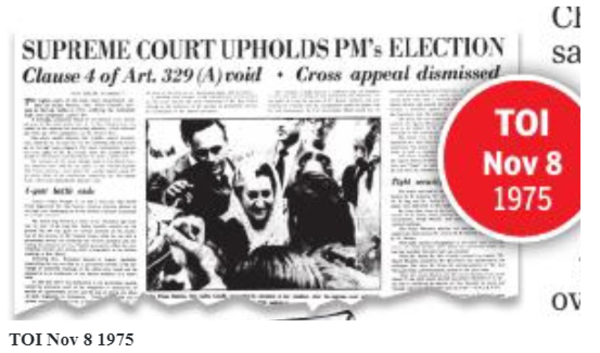
Source: Times of India
This was the first case in which the basic structure doctrine from Kesavananda Bharati (1973) was actually applied to strike down a constitutional amendment. It gave the doctrine a practical-teeth. This case became a constitutional milestone that preserved the principle of the separation of powers and judicial independence and reaffirmed that courts remain the ultimate guardians of the Constitution.35
The Prime Minister was not the only person on trial
What began in 1971 as an election challenge from Rae Bareli ultimately became one of the most consequential constitutional disputes in independent India. The Prime Minister was not the only person on trial instead the real trial was whether India’s constitutional framework could preserve democratic accountability when confronted with concentrated political power. By the time the Supreme Court delivered its judgment, the controversy had touched almost every major institution of the Indian State. A High Court had invalidated the election of a sitting Prime Minister, Parliament had intervened through constitutional amendments, and the Supreme Court had been called upon to decide questions that went far beyond the outcome of a single election.
The significance of the case therefore cannot be measured solely by the political fortunes of Indira Gandhi or Raj Narain. The dispute became a point of confrontation between electoral politics and constitutional governance, compelling institutions to define the limits of their respective powers. What started as an election petition gradually evolved into a constitutional conversation about authority, accountability, and the role of institutions in a democratic system.
The litigation may have formally ended with the Supreme Court’s verdict, but its impact extended well beyond the courtroom. The questions raised during the case continued to influence constitutional thought and shaped the way later generations understood the relationship between political power and constitutional limitations.
Why this 1975 battle still matters to Indian democracy
Democratic elections should operate within a legal framework. For elections to truly reflect the will and sovereignty of the people, they must be free and fair, giving citizens the power to choose their representatives and ensure that the government derives its authority from the people.36
More than five decades have passed since the Supreme Court delivered its judgment in the case Indira Nehru Gandhi37, yet the questions raised by the case remain remarkably relevant. Democracies are not sustained merely through elections and political majorities. They also depend upon institutions that ensure accountability, transparency, and respect for constitutional boundaries.38
The case showed that democratic legitimacy does not arise solely from winning elections. Public confidence in a democratic system depends equally on the fairness of the electoral process39 and the existence of institutions capable of enforcing the rules. When those rules are questioned, citizens must be able to rely on independent bodies to examine the dispute and ensure that power is exercised according to law. The case had a profound impact in demonstrating that Parliament could never arm-twist the judiciary and “No authority is above the Law and Our Constitution is supreme.”
Even today, this case reminds us of the continuing importance of constitutional institutions in preserving democratic governance. Political circumstances may change, governments may come and go, and electoral verdicts may shift from one generation to another. Yet, the need for institutional accountability remains constant. It is clear that the strength of a democracy lies not only in its elected representatives but also in the resilience of the Constitutional framework within which they function. Elections give governments the mandate to govern, but constitutional principles ensure that such authority is exercised within recognised limits. This balance protects both democratic participation and constitutional governance.40 The case may have originated in a courtroom, but its legacy extends far beyond it. It reinforces the principle that the true strength of a democracy lies not in the power of its leaders, but in the ability of its institutions to uphold the Constitution41 impartially and ensure that no public office stands above the law.
As we observe the International Day of Democracy on 15 September, the legacy of Indira Nehru Gandhi v. Raj Narain provides an opportunity to reflect on the principles that give democracy its true meaning beyond the mere exercise of voting. This day emphasises that democratic governance is grounded in the Rule of Law, respect for the separation of powers, the safeguarding of civil liberties, and robust institutions that promote adherence to constitutional values. In the face of evolving political and social challenges, Democracy Day reminds us that democracy should not merely be preserved as a form of government but must also be continuously strengthened through vigilance, active participation, and a collective effort to protect the values and principles enshrined in the Constitution.
*Editorial Assistant Trainee, EBC Publishing Pvt. Ltd.
1. Md. Naiyar Equbal, “Electoral Reforms in India: An Analysis”, (2019) 1(1) International Journal of Political Science and Governance 43-45, available at <Electoral reforms in India: An analysis>.
2. Jasleen Kaur Anand, “Indira Gandhi v. Raj Narain Case and How Far this Decision has Helped in Strengthening the Growth of Democratic Institutions?”, (2023) 6(5) International Journal of Law Management & Humanities, available at <Indira Gandhi v. Raj Narain Case and How Far this Decision has Helped in Strengthening the Growth of Democratic Institutions? — IJLMH>.
3. Jasleen Kaur Anand, “Indira Gandhi v. Raj Narain Case and How Far this Decision has Helped in Strengthening the Growth of Democratic Institutions?”, (2023) 6(5) International Journal of Law Management & Humanities 695—702, available at <Indira Gandhi v. Raj Narain Case and How Far this Decision has Helped in Strengthening the Growth of Democratic Institutions? — IJLMH>.
4. Advocate (Dr.) Abhishek Gandhi, “Election Petition in India: Legal Framework, Procedure, and Landmark Judgments” (30-8-2025), available at <Election Petition in India: Legal Framework, Procedure, and Landmark Judgments – Dr. Abhishek Gandhi>.
5. Shreya Saxena and Gunjan Maji, “Corrupt Practices: Analysis of Representation of People Act, 1951”, Journal for Law Students and Researchers (29-6-2020), available at <CORRUPT PRACTICES: ANALYSIS OF REPRESENTATION OF PEOPLE ACT, 1951 by Shreya Saxena & Gunjan Maji — JOURNAL FOR LAW STUDENTS AND RESEARCHERS>.
6. Indira Nehru Gandhi v. Raj Narain, 1975 Supp SCC 1.
7. Indira Nehru Gandhi v. Raj Narain, 1975 Supp SCC 1.
8. PTI, “Allahabad HC’s 1975 Verdict Disqualifying Then PM Indira Gandhi was Judgment of Great Courage: CJI Ramana”, The Times of India (11-9-2021), available at <India News – Times of India>.
9. Indira Nehru Gandhi v. Raj Narain, 1975 Supp SCC 1.
10. “The Court Verdict that Prompted Indira Gandhi to Declare Emergency”, Hindustan Times (26-6-2015), available at <India News>.
11. V. Krishna Ananth, “Constitutional Democracy Cannot Be Taken for Granted: Decoding the Allahabad High Court’s Judgment of 12 June 1975”, The Polis Project (12-6-2021), available at <Constitutional Democracy Cannot Be Taken For Granted: Decoding The Allahabad High Court’s Judgment Of 12 June 1975 – The Polis Project>.
12. Jasleen Kaur Anand, “Indira Gandhi v. Raj Narain Case and How Far this Decision has Helped in Strengthening the Growth of Democratic Institutions?”, (2023) 6(5) International Journal of Law Management & Humanities 695—702, available at <Indira Gandhi v. Raj Narain Case and How Far this Decision has Helped in Strengthening the Growth of Democratic Institutions? — IJLMH>.
13. “How Allahabad High Court’s Verdict Against Indira Gandhi 50 Years Ago Resulted in Emergency”, Firstpost (12-6-2025) available at <How Allahabad High Court’s verdict against Indira Gandhi 50 years ago resulted in Emergency>.
14. Aakanksha Rajesh, “50 Years Since The Emergency: Revisiting Indira Nehru Gandhi V. Raj Narain, The Case That Triggered It”, (2025) 3(5) International Journal of Legal Studies and Social Sciences, 384—392, available at <“50 Years Since The Emergency: Revisiting Indira Nehru Gandhi V. Raj Narain, The Case That Triggered It”>.
15. “How Allahabad High Court’s Verdict Against Indira Gandhi 50 Years Ago Resulted in Emergency”, Firstpost (12-6-2025), available at <How Allahabad High Court’s verdict against Indira Gandhi 50 years ago resulted in Emergency>.
16. “The Court Verdict that Prompted Indira Gandhi to Declare Emergency”, Hindustan Times (26-6-2015), available at <India News>.
17. “How Allahabad High Court’s Verdict Against Indira Gandhi 50 Years Ago Resulted in Emergency”, Firstpost (12-6-2025), available at <How Allahabad High Court’s verdict against Indira Gandhi 50 years ago resulted in Emergency>.
18. Prof. (Dr) Surendra Kumar Nirala and Dharm Chandra Pandey, “Analyzing the Concept of Judicial Review as Outlined in the Indian Constitution”, (2024) 11(2) International Journal of Research and Analytical Reviews, available at <IJRAR24B1113.pdf>.
19. Indira Nehru Gandhi v. Raj Narain, 1975 Supp SCC 1.
20. Udai Raj Rai, Constitutional Law: Governance Structure (Eastern Book Company, 2022) available at <Constitutional Law: Governance Structure>.
21. Indira Nehru Gandhi v. Raj Narain, 1975 Supp SCC 1.
22. Priyanshi Kaushik, “Doctrine of Separation of Powers and Its Modern Relevance”, (2026) 6(5) Indian Journal of Legal Review (IJLR) 167—168, available at <V6I520.pdf>.
23. Indira Nehru Gandhi v. Raj Narain, 1975 Supp SCC 1.
24. Indira Nehru Gandhi v. Raj Narain, 1975 Supp SCC 1.
25. Jasleen Kaur Anand, “Indira Gandhi v. Raj Narain Case and How Far this Decision has Helped in Strengthening the Growth of Democratic Institutions?”, (2023) 6(5) International Journal of Law Management & Humanities 695—702, available at <Indira Gandhi v. Raj Narain Case and How Far this Decision has Helped in Strengthening the Growth of Democratic Institutions? — IJLMH>.
26. Indira Nehru Gandhi v. Raj Narain, 1975 Supp SCC 1.
27. Aakanksha Rajesh, “50 Years Since the Emergency: Revisiting Indira Nehru Gandhi V. Raj Narain, The Case That Triggered It”, (2025) 3(5) International Journal of Legal Studies and Social Sciences 384—392, available at “50 Years Since The Emergency: Revisiting Indira Nehru Gandhi V. Raj Narain, The Case That Triggered It”>.
28. Kesavananda Bharati v. State of Kerala, (1973) 4 SCC 225.
29. Dr Santosh Kumar, “Basic Structure Doctrine: Evolution, Challenges, and Future Prospects”, (2026) 3(3) The Infinite, available at <Basic-Structure-Doctrine.pdf>.
30. Mahendra Pal Singh, V.N. Shukla’s Constitution of India (12th Edn., Eastern Book Company, 2013).
31. Mahendra Pal Singh, V.N. Shukla’s Constitution of India (12th Edn., Eastern Book Company, 2013).
32. Jasleen Kaur Anand, “Indira Gandhi v. Raj Narain Case and How Far this Decision has Helped in Strengthening the Growth of Democratic Institutions?”, (2023) 6(5) International Journal of Law Management & Humanities 695—702, available at <Indira Gandhi v. Raj Narain Case and How Far this Decision has Helped in Strengthening the Growth of Democratic Institutions? — IJLMH>.
33. Indira Nehru Gandhi v. Raj Narain, 1975 Supp SCC 1.
34. HT This Day: Nov 8, 1975 — “Mrs Gandhi’s Election Upheld, Unanimous Verdict of Supreme Court”, Hindustan Times, available at <HT This Day: Nov 8, 1975 — Mrs Gandhi’s election upheld, unanimous verdict of Supreme Court | India News>.
35. Aryan Garg, “The Election Case: A Dictum Affirming Executive’s Accountability”, (2023) 1(1) ILE Lex Speculum 370—373, available at <https://ls.iledu.in/wp-content/uploads/2023/08/V1I158.pdf>.
36. Swathi Krishna V.S. and G. Sowndarya Lakshmi, “Critical Analysis of Free and Fair Elections in India”, Vol. 11, Issue 11, November 2023, available at <IJCRT2311114.pdf>.
37. Indira Nehru Gandhi v. Raj Narain, 1975 Supp SCC 1.
38. Dr Rahul V. Karad, “Democracy Needs Leadership Institutions, Not Just Elections”, The Times of India (3-6-2026), available at <Democracy needs leadership institutions, not just elections>.
39. Md. Naiyar Equbal, “Electoral Reforms in India: An Analysis”, (2019) 1(1) International Journal of Political Science and Governance 43—45, available at <Electoral reforms in India: An analysis>.
40. Aryan Garg, “The Election Case: A Dictum Affirming Executive’s Accountability”, (2023) 1(1) ILE Lex Speculum 370—373, available at <https://ls.iledu.in/wp-content/uploads/2023/08/V1I158.pdf>.
41. Aakanksha Rajesh, “50 Years Since the Emergency: Revisiting Indira Nehru Gandhi V. Raj Narain, The Case That Triggered It”, (2025) 3(5) International Journal of Law, Social Sciences and Studies 384—392, available at <“50 Years Since The Emergency: Revisiting Indira Nehru Gandhi V. Raj Narain, The Case That Triggered It”>.





