


A strong point of the textbook is its practical orientation. The authors generously illustrate theoretical provisions with concrete examples from international practice, analysis of real cyber incidents, and their legal consequences.
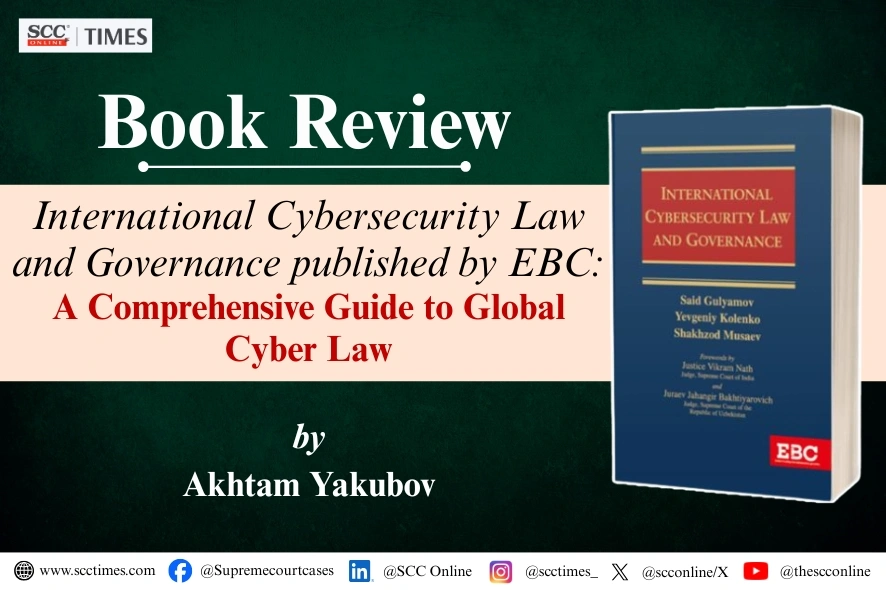
In the modern world, where digital technologies permeate all spheres of society, cybersecurity issues are of paramount importance. The textbook “International Cybersecurity Law and Governance” authored by DSc, Prof. (Dr) Said Gulyamov, Dr Yevgeniy Kolenko and Shakhzod Musaev, is a timely and much-needed work aimed at systematising and analysing the legal aspects of this complex and dynamically developing field.
The structure and content of the textbook demonstrate the authors’ deep understanding of the complex nature of cybersecurity. The material is logically organised, starting with fundamental concepts of international law and their application in cyberspace, and gradually moving to more specific topics such as legal regulation of cyber wars, combating cybercrime, and protection of critical infrastructure.
The authors’ interdisciplinary approach deserves special attention. The textbook is not limited to purely legal aspects but also touches on technological, political, and economic factors influencing the formation and implementation of international law in the field of cybersecurity. Such a comprehensive view allows readers to form a holistic understanding of the subject.
A strong point of the textbook is its practical orientation. The authors generously illustrate theoretical provisions with concrete examples from international practice, analysis of real cyber incidents, and their legal consequences. This not only facilitates the assimilation of the material but also demonstrates the practical significance of the concepts being studied.
The international coverage of the textbook is also praiseworthy. The authors do not limit themselves to analysing approaches of individual countries or regions but provide a truly global perspective, considering various national and regional approaches to cybersecurity regulation. This is especially valuable in the context of the cross-border nature of cyber threats.
The textbook is also distinguished by its relevance and future orientation. The authors not only analyse the current state of international cybersecurity law but also discuss emerging issues such as legal aspects of using artificial intelligence in cybersecurity, problems of regulating the Internet of Things, and quantum computing in the context of cybersecurity.
Despite the overall high quality of the textbook, there are several aspects that could be improved or expanded in future editions:
1. More detailed consideration of the role of non-state actors in shaping international cybersecurity law. Although the textbook touches on this topic, a deeper analysis of the influence of large technology companies, international organisations, and civil society on the development of legal norms in this area would be useful.
2. Expanded analysis of legal aspects of cyberattack attribution. Given the complexity and political sensitivity of this issue, a more detailed discussion of the legal problems associated with establishing the source of cyberattacks would be a valuable addition.
3. A deeper examination of the relationship between international cybersecurity law and other branches of international law, such as international economic law or human rights law.
4. Additional practical cases and exercises at the end of each chapter that would help students better assimilate the material and develop skills in applying theoretical knowledge to real situations.
5. The inclusion of a section devoted to research methodology in the field of international cybersecurity law. This would be especially useful for graduate students and young researchers in this field.
6. More detailed analysis of regional approaches to cybersecurity, including comparative analysis of cybersecurity policies and legislation in different regions of the world.
7. Expanded discussion of ethical aspects of cybersecurity and their relationship with legal regulation.
8. More detailed consideration of legal aspects of cybersecurity in the context of new technologies such as 5G, cloud computing, and distributed ledger technologies.
9. The inclusion of a section devoted to legal aspects of cybersecurity in outer space, given the growing dependence on space systems and the corresponding risks of cyberattacks.
10. A deeper analysis of the problems of harmonising national legislation in the field of cybersecurity and the prospects for creating universal international legal norms in this area.
Despite these suggestions for improvement, it should be emphasised that the textbook “International Cybersecurity Law and Governance” in its current form is already a valuable contribution to the literature on this topic. It fills an important gap in educational resources, providing students, researchers, and practitioners with a comprehensive and up-to-date overview of the legal aspects of cybersecurity.
The textbook is particularly valuable for law students specialising in international law or information law. It provides them with a solid foundation for understanding complex legal issues arising at the intersection of technology and international law. In addition, the textbook will be useful for practicing lawyers working in the field of cybersecurity, providing them with an up-to-date overview of the international legal aspects of their activities.
For researchers in the fields of international law, political science, and cybersecurity, this textbook can serve as a starting point for further research, providing a comprehensive overview of the current state of international cybersecurity law and pointing to areas requiring further study.
The textbook may also be useful for politicians and civil servants working in the field of national security and international relations, helping them better understand the legal framework in which international cooperation on cybersecurity issues is carried out.
In conclusion, I strongly recommend the textbook “International Cybersecurity Law and Governance”, for publication. This work has the potential to become a standard reference in its field, making a significant contribution to the development of education and research in the field of international cybersecurity law. The publication of this textbook will contribute to raising the level of knowledge and competencies of specialists in this critically important area, which will ultimately help in creating a safer and more stable cyberspace.
A copy of the book can be purchased from here.
*Doctor of Law, Professor, Tashkent State University of Law.