The twenty-first century international order is undergoing a profound transformation marked by geopolitical realignments, economic uncertainty, technological disruption, climate insecurity, and the emergence of new centres of power. The gradual shift from a unipolar to a multipolar world has fundamentally altered the dynamics of diplomacy, strategic engagement, and international governance. In this evolving global landscape, India has emerged as a significant geopolitical actor whose foreign policy choices increasingly shape regional stability, economic cooperation, and global governance frameworks.
India’s diplomatic evolution today extends beyond traditional statecraft. Contemporary foreign policy is no longer confined to external relations alone; it directly influences domestic governance, economic development, technological innovation, national security, energy sustainability, digital regulation, migration, and social transformation. The growing interconnection between external strategy and internal policy has created a new vocabulary of diplomacy—an “India’s Nexum”—where foreign policy operates as an instrument of both global influence and domestic advancement and depicts the connect globally.
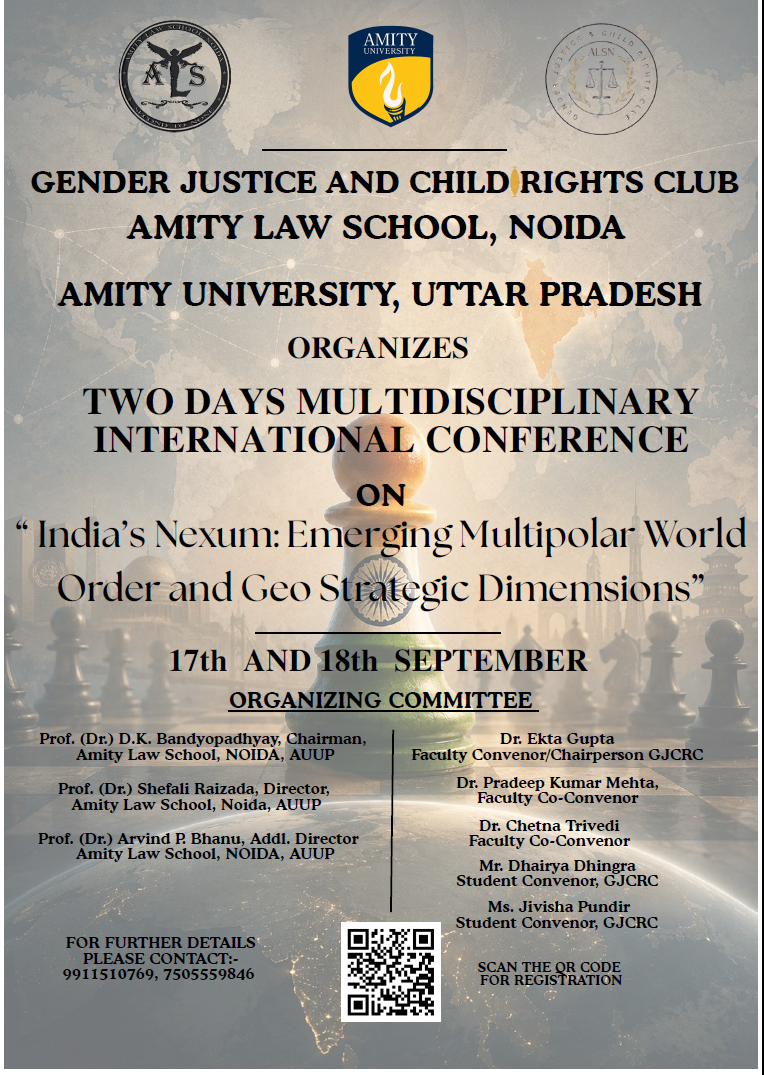
Against this backdrop, the Two Days Multidisciplinary International Conference on “India’s Nexum : Emerging Multipolar World Order and Geo strategic Dimensions” seeks to critically examine India’s evolving diplomatic posture and its implications in a rapidly transforming world order. This multidisciplinary conference aims to provide an interdisciplinary platform for scholars, academicians, researchers, policymakers, diplomats, practitioners, and students to engage in meaningful dialogue on the changing and emerging dimensions of India’s foreign policy.
The conference intends to explore how India’s external engagements increasingly intersect with domestic priorities such as economic growth, digital governance, national security, environmental sustainability, trade, technology regulation, and social development.
It also seeks to analyse India’s transition from a regional power to a global stakeholder and emerging as a norm-shaper in contemporary international relations by fostering research-driven discussion across disciplines including international relations, law, political science, economics, security studies, technology governance, and public policy, the conference aspires to generate innovative academic perspectives and policy-oriented solutions concerning India’s role in the changing global order.
Objectives of the Conference
The two days multidisciplinary conference aims to create a dynamic platform for academic exchange and policy-oriented dialogue on India’s foreign policy and its domestic implications. The key objectives include:
- To critically analyse India’s foreign policy in the context of an evolving multipolar world order.
- To examine the relationship between foreign policy decisions and their domestic political, economic, legal, technological, and social impact.
- To encourage interdisciplinary research on diplomacy, strategic affairs, global governance, trade, cyber security, climate diplomacy, and international law.
- To analyse India’s role in regional and global institutions including the United Nations, G20, BRICS, SCO, QUAD, BIMSTEC, and WTO.
- To explore the impact of emerging technologies, artificial intelligence, cyber warfare, and digital sovereignty on foreign policy formulation.
- To provide a platform for scholars, students, researchers, and practitioners to present research and exchange ideas on contemporary international developments.
- To generate policy-relevant recommendations concerning India’s strategic interests, governance priorities, and global engagements.
-
To strengthen academic collaboration and promote informed discourse on international relations and foreign policy studies.
Rationale and Contemporary Relevance
The contemporary international system is characterised by geopolitical competition, strategic realignments, regional conflicts, technological rivalry, economic fragmentation, and increasing uncertainty within global institutions. Issues such as the Russia—Ukraine conflict, Indo-Pacific tensions, climate emergencies, supply-chain disruptions, cyber threats, artificial intelligence governance, and energy insecurity have significantly reshaped international relations.
India’s foreign policy today reflects a complex balancing exercise between strategic autonomy and strategic partnerships. India simultaneously engages with competing global powers while safeguarding national interests and expanding its diplomatic influence. The rise of India as a major economic and strategic actor has also increased expectations regarding its role in global governance, peace-building, development diplomacy, climate negotiations, and digital cooperation.
At the domestic level, foreign policy decisions increasingly influence economic reforms, energy policy, technology regulation, defence preparedness, data governance, employment generation, trade opportunities, and internal security. India’s Digital Public Infrastructure, international trade partnerships, semiconductor collaborations, defence agreements, and climate commitments demonstrate how global diplomacy directly shapes domestic development trajectories.
In this context, understanding the intersection between external diplomacy and internal transformation becomes essential for evaluating India’s evolving role in the changing world order ie. why we are proposing this conference to discuss and deliberate on all the emergent and relevant issues.
Identifying Challenges
India’s foreign policy currently operates within an increasingly volatile and competitive international environment. Some of the major contemporary challenges include:
- Balancing strategic autonomy while deepening partnerships with major global powers such as the United States, Russia, the European Union, and emerging regional blocs.
- Managing regional security concerns arising from border disputes, terrorism, maritime tensions, and geopolitical competition in the Indo-Pacific region.
- Addressing challenges posed by cyber warfare, artificial intelligence, misinformation campaigns, hybrid warfare, and data security.
- Responding to climate change, resource insecurity, migration crises, and global health emergencies through effective international cooperation.
- Navigating economic uncertainty, supply-chain disruptions, trade protectionism, and global financial instability.
- Ensuring that foreign policy initiatives contribute positively to domestic growth, employment generation, technological advancement, and social welfare.
- Balancing national sovereignty with international commitments under multilateral treaties, trade agreements, and global governance mechanisms.
-
Reviewing the social structure of the society in the changing facet of socio , economic, political, behavioral and even cultural atmosphere.
Legal and Constitutional Framework of India’s Foreign Policy
India’s foreign policy framework derives legitimacy from constitutional principles, statutory mechanisms, and international legal commitments. Article 51 of the Constitution of India directs the State to promote international peace and security, maintain just and honourable relations among nations, respect international law and treaty obligations, and encourage settlement of disputes through peaceful means.
Articles 73 and 253 empower the Union Government to conduct foreign affairs and implement international treaties through domestic legislation. While treaty-making remains predominantly an executive function, legislative approval becomes necessary when implementation requires changes in domestic law.
India’s foreign policy is also shaped by its obligations under the United Nations Charter, international trade agreements, environmental conventions, human rights frameworks, maritime law obligations, and regional cooperation arrangements. These legal commitments reflect India’s attempt to balance sovereignty, strategic interests, constitutional values, and global responsibilities.
Further, evolving domains such as cyber law, artificial intelligence governance, digital sovereignty, cross-border data regulation, and international investment law have expanded the legal dimensions of foreign policy in unprecedented ways.
Proposed Reforms and Policy Recommendations
The multidisciplinary conference seeks to encourage discussion on reforms necessary for strengthening India’s foreign policy framework and its domestic implementation mechanisms. Suggested areas of reform include:
- Strengthening parliamentary oversight and institutional accountability in treaty-making and foreign policy decision-making.
- Establishing a comprehensive legal framework governing treaty ratification and implementation to ensure transparency and democratic participation.
- Enhancing coordination between the Ministry of External Affairs and domestic institutions for effective execution of international commitments.
- Developing stronger cyber security laws and technology governance frameworks addressing artificial intelligence, digital sovereignty, and data protection.
- Creating robust legal and institutional mechanisms for addressing terrorism, transnational crime, hybrid warfare, and cross-border security threats.
- Expanding India’s development diplomacy and strategic outreach within the Global South through sustainable partnerships and capacity-building initiatives.
- Promoting research and institutional collaboration in strategic studies, maritime security, climate diplomacy, and international economic law.
-
Reconstructing and reforming where were needed the socio-economic fabric to strengthening the social structure
Two Day Multidisciplinary Conference
Title as Follows
“India’s Nexum : Emerging Multipolar World Order and Geo strategic Dimensions”
The two day multidisciplinary conference theme seeks to analyse the evolving language of Indian diplomacy in an era shaped by geopolitical transitions, technological transformation, and emerging global challenges. It emphasises on the interconnection between India’s foreign policy objectives and their domestic political, economic, legal, and social implications.
The conference aims to facilitate critical discussions on India’s strategic rise, diplomatic engagements, global governance participation, technological influence, and developmental diplomacy while examining how these external engagements shape domestic institutions, governance, and national priorities.
Key Themes and Sub-Themes
1. India as a Global Rule-Shaper: Strategic Autonomy, Norms and New Diplomacy
Sub-Themes:
- Strategic autonomy and multi-alignment in India’s foreign policy
- India’s role in global governance and institutional reform (UNSC, WTO, IMF)
- India’s participation in G20, BRICS, SCO, QUAD and multilateral diplomacy
- India’s approach towards major power rivalry and geopolitical balancing
- Peace diplomacy, conflict mediation, and crisis management
-
Foreign policy and its domestic political implications
2. Indo-Pacific Security : Maritime Strategy, QUAD and the Blue Economy
Sub-Themes:
- India’s Indo-Pacific vision and maritime diplomacy
- QUAD cooperation and regional security partnerships
- China’s maritime expansion and strategic implications for India
- Freedom of navigation and South China Sea disputes
- Role of ASEAN, BIMSTEC and IORA in India’s regional outreach
-
Blue economy, energy security, and domestic economic impact
3. Digital Geopolitics and Technology : In the Era of AI, Cyber Deterrence and Data Sovereignty
Sub-Themes:
- AI diplomacy and governance of emerging technologies
- Cyber security, cyber warfare, and strategic deterrence
- India’s Digital Public Infrastructure (UPI, Aadhaar, ONDC) as a global model
- Technology alliances and strategic partnerships
- Misinformation, digital propaganda, and hybrid warfare
-
Data sovereignty, privacy regulation, and domestic legal implications
4. Global South 2.0 and Development Diplomacy: India’s Strategic Outreach to Africa and Latin America
Sub-Themes:
- India’s leadership role within the Global South
- South-South cooperation and development partnerships
- India-Africa relations in trade, infrastructure, education, and defence
- India-Latin America engagement and energy diplomacy
- Development diplomacy and sustainable growth
-
Domestic economic and developmental impact of global partnerships
5. Climate Diplomacy, Sustainable Development and Global Commons
Sub-Themes:
- India’s climate diplomacy and international environmental negotiations
- Renewable energy partnerships and sustainable development
- Water security, food security, and environmental governance
- Climate justice and responsibilities of developing nations
-
Domestic environmental policies shaped by international commitments
6. Trade, Economics and Strategic Connectivity
Sub-Themes:
- International trade agreements and economic diplomacy
- Supply chains, semiconductor diplomacy, and economic resilience
- India-Middle East-Europe Economic Corridor (IMEC) and connectivity initiatives
- Energy diplomacy and resource security
-
Impact of global economic shifts on India’s domestic economy and labour markets.
7. Foreign Policy and Domestic Governance: Law, Institutions and Public Policy
Sub-Themes:
- Impact of international commitments on domestic legislation
- Constitutional dimensions of foreign policy
- Parliamentary oversight and treaty implementation
- International law and domestic legal reforms
- Federalism and sub-national diplomacy
-
Role of think tanks and policy institutions in foreign policy formulation
8. Economic Statecraft and India’s Global Aspirations
Sub-Themes:
- Trade diplomacy and Free Trade Agreements
- Investment diplomacy and economic growth
- Supply chain resilience and strategic industries
- Semiconductor and critical minerals diplomacy
- India’s manufacturing ambitions and foreign policy
-
Economic security in a fragmented global economy
9. Diaspora Diplomacy, Soft Power and Cultural Influence
Sub-Themes:
- Indian diaspora as a strategic asset
- Cultural diplomacy and India’s civilizational heritage
- Yoga, Ayurveda and soft power projection
- Public diplomacy and nation branding
- Education diplomacy and international academic cooperation
-
Media, cinema and digital diplomacy
10. National Security, Border Management and Emerging Threats
Sub-Themes:
- Cross-border terrorism and counter-terrorism cooperation
- Border security and regional stability
- Hybrid warfare and information warfare
- Space security and strategic technologies
- Defence diplomacy and military partnerships
-
Internal security implications of geopolitical conflicts
Expected Outcomes
- The multidisciplinary conference is expected to create a meaningful academic platform for critical engagement with India’s evolving foreign policy priorities and their domestic implications.
- It seeks to encourage innovative and interdisciplinary research on diplomacy, governance, law, technology, economics, security, and international cooperation.
- The conference aims to generate policy-oriented recommendations addressing contemporary geopolitical and domestic challenges faced by India in the changing world order.
- It is further expected to strengthen academic collaboration between institutions, researchers, policymakers, and strategic thinkers while promoting informed discourse on international relations and global governance.
-
Overall, the conference aspires to contribute meaningfully to contemporary scholarship by examining how India’s foreign policy increasingly shapes both global engagements and domestic transformation.
Analytical Dimensions
As the international system witnesses unprecedented geopolitical shifts, technological transitions, and emerging global uncertainties, India’s foreign policy continues to evolve as a dynamic instrument of strategic engagement and national transformation. India today is not merely responding to changes in the world order; it is actively contributing to the shaping of new diplomatic narratives, governance structures, and developmental frameworks.
The two day multidisciplinary conference, “India’s Nexum : Emerging Multipolar World Order and Geo Strategic Dimensions” seeks to critically examine these transformations through rigorous academic dialogue and interdisciplinary engagement. By bringing together scholars, researchers, policymakers, diplomats, and students, the conference aspires to foster innovative perspectives on India’s expanding global role and the domestic consequences of its foreign policy choices.
Through meaningful discussion, collaborative research, and policy-oriented deliberation, this multidisciplinary conference aims to contribute to a deeper understanding of India’s strategic future in an increasingly interconnected and complex world order.
Organizing Committee
Prof. (Dr.) D.K. Bandyoupdhyay , Chairman , Amity Law School, NOIDA , Chief Advisor , Founder President Office of Amity Education Group , Former Vice Chancellor , Guru Gobind Singh Indraprastha University – Conference Advisor
Prof. (Dr.) Shefali Raizada , Director & Head of The Institution , Amity Law School NOIDA, AUUP – Conference Director and Local Executive Authority from Institution ie . Amity Law School, NOIDA , AUUP
Dr. Ekta Gupta , Associate Professor and Chairperson , Gender Justice and Child Club , Amity Law School, NOIDA, AUUP – Conference Organiser & Nodal Officer for communication
To know more click here