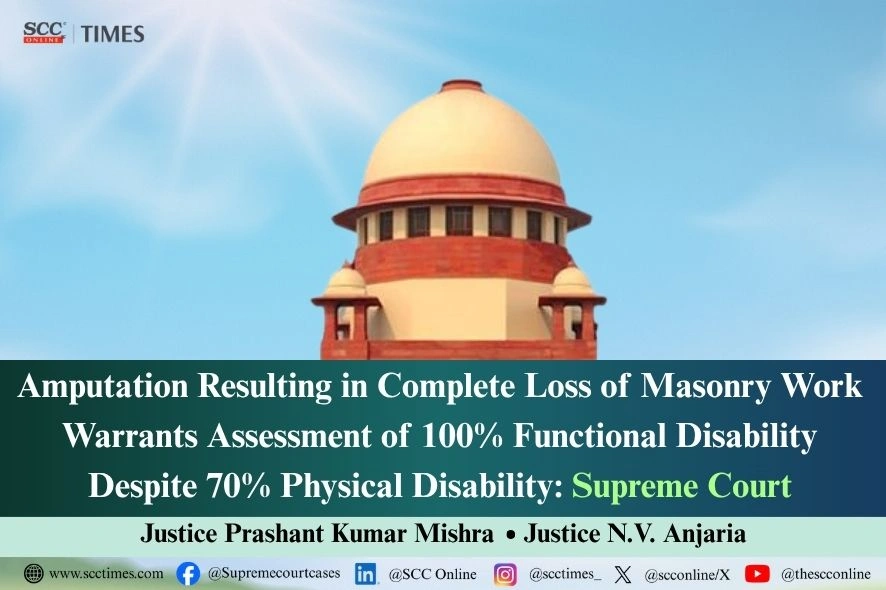
Supreme Court: In an appeal arising from Madras High Court’s judgment dated 29 November 2023, which had partly allowed the claimant’s appeal and enhanced the compensation awarded by the Motor Accident Claims Tribunal (Tribunal) from ₹10,84,330 to ₹23,86,320 with interest at 7.5 per cent per annum, the Division Bench of Prashant Kumar Mishra* and N.V. Anjaria, JJ., enhanced the compensation to ₹40,29,730, holding that for determining compensation in motor accident claims involving permanent disability, the decisive factor is not the percentage of physical disability but the extent to which the disability impairs the claimant’s earning capacity. Thus, the Court held that considering the nature of claimant’s occupation, i.e., mason, such an injury would completely deprive him of the ability to pursue his vocation, therefore, the functional disability must be assessed at 100 per cent even though the certified physical disability is 70 per cent.
Also Read: Supreme Court Recognises Homemakers’ Unpaid Work; Creates “Loss of Domestic Care” Compensation Head
Factual Matrix
On 18 April 2017, the appellant was riding his bicycle along the left side of the Namakkal—Salem National Highway when a lorry coming from behind struck him in a rash and negligent manner. The collision caused severe injuries to his head, jaw, eye, and right leg. The injuries were so grave that his right leg had to be amputated above the knee. Following the accident, an FIR was registered against the driver of the offending vehicle. The findings of negligence recorded by the Tribunal and affirmed by the High Court were not disputed before the Supreme Court, and therefore the issue of liability stood concluded against the owner and insurer of the lorry.
Procedural History
The appellant instituted proceedings under Section 166, Motor Vehicles Act, 1988 (MV Act), seeking compensation of ₹25,00,000.
The Tribunal held that the accident was the result of rash and negligent driving of the offending lorry. It assessed the claimant’s monthly income at ₹6,000 and awarded compensation amounting to ₹10,84,330 together with interest at 7.5 per cent per annum from the date of filing of the claim petition until realisation. Compensation was granted under heads such as loss of earning capacity, pain and suffering, and medical expenses. However, the Tribunal neither awarded future prospects nor considered certain heads such as attendant charges, loss of amenities, or future medical expenses.
The claimant challenged the adequacy of compensation before the Madras High Court, based on low assessment of income, denial of future prospects, and insufficient compensation under several conventional heads considering the nature of injuries suffered. The High Court partly allowed the appeal and enhanced the monthly income to ₹12,000, added 40 per cent towards future prospects, and awarded additional amounts under the heads of attendant charges, loss of amenities, and future medical expenses for an artificial limb. Consequently, compensation was increased to ₹23,86,320 with interest at 7.5 per cent per annum.
Issues for Determination
-
Whether the High Court had correctly calculated claimant’s prospects?
-
Whether the claimant’s disability should be treated merely as a 70 per cent physical disability or as a case of complete functional disability affecting earning capacity?
-
Whether compensation under the head of future medical expenses required enhancement?
Analysis
At the outset, the Court noticed certain computational errors in the High Court’s award. Although the High Court enhanced the claimant’s monthly income to ₹12,000, it calculated future prospects based on the Tribunal’s figure of ₹8,56,800 instead of the recalculated loss of earning capacity of ₹17,13,600. The Court held that once the income was revised, future prospects ought to have been computed on the enhanced figure, resulting in a substantially higher amount. The Court also found that the amounts awarded by the Tribunal towards nutrition, clothing and ornaments, and medical expenses had been omitted from the High Court’s final computation despite not having been disturbed.
Further, the Court declined to interfere with the High Court’s assessment of monthly income at ₹12,000, asserting that no cogent documentary evidence substantiating the higher income claimed by the appellant was produced.
On the question of disability, the Court noted that both the Tribunal and the High Court assessed loss of earning capacity at 70 per cent based on physical disability but failed to examine the aspect of functional disability which was the actual impact of the injury on the claimant’s ability to earn a livelihood.
The Court relied on Raj Kumar v. Ajay Kumar, (2011) 1 SCC 343, wherein this Court had elaborately explained the distinction between physical disability and functional disability and had held that compensation for future loss of earnings must be determined not by mechanically applying the percentage of physical disability but by examining the actual impact of the disability on the earning capacity of the injured person. It was emphasised that “the effect of the permanent disability on the earning capacity of the injured is the relevant consideration”.
Applying these principles, the Court observed that masonry is a physically demanding occupation requiring continuous use and support of both legs. The appellant had suffered amputation of his right leg above the knee and had thereby “effectively lost his capacity to continue the work of a mason”. The Court noted that it was not the case of the respondents that the appellant was engaged in any alternative sedentary occupation or that his earning capacity remained unaffected. Consequently, the Court held that restricting the loss of earning capacity to 70 per cent merely based on physical disability would not be justified. Accordingly, the Court assessed the appellant’s functional disability at 100 per cent.
The Court further observed that an individual who has undergone an above-knee amputation would require periodic replacement and maintenance of an artificial limb throughout his lifetime, along with continued medical assistance and rehabilitation. Considering these circumstances, compensation under the head of future medical expenses was enhanced from ₹1,00,000 to ₹2,00,000.
Final Computation of Compensation
After treating the appellant’s functional disability as 100 per cent, retaining the monthly income at ₹12,000, applying the multiplier of 17, and adding 40 per cent towards prospects, the Court recalculated the compensation payable for loss of earning capacity as 24,48,000. Thus, the total amount to ₹40,29,730. The amounts awarded under other heads were largely maintained, except for enhancement of future medical expenses.
Decision
The Court partly allowed the appeal, modified the impugned judgment and enhanced the compensation to ₹40,29,730 with interest at the same rate fixed by the High Court, i.e., 7.5 per cent per annum. It directed the Insurance Company to deposit the enhanced amount before the Tribunal within 6 weeks, whereupon the appellant would be entitled to withdraw the same in accordance with law.
Also Read: Motor Vehicle Aggregators Guidelines 2025: Discover what’s noteworthy!
[M. Paramesh v. VRL Logistics Ltd., 2026 SCC OnLine SC 1188, decided on 23-6-2026]
*Judgment Authored by: Justice Prashant Kumar Mishra
Advocates who appeared in this case:
Ms. R. Shase, AOR and Ms. R Kanishca, Mr. Senthil Kumar and Mr. Kamalesh C, Advs., Counsel for the Appellant
Mr. Sudhir Naagar, AOR with Mr. Abhishek Kumar Gola, Mr. Arun Kumar Nagar, Mr. Anshul Mehral, Mr. Sidharth Khatana, Mr. Kunal Chaudhary, Ms. Mahin Khan and Ms. Seerat Nissar Bhat, Advs., Counsel for the Respondents