
Disclaimer: This has been reported after the availability of the order of the Court and not on media reports so as to give an accurate report to our readers.
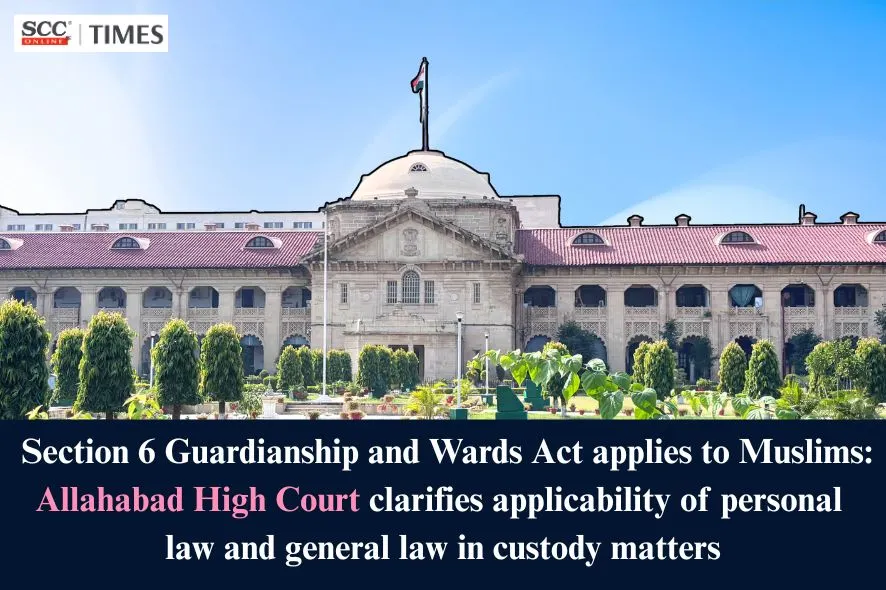
Allahabad High Court: In a writ of habeas corpus filed by a mother seeking production of her children from her husband, the Single Judge Bench of Anil Kumar-X, J., dismissed the petition, holding that it would be appropriate for her to avail the remedy before the Family Court concerned, which is duly empowered to examine all aspects relating to guardianship and custody and to pass appropriate orders in accordance with law. The Court also held that Section 6, Guardians and Wards Act (GWA), 1890, or rather the entire Act, does apply to Muslims as it does not contain any provision excluding such applicability.
Background
The parties were married in 2013 according to Muslim rites and rituals and had two children. The mother was driven out of the matrimonial home allegedly due to unfulfilled demands of dowry, and the children were taken away from her. Aggrieved, she filed the present habeas corpus writ petition seeking production of her minor children.
Analysis and Decision
At the outset, the Court referred to Section 4 GWA and stated that a guardian is a person having legal authority and responsibility for the care and protection of a minor, which may extend to the custody and upbringing of the minor, management of his property, or both. The term “guardian” is of wide import and inclusive in nature, encompassing within its ambit the concept of “custody” and not excluding it.
Regarding the argument that Section 6 GWA excludes Muslims, the Court clarified that Section 6 does not exclude Muslims from invoking provisions of the GWA. The GWA is a general law regarding guardianship and applies to all persons, irrespective of religion, subject to their personal law. The scheme of the GWA makes it clear that it is a supplementary and procedural law, which enables the Court to appoint or declare a guardian in appropriate cases.
“Section 6 of the Act does not bar any class of persons from approaching the Court; rather, it operates in the context of recognising certain categories of guardians. The Act nowhere provides that persons professing Muslim law are precluded from seeking relief under it.”
The Court reiterated that in matters of custody and guardianship, even where parties are governed by personal law, the jurisdiction of the Court under the Guardians and Wards Act remains intact. Personal law may guide the Court in determining the rights of parties; however, the paramount consideration is always the welfare of the minor, which overrides all other considerations. Thus, the Court held that merely because the parties are governed by Muslim personal law, it cannot be said that they are barred from invoking the provisions of the GWA for seeking custody of a minor.
The Court further substantiated this by referring to the Explanation to Section 7(g), Family Courts Act, 1984, which confers jurisdiction upon the Family Court for suits and proceedings relating to the guardianship of the person or the custody of, or access to, any minor. Thus, even in cases where custody of a minor is sought, including between parties governed by personal laws such as Muslim law, the Family Court is duly empowered to entertain and decide such matters. The Court added that this jurisdiction is wide and encompasses issues of guardianship as well as custody, to be adjudicated primarily on the touchstone of the welfare of the minor. The remedy under the GWA and the Family Courts Act is available, and the Court is competent to adjudicate such disputes, keeping in view both personal law principles and the welfare of the child.
Accordingly, the Court held that the custody of a minor child cannot be determined mechanically without arriving at a definite conclusion regarding the welfare of the child, which is the paramount consideration. Such an evaluation requires an appreciation of evidence, interaction with the parties, and a comprehensive inquiry into all relevant circumstances affecting the child’s welfare. However, such an exercise is not feasible in proceedings under a writ of habeas corpus, which are summary in nature and not intended for detailed adjudication of disputed questions relating to custody.
Therefore, the Court dismissed the petition, holding that it would be appropriate for the mother to avail the remedy before the Family Court concerned.
[Rizwana v. State of UP, 2026 SCC OnLine All 1318, decided on 25-3-2026]
Advocates who appeared in this case :
For the petitioners: Dharmraj Chaudhary, Pradeep Kumar Singh
For the respondents: AGA, Ravindra Prakash Srivastava, Amrit Raj