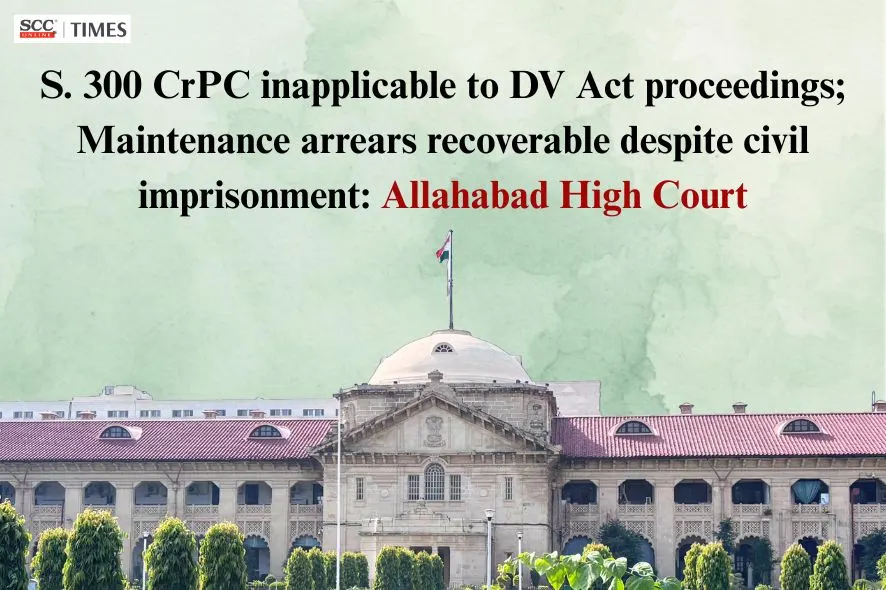
Allahabad High Court: In an application under Section 482, Criminal Procedure Code, 1973 (CrPC) challenging the order dated 23 January 2023 passed by the Civil Judge (Crime Against Women), whereby the execution application for recovery of maintenance arrears was partly rejected by invoking Section 300 CrPC, the Single Judge Bench of Praveen Kumar Giri, J., held that the maintenance order had already attained finality and could not be reopened at the stage of execution. It was further held that proceedings under the Protection of Women from Domestic Violence Act, 2005 (DV Act) are civil in nature and do not culminate in conviction or acquittal; consequently, the bar under Section 300 CrPC was held to be inapplicable. The Court observed that imprisonment for non-payment of maintenance is only a mode of enforcement and does not absolve the defaulter of his subsisting liability.
Accordingly, the Court quashed the impugned order dated 23 January 2023 and directed the trial court to recover the entire arrears of maintenance along with simple interest at the rate of 6%.
Background
The applicant married the respondent on 23 May 1990 in accordance with Muslim customary rites, and out of the wedlock, a male child was born in 1992, who is stated to be disabled. Owing to disputes relating to non-fulfilment of dowry demands, the applicant was allegedly ousted from her matrimonial home along with her minor son in July, 1995, following which she initiated proceedings under Section 498-A IPC against her husband and his family members. In 2011, the parties arrived at a compromise and resumed cohabitation. However, in May, 2017, the applicant was again allegedly driven out by the husband and since then has been residing in a rented accommodation with her disabled son without any financial support.
It was alleged that despite the respondent earning ₹50,000 per month, he failed to maintain the applicant and their son, leading the applicant to initiate proceedings under the DV Act. The trial court, vide order dated 19 July 2019, awarded interim maintenance of ₹4,000 per month each to the applicant and her son, which was affirmed by the Sessions Court by order dated 1 April 2022 and upheld by the High Court by order dated 2 November2022.
Upon non-compliance, the applicant-initiated execution proceedings for recovery of arrears. A recovery warrant was issued, pursuant to which the husband was arrested and later sent to civil imprisonment for 30 days. However, the dues remained unpaid. Subsequently, the applicant filed an application seeking further recovery. The trial court, vide order dated 23 January 2023, partly rejected the claim by limiting recovery to ₹32,000 and disallowing recovery of earlier arrears on the ground that the husband had already undergone detention.
Aggrieved, the applicant approached the High Court, which set aside the trial court’s order. However, the Supreme Court, by order dated 20 September 2024, set aside the High Court’s decision on the ground of lack of hearing and remanded the matter for fresh consideration on merits. Pursuant to such order the application was restored and placed before this Court for hearing and disposal.
Analysis, Law, and Decision
The Court observed that the validity of the original maintenance order dated 19 July 2019 could not be reopened, as the issue had already attained finality in earlier proceedings under Section 482 CrPC., which were dismissed and not further challenged in Supreme Court. Accordingly, the maintenance order remained binding on the parties.
The primary issue before the Court was whether proceedings for enforcement of maintenance under the DV Act could be barred by invoking Section 300 CrPC. The Court categorically held that Section 300 CrPC was inapplicable, as proceedings under the DV Act do not result in either conviction or acquittal, but only award maintenance to aggrieved party.
The Court observed that invoking a plea under Section 300 CrPC. appeared to be contrary to law and indicative of non-application of judicial mind. Further, relying on Tarun Kumar Mittal v. State of U.P., 2021 SCC OnLine All 649, the Court reiterated that the provisions of Section 31 of the DV Act can be invoked to enforce orders passed under Section 12 of the Act, including maintenance orders.
Relying on precedents including Rajnesh v. Neha (2021) 2 SCC 324, the Court reiterated that maintenance can be recovered as a money decree and that proceedings under the DV Act permit enforcement, including under Section 31.
Accordingly, the Court quashed the impugned order dated 23 January 2023, and directed the trial court to recover the arrears along with simple interest at 6%, and in case of non-payment, to proceed with attachment of property of the respondent. It was fi=urther ordered that the proceeds were to be kept in the account of the Principal Judge, Family Court, Moradabad, or the District Judge, Moradabad, or any other concerned court of the Civil Judge/Magistrate of District Moradabad, and would to be applied toward the payment of the arrears with simple bank interest at 6% on delayed payment.
The Court directed the respondent to continue payment of monthly maintenance, and the entire exercise to be completed within 60 days, with a caution that failure by the Presiding Officer to act in a timely manner may invite disciplinary action.
Thus, the application was allowed.
[Hasina Khatoon v. State of U.P., 2026 SCC OnLine All 1153, decided on 24-3-2026]
Advocates who appeared in this case:
Applicant: Akshaya Kumar, Jaideep Pandey, Advocates
Opposite Party: G.A., Mahtab Alam, Advocates
Buy Code of Criminal Procedure, 1973 HERE