
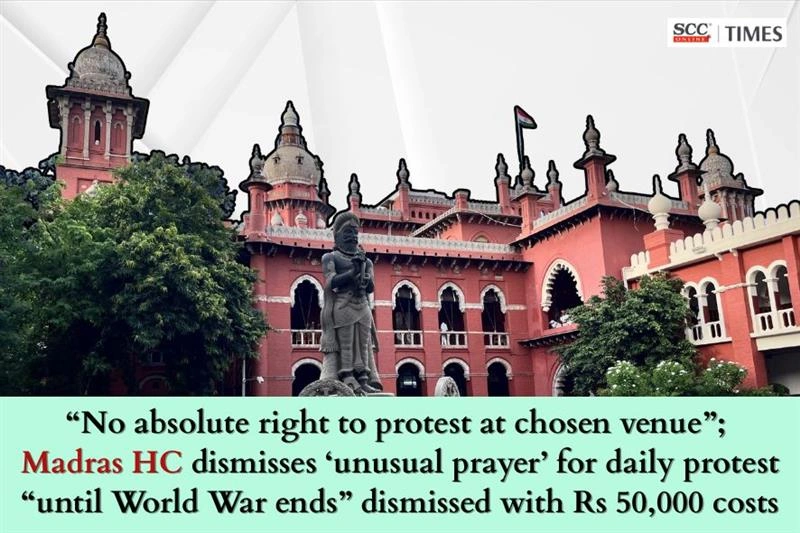
Madras High Court: In a writ petition under Article 226 seeking permission to conduct a daily protest “Ahimsa Path” until the end of the “World War” at the place chosen by him, a Single Judge Bench of L. Victoria Gowri held that although freedom of speech and peaceful assembly are cherished constitutional rights, they are not absolute. The Court noted that the petitioner’s request was open-ended and imposed an impossible burden on the authorities. The Court further observed that alternate venues had been offered, but the petitioner rejected them on untenable grounds, making disparaging remarks about respected public figures. Emphasising that writ jurisdiction cannot be invoked to enforce personal obstinacy under the guise of constitutional liberty, the Court dismissed the petition and directed the petitioner to pay costs of Rs 50,000 to a government school.
Background
The petitioner sought permission to conduct a daily “Ahimsa Path” from 10.00 a.m. to 12.00 noon until the end of the “World War”. He claimed this was a peaceful protest intended to spread a message of non-violence and world peace, asserting it as part of his fundamental rights under Articles 19(1)(a) and (b) of the Constitution.
The grievance arose when the police rejected his request, citing public inconvenience and traffic congestion at the chosen busy junction. The petitioner contended that the rejection was mechanical, unconstitutional, and amounted to an unreasonable curtailment of his rights. He insisted that the protest must be held only at the location identified by him, arguing that the venue carried symbolic relevance.
The respondents submitted that the rejection was not arbitrary. They argued that the chosen location was unsuitable for a recurring daily protest and that alternate venues had been suggested where the programme could be conducted without obstruction. Thus, the order was not a denial of rights but a regulation in the interest of public order and convenience.
Analysis and Decision
The Court emphasised that the right to freedom of speech and expression and the right to assemble peaceably and without arms are undoubtedly cherished constitutional freedoms. However, the Court highlighted that such rights are not absolute in character, since the constitutional scheme itself recognises that these freedoms are subject to reasonable restrictions in the interests of sovereignty, integrity, public order, and orderly civic administration. The Court remarked that the right to protest cannot, therefore, be elevated into a right to occupy any place, at any time, for any duration, solely at the will of the person asserting it.
The Court observed that the petitioner sought permission not for a one-time event or a limited-duration representation, but for a daily recurring protest extending indefinitely “until the World War ends”. It was noted that the expression employed in the prayer itself reveals the open-ended and indeterminate nature of the request, and such a request, by its very nature, places an impossible administrative burden on the authorities and disregards the need for regulation of public spaces.
The Court emphasised that the rejection was founded upon the practical consideration that the particular junction chosen by the petitioner is a busy location and that any daily protest at such a place would hinder the general public. The Court highlighted that such reasoning is neither arbitrary nor extraneous, and such regulation of assemblies in busy public junctions falls squarely within the domain of lawful administrative control exercised in the interest of public convenience and safety. The Court noted that alternative venues being offered demonstrated that the respondents were willing to balance the petitioner’s desire to protest with the larger demands of public order. The petitioner, however, sought not the regulation of his right, but an insistence upon his absolute choice of place, and such insistence is contrary to the settled constitutional principles.
The Court further observed that the difficulty arose only because the petitioner categorically refused to hold the protest at either of the suggested alternate places, as his refusal was not on grounds of physical inconvenience or logistical impossibility, but on the assertion that both Dr B.R. Ambedkar and Pasumpon Muthuramalinga Thevar had become icons of casteism and that he therefore did not wish to conduct his protest in the vicinity of their statues.
The Court emphasised that the remarks made in the course of a judicial proceeding are wholly unwarranted, as Dr B.R. Ambedkar occupies an exalted place in the constitutional history of this nation as the principal architect of the Constitution of India and as a towering voice for social justice, equality, and human dignity. Likewise, Pasumpon Muthuramalinga Thevar is remembered in the public sphere as a significant historical and political figure, and therefore a litigant cannot be permitted to justify his refusal of reasonable alternatives by making disparaging generalisations about personalities of such public importance.
The Court emphasised that it is one thing to seek judicial review against an arbitrary State action, and it is another to invite the Court to compel the administration to permit an indefinite daily protest at a busy public junction, despite the existence of reasonable alternatives. The Court noted that the writ jurisdiction of the Court cannot be converted into a mechanism to enforce personal obstinacy under the guise of constitutional liberty. Further, constitutional rights are meant to enlarge democratic participation, but they cannot be asserted in a manner that disregards public order, administrative reasonableness, and civic coexistence. The Court also opined that the right to protest is protected, however, the right to insist upon a particular public junction for an indefinite recurring protest is not.
The Court held that the impugned proceedings of the respondents do not suffer from any infirmity warranting interference, as the respondents acted fairly by declining permission at the busy junction while offering alternate venues. The petitioner, having refused such alternatives on wholly untenable grounds, is not entitled to any relief in this writ petition.
Finally, the Court dismissed the writ petition by imposing costs of Rs 50,000 to be paid to a local school and ordered simple imprisonment for one day in case of default.
[S. Prabhu v. Collector, W.P. Crl. (MD) No.1596 of 2026, decided on 24-3-2026]
Advocates who appeared in this case:
For the Petitioner: S.Prabhu
For the Respondents: M. Sakthi Kumar, M. Muthumanikkam, Government Advocate
Buy Constitution of India HERE