
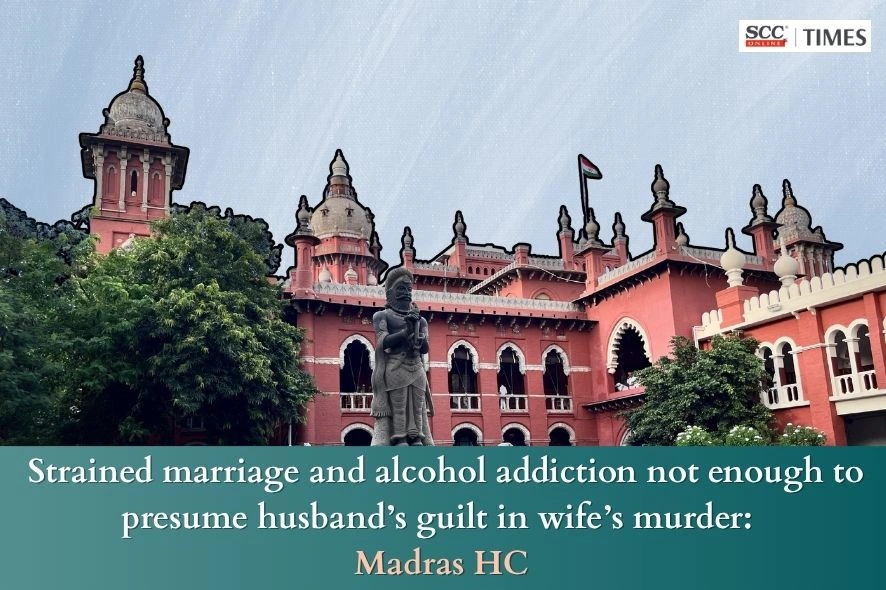
Madras High Court: In a criminal appeal under Section 302 of the Penal Code, 1860 (IPC), wherein a man was accused of murdering his wife, the Division Bench of N. Anand Venkatesh* and P. Dhanabal, JJ., held that the prosecution had failed to prove its case beyond reasonable doubt. The Court noted that the nonexamination of the deceased’s son, who was a crucial witness, and the absence of evidence to establish the “last seen theory” created serious gaps in the prosecution’s case. The Court further observed that strained marital relations and the accused’s addiction to alcohol could not, by themselves, justify a presumption of guilt. Emphasising that even strong suspicion cannot substitute proof, the Court concluded that the chain of circumstances was incomplete and accordingly acquitted the accused of the conviction under Section 302 IPC.
Background
The case arose from strained marital relations between the accused and the deceased. The accused, who had suffered a femur fracture and was unable to continue working, became addicted to alcohol and frequently quarrelled with his wife. On 20 November 2017, he allegedly strangulated her with a towel and assaulted her with a kitchen cutting tool, leading to her death due to cardio-respiratory arrest.
The brother of the deceased, lodged a complaint, resulting in registration of FIR under Section 302 IPC. The investigation included seizure of material objects, recovery of material objects based on confession, and postmortem examination which confirmed death due to mechanical asphyxia. Subsequently, the trial court convicted the accused under Section 302 IPC and sentenced him to life imprisonment.
On appeal, it was argued that there was no direct evidence linking the accused to the crime, and the trial court had relied on surmises. It was contended that the prosecution failed to examine a crucial witness, the son of the deceased, who was said to have informed brother of the deceased about the incident. However, the prosecution maintained that the chain of circumstances established guilt.
Analysis and Decision
The Court noted that the prosecution had not chosen to examine the son of the deceased and the accused, who was said to have witnessed the incident or at least seen the accused at the place of occurrence. The Court observed that it was clear from the evidence that he was the one who had informed others after the incident, and if he had been called and examined as a witness, the entire truth would have come out and probably it would have made the task of the prosecution easier in proving the case against the accused.
The Court emphasised that the Investigation Officer (IO) had not cared to record the statement of the boy during the investigation, nor included him in the list of witnesses, nor taken steps to examine him before the Court, thereby making it a very serious lapse on the part of the IO.
The Court highlighted that the prosecution had not chosen to establish the “last seen theory” by examining witnesses who could speak about the presence of the accused in the same house where the deceased was found dead. It was further noted that there was no witness who spoke about the fact that the accused was inside the house before or at the time of the occurrence, and in the absence of examining the son, there was no material to link the accused to the incident.
The Court emphasised that just because the accused and the deceased had a strained relationship and the accused was a drunkard, that could not lead to a presumption that it was only the accused who could have committed the offence. The Court observed that in a case of circumstantial evidence, it was the prosecution that had to prove each circumstance forming a chain so as to completely exclude every hypothesis other than the guilt of the accused.
The Court noted that even a strong suspicion was not enough to convict a person and that the prosecution had to necessarily prove each circumstance in the chain beyond reasonable doubt. Moreover, a strong suspicion could not be a substitute for proving the case beyond reasonable doubt by the prosecution. The Court further emphasised that when two views were possible, the accused was entitled to the benefit of doubt on the one favourable to him.
Accordingly, the Court quashed and set aside the conviction under Section 302 IPC and acquitted the appellant by allowing the criminal appeal, holding that the prosecution had failed to prove the case beyond reasonable doubt.
[M. Senthilmurugan v. State of T.N., Crl. A(MD)No.638 of 2023, decided on 10-3-2026]
*Judgment authored by: Justice N. Anand Venkatesh
Advocates who appeared in this case:
For the Appellant: G. Karuppasamypandiyan
For the Respondent: A. Thiruvadi Kumar, Additional Public Prosecutor
Buy Penal Code, 1860 HERE