
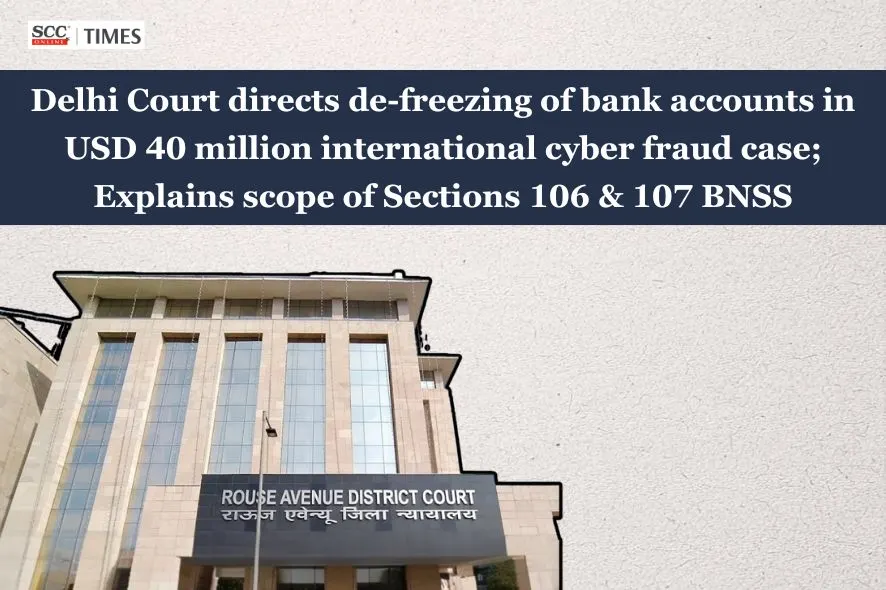
Rouse Avenue District Court, Delhi: In an application filed under Section 503 read with Section 106, Nagarik Suraksha Sanhita, 2023 (BNSS) against the freezing of his bank accounts, the Single Judge Bench of Neetu Nagar, J., allowed the application, holding that the order debit-freezing the bank accounts of the accused was in clear violation of the mandatory requirement of law as per Sections 106 and 107 BNSS.
Background
The present case was registered against the co-accused under Section 61, read with Sections 318, 336, 338, 339, and 340, Nyaya Sanhita, 2023 (BNS), and Section 66-D, Information Technology Act, 2000.
Allegedly, the accused persons were operating a network of transnational cyber-enabled financial crime by running illegal call centres in New Delhi, Punjab, and other parts of India since 2023. They were targeting US citizens online under fake identities of federal officers and committing tech fraud/identity theft/impersonation fraud. They falsely informed the victims that their bank accounts had been compromised due to identity theft, and their retirement and investment accounts were at risk. Thus, they had to carry out verification of their bank accounts; they would risk losing all of their funds, thereby inducing the victims to liquidate their accounts and transfer their financial assets. The fraud amount was approximately USD 40 million.
It was further alleged that the present accused was arrested, and incriminating documents were recovered from his residence relating to a large number of immovable properties worth crores of rupees acquired by him and other accused persons out of the proceeds of crime obtained from the US victims.
During the search, documents relating to various bank accounts in his name and his wife’s name were recovered. The said accounts of the applicant/accused were found to contain deposits worth around Rs 10 crores, and the investigating agency had reasons to believe that the same were obtained out of the proceeds of crime and accordingly, the said bank accounts were frozen. The applicant was also allegedly found to be one of the main recipients of the proceeds of crime, and he did not have sufficient means to support the assets found in his possession.
The accused was granted bail on 9 October 2025, and thereafter, he received emails from Yes Bank and ICICI Bank that his bank accounts had been frozen pursuant to the directions of the Central Investigation Bureau (CBI) under Section 106 BNSS.
Analysis
At the outset, the Court noted that the investigation was still pending in the present case.
Delving into Section 106 BNSS, the Court referred to the power to issue a prohibitory order in respect of bank account of the accused under Section 102, Criminal Procedure Code (CrPC), which was first discussed in State of Maharashtra v. Tapas D. Neogy, (1999) 7 SCC 685, wherein the Supreme Court held that the bank accounts of an accused or any of his relations is “property” within the meaning of Section 102 CrPC and a police officer in course of investigation, can seize or prohibit the operation of the said account if such assets have direct links with the commission of the offence. Thus, the Court reiterated that though Section 102 CrPC never explicitly mentioned freezing bank accounts, the term “seizure of property” has been interpreted broadly to include the bank account of the accused and his relatives.
The Court further noted that the CrPC did not contain any definition of “proceeds of crime”. However, it has been defined under Section 111(c) BNSS to mean any property derived or obtained directly or indirectly, by any person as a result of criminal activity (including crime involving currency transfers) or the value of any such property. Under Section 107 BNSS, a police officer investigating a crime has to approach a jurisdictional Magistrate to seek attachment of any property believed to be derived directly or indirectly from a criminal activity or commission of an offence.
In this regard, the Court referred to Headstar Global (P) Ltd. v. State of Kerala, 2025 SCC OnLine Ker 3546, wherein the Kerala High Court held that after the enactment of BNSS, the proceeds of crime can be attached or the account frozen only as per the procedure prescribed in Section 107 BNSS. This decision was later upheld by the Supreme Court. The Court further referred to Kartik Yogeshwar Chatur v. Union of India, 2025 SCC OnLine Bom 4778, wherein the Bombay High Court held that a debit freezing account is not permissible under Section 106 BNSS.
Noting the aforesaid, the Court held that the seizure of the accused’s bank accounts by CBI on the ground of them being ‘proceeds of transfer’ could not have been done under section 106 BNSS. Thus, the seizure completely violated the mandate of Section 107 BNSS.
On the merits of the application, the Court noted that the intimation regarding the search at the accused’s house was submitted before the Court on 8th September 2025, and intimation regarding seizure of the bank accounts of the co-accused persons was submitted the next day. Letters were sent to the banks concerned for the accused and his wife’s accounts on 9th September. However, information regarding the freezing of bank accounts was provided to the Court and the accused via a bail reply submitted against the accused’s application on 19th September. This meant that no formal intimation was sent by the investigating officer (IO) concerned, as he had done for other co-accused persons.
Thus, the Court stated that there was a delay of 10 days in sending intimation to the Court. Neither were the reasons for the delay forthcoming, nor was any explanation tendered by the IO. Thus, it was clear from the record that the IO had not intimated the Court about the freezing of the accounts from the date of sending such a request to the banks till the date of filing of the reply to the accused’s bail application. The Court remarked that had the bail application not been moved on behalf of the accused, then no intimation would have been received by the Court regarding seizure of the bank accounts. This is complete negligence on behalf of the IO with regard to providing intimation, which is mandated under section 106 BNSS. Thus, the compliance of Section 102 CrPC was also not done in the case of the other co-accused.
“Clearly, the CBI has the power to freeze the bank accounts, but the same has to be done as per law.”
The Court stated that simply calling the bank entries “proceeds of crime” was not sufficient. Such a blanket freezing order cannot be passed even under Section 106 BNSS (Section 102 CrPC) when the defrauded amount has not been quantified to date. Furthermore, the investigation was still pending, and the IO had not been able to link the bank entries with the offence. It was simply stated that the accused could not justify the huge amount of entries in his bank accounts compared to his known source of income, but the same could not be treated as proceeds of crime in the absence of any connecting evidence to the offence in question.
“Once the investigating officer chooses to blanket freeze the accounts of the accused, he must offer some justification for the same. The prerequisite for exercising powers under Section 106 BNSS is the existence of a direct or close link between the tainted property and the alleged offence.”
The Court further added that the apprehension that the allegedly tainted money would be withdrawn by the accused could be dealt with by balancing the right of the accused to carry on his trade or business vis-à-vis the right of the victims to be compensated by putting appropriate conditions.
Decision
Accordingly, the Court held that the order of the IO to freeze the bank accounts of the accused was in clear violation of the mandatory requirement of law as per Sections 106 and 107 BNSS.
Therefore, the Court directed the said accounts to be de-freezed, subject to the condition that before de-freezing the accused shall furnish personal bond for the total amount lying deposited in the bank accounts at the time of freezing by giving an undertaking therein to produce the said amount in the Court or anywhere else, wherever directed by the Court during trial or on conclusion of trial and same shall be complied by him.
Accordingly, the application was allowed, and the Court also clarified that this order shall not exclude the investigating agency from taking recourse to such remedies as may be available to them in accordance with law or under section 107 BNSS, if warranted.
[CBI v. Joney, CBI No. 116 of 2025, decided on 16-03-2026]
Advocates who appeared in this case:
For the petitioner: Public Prosecutor Priya Gaur
For the respondent: Arjun Syal and Naman Verma
Buy Code of Criminal Procedure, 1973 HERE