
Disclaimer: This has been reported after the availability of the order of the Court and not on media reports so as to give an accurate report to our readers.
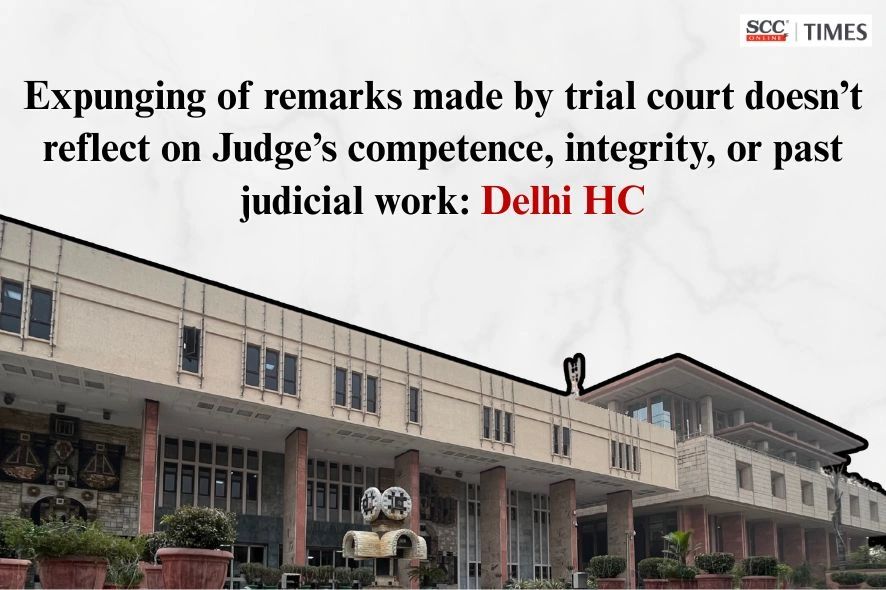
Delhi High Court: In an application seeking recall of the judgment dated 1 March 2023 passed by the High Court and for expunging certain observations allegedly made against the recall applicant, who at the relevant time was serving as Special Judge (NDPS)/Additional Sessions Judge, North-East District, Karkardooma Courts, Delhi, a Single Judge Bench of Dr. Justice Swarana Kanta Sharma,* J., held that merely expunging the observations made against a police officer by a judicial officer, cannot be treated as a reflection on the competence and integrity of the judicial officer in question or on the work done by him, as a judge. The Court clarified that the observations in the earlier judgment should not be treated as adverse remarks against the judicial officer for any service-related purpose.
Factual Matrix
In the instant matter, the, the High Court by order dated 1 March 2023 had examined certain judicial orders passed by the recall applicant, who was then functioning as Additional Sessions Judge. In those orders, the trial court had made observations against the petitioner, a police officer, in relation to delay in investigation and filing of Forensic Science Laboratory (FSL) reports in a criminal case where the accused had been in custody since 2019.
While deciding the writ petition, the High Court had held that the delay in furnishing FSL reports was attributable to the FSL and not to the police officer, who had issued priority letters and followed up with the FSL. Consequently, the Court had expunged the remarks made by the trial court against the police officials and recorded reasons for doing so.
The recall applicant contended that while expunging the remarks against the police officer, the High Court had also made adverse observations against him, which affected his reputation and service record. He further asserted that the judgment had been passed without issuing notice to him, without calling for the trial court record, and without affording him an opportunity of hearing, thereby violating the principles of natural justice.
It was also submitted that the judgment had later been circulated with his name mentioned in the covering letter, which caused embarrassment and allegedly resulted in adverse consequences, including downgrade of his Annual Confidential Report and transfer.
Court’s Analysis
The Court observed that while passing the earlier judgment, it had confined itself to examining the legality of the orders passed by the trial court and had not made any personal observations against the judicial officer. The judgment had referred only to the “learned Trial Court” and had not mentioned the name of the recall applicant anywhere.
The Court further noted that the earlier judgment had specifically noted that there was no mala fide on the part of the trial court and that the strict approach adopted by the trial court stemmed from concern over delay in framing of charges while the accused was in custody. The remarks against police officials were found unwarranted only because the delay was attributable to the FSL.
The Court emphasised on the settled principle that in the hierarchical judicial system, orders of lower courts are subject to scrutiny by higher courts, and when such orders are set aside or modified, reasons must necessarily be recorded. Recording reasons while setting aside an order cannot by itself be treated as reflection on the competence or integrity of the judge who passed the order, unless specific adverse remarks are made.
The Court held that “hierarchical scrutiny of judicial orders is an essential feature of the Indian judicial system, wherein orders are examined at successive levels, but essentially in accordance with law” and the same cannot be construed as criticism of the judicial officer. Even strong criticism of an order, when necessary, is permissible so long as it relates to the legality of the order and not to the personal conduct of the judge. The Court relied upon observations of the Supreme Court in Sonu Agnihotri v. Chandra Shekhar, 2024 SCC OnLine SC 3382, that there is a difference between criticising an erroneous order and criticising a judicial officer, and the latter should ordinarily be avoided.
The Court held that “the fact that an order passed by a court, whether Trial Court or even High Court, is stayed, modified, or otherwise interfered with by a higher court such as High Court or Supreme Court respectively, cannot, by itself, be regarded as a reflection on the competence or ability of the judge who passed the order.”
This Court reiterated that merely expunging the observations made against the petitioner, a police officer, by the present recall applicant, a judicial officer, cannot be treated as a reflection on the competence and integrity of the judicial officer in question or on the work done by him, as a judge, over the last several years.
The Court also addressed the grievance regarding circulation of the judgment with the name of the judicial officer mentioned in the covering letter, and reiterated earlier directions issued under Ajit Kumar v. State (NCT of Delhi), 2022 SCC OnLine Del 3945, that while circulating judgments, the name of the judicial officer should not be mentioned, and only the designation or court number should be referred to.
However, considering the anxiety expressed by the recall applicant, the Court clarified that the observations made in the earlier judgment were confined to adjudication of the writ petition and should not be treated as adverse remarks for the purpose of assessment of his Annual Confidential Report, nor as reflection on his competence or integrity.
Court’s Decision
The Court held that no adverse remarks touching the competence, integrity, or personal conduct of the recall applicant had been made in the judgment dated 1 March 2023, and therefore no recall of the judgment was required. The Court clarified that the observations in the earlier judgment shall not be treated as adverse remarks against the judicial officer for any service-related purpose.
Accordingly, the Court disposed of the recall application with the above-mentioned clarification.
[Sanjay Kumar Sain v. State (NCT of Delhi), 2026 SCC OnLine Del 1141, decided on 11-3-2026]
*Judgment by Justice Dr. Justice Swarana Kanta Sharma
Advocates who appeared in this case:
Mr. Prabhav Ralli, Mr. Samraat Saxena, Ms. Deeya Mittal and Mr. Devvrat Arya, Counsel for the Petitioner
Ms. Rupali Bandhopadhya, ASC for the State with Mr. Abhijeet Kumar, Ms. Amisha Gupta, Counsel for the Respondent
Mr. Sagar Suri and Mr. Kabir Sagar Ghosh, Counsel for the Recall Applicant