Disclaimer: This has been reported after the availability of the order of the Court and not on media reports so as to give an accurate report to our readers.
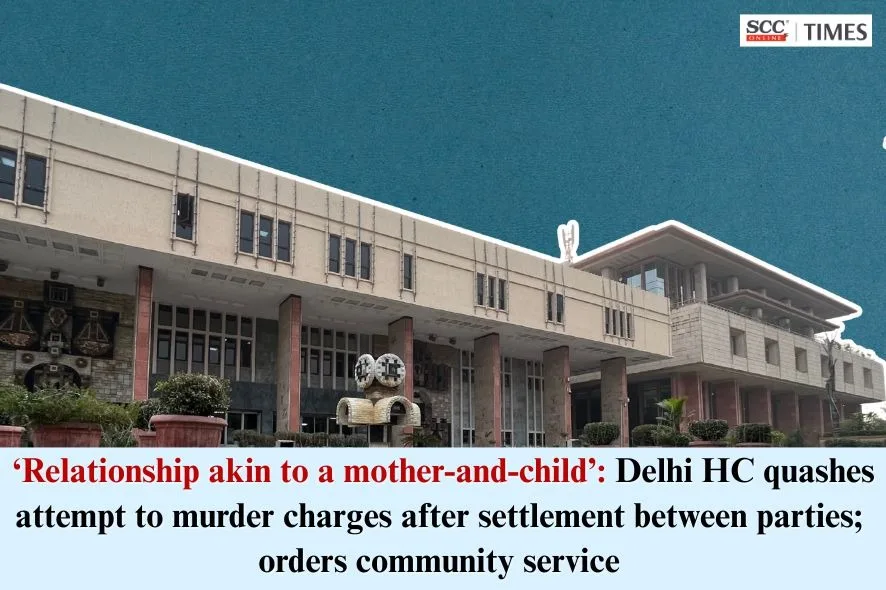
Delhi High Court: In a petition filed under Section 528, Nagarik Suraksha Sanhita, 2023 (BNSS), seeking quashing of FIR registered for offences under Section 308, Penal Code, 1860 (IPC) which had later culminated in a charge under Section 307 IPC during trial, on the ground that the dispute between the petitioner and the complainant had been amicably settled, a Single Judge Bench of Prateek Jalan, J., took note of the petitioner’s unique family setting and that the relationship between the parties was “akin to a mother-and-child relationship”, a bond “socially recognised as singular and sacrosanct,”. The Court, hence, held that forcing the criminal prosecution to continue despite the complainant’s forgiveness would amount to a “travesty of justice.” The Court quashed the criminal proceedings, but considering the nature of the allegations, directed the petitioner to perform community service.
In the instant matter, the petitioner had an unusual family background. She was an orphan and was brought up by the Missionaries of Charity in Civil Lines, Delhi. When she was about three months old, Respondent 2-complainant and her husband applied before the District Judge, Delhi, under the Guardians and Wards Act, 1890, to be appointed as her guardians. By order dated 25 February 1993, the District Judge appointed them as guardians until the petitioner attained majority.
The petitioner thereafter lived with Respondent 2 and her family from infancy. She grew up in their household and later completed her college education from Jesus and Mary College, New Delhi.
Respondent 2 alleged that on 3 February 2019 the petitioner attacked her while she was praying. It was alleged that the petitioner struck her on the head with a wooden cross, bit her hands, injured her eye, and also inflicted injuries to the abdomen using a knife. However, Respondent 2 initially refrained from reporting the matter to the police, treating it as a “family matter.” Subsequently, she made a statement to the police on 16 February 2019, and the FIR was eventually registered on 7 March 2019. The medical report described the injuries suffered by Respondent 2 as “simple.” A chargesheet was filed on 7 January 2020, followed by a supplementary chargesheet on 29 September 2023.
On 8 December 2023, the Principal District and Sessions Judge (North), Rohini Courts (trial court) framed a charge against the petitioner under Section 307 IPC (attempt to murder). The trial commenced and evidence began to be recorded. During cross-examination on 9 December 2024, however, Respondent 2 indicated her willingness to settle the matter and support quashing of the FIR.
Thereafter, the parties entered into a Memorandum of Understanding (MOU) dated 11 August 2025, recording that all disputes had been amicably resolved. Respondent 2 also filed an affidavit stating that she had forgiven the petitioner for the events of 3 February 2019 and had “no objection if the FIR… is quashed.”
The Court reiterated the well-settled principle that the inherent powers of the High Court under Section 482, Criminal Procedure Code, 1973 (CrPC) (now Section 528 BNSS) are distinct from the statutory power of compounding offences under Section 320 CrPC. These inherent powers may be exercised “to secure the ends of justice” or “to prevent abuse of the process of any court.”
The Court relied on several Supreme Court decisions, including Gian Singh v. State of Punjab, (2012) 10 SCC 303; Narinder Singh v. State of Punjab, (2014) 6 SCC 466; State of M.P. v. Laxmi Narayan, (2019) 5 SCC 688 and Naushey Ali v. State of U.P., (2025) 4 SCC 78 and observed that although Section 307 IPC offences are generally treated as serious offences against society, the High Court may still examine the facts to determine whether the charge is justified or whether the chances of conviction are “remote and bleak.”
The Court noted that although Respondent 2 had suffered multiple injuries, they had been medically described as “simple”. Therefore, a conviction under Section 307 IPC could not be anticipated at this stage.
The Court placed considerable emphasis on the unique relationship between the parties and stated that the petitioner had been brought into Respondent 2’s home as an infant and had been raised by her. Though not legally adopted, their relationship was “akin to a mother-and-child relationship”. The Court further observed that such a relationship is socially recognised as “singular and sacrosanct”. It further noted that the Respondent 2 herself had initially described the incident as a family dispute, which explained the delay in lodging the complaint.
The Court also emphasised that the Respondent 2 had consistently supported the settlement in the civil settlement in 2022, during cross-examination in December 2024, in the MoU and affidavit of August 2025, and again in February 2026, including during her personal interaction with the Court.
The Court asserted that compelling continuation of the criminal proceedings despite the Respondent 2’s forgiveness would amount to a “travesty of justice”. The Court held that the peculiar circumstances justified exercising the inherent jurisdiction of the High Court.
The Court allowed the petition and quashed the criminal proceedings. However, considering the nature of the allegations, the Court directed the petitioner to perform community service, report to the Medical Superintendent of St. Stephen’s Hospital, New Delhi, and perform 30 sessions of three hours each, to be completed within four months. It directed to submit a compliance certificate before the Court within five months.
[Antonette Pamela Fernandez v. State (NCT of Delhi), 2026 SCC OnLine Del 809, decided on 3-3-2026]
Advocates who appeared in this case:
Mr. Ravi Sharma, Ms. Srishti Sharma, Mr. Pulkit Luthra & Mr. Harshit Luthra, Counsel for the Petitioner
Mr. Hitesh Vali, APP with SI Harish Kumar, P.S. S.B. Dairy, Counsel for the Respondent/State
Mr. Devansh Gupta, Counsel for the Respondent 2
Buy Penal Code, 1860 HERE
Buy Code of Criminal Procedure, 1973 HERE