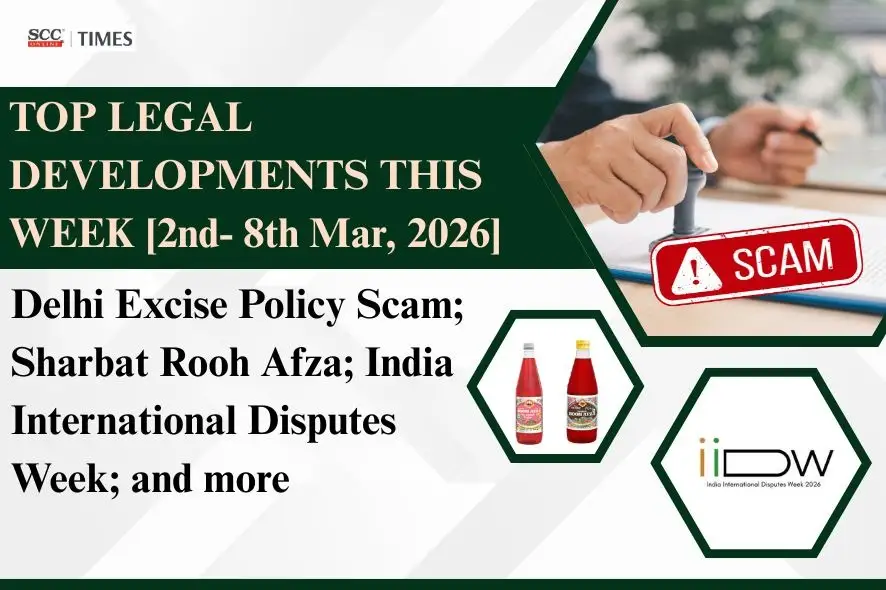
Catch up on the top legal developments this week (2nd- 8th March 2026), including Delhi Excise Policy Scam case, Sharbat Rooh Afza’s taxability, Lack of girls’ toilets, India International Disputes Week, and much more.
STORY OF THE WEEK
Delhi Excise Policy Scam case | Principles for appreciating prosecution material at the stage of charge explained
In CBI v. Kuldeep Singh1, dealing with alleged irregularities in the Delhi Excise Policy 2021-2022 (Delhi Excise Policy) to extend undue benefit to certain private persons/entities described as the “South Group” and allied intermediaries in consideration of illegal gratification quantified at approximately Rs 90—100 crores. While determining whether charges should be framed against the accused or whether they were entitled to discharge under the provisions of the Criminal Procedure Code, 1973 (CrPC), a Single Judge Bench of Jitendra Singh, J., discharged the accused A-1 to A-23 of all the offences alleged against them and held that material placed on record did not disclose even a prima facie case, much less any grave suspicion, against any of the accused persons. Read more HERE
SUPREME COURT HIGHLIGHTS
Taxability | ‘Sharbat Rooh Afza’ classifiable as fruit drink under Entry 103 of UPVAT Act taxable at 4%
In Hamdard (Wakf) Laboratories v. CCT, 2026 SCC OnLine SC 306 , the Supreme Court held that ‘Sharbat Rooh Afza’ was classifiable under Entry 103 of Schedule II, Part A of the UPVAT Act as a fruit drink / processed fruit product and was exigible to VAT at the concessional rate of 4% during the relevant assessment years. The Court directed the respondent authorities to grant consequential relief, including refund or adjustment of excess tax paid, in accordance with law. Read more HERE
Prisons and Prisoners | Addressing overcrowding in prisons, directions issued for expansion and uniform governance of Open Correctional Institutions
In a writ petition titled Suhas Chakma v. Union of India, 2026 SCC OnLine SC 317, the Supreme Court held that Open Correctional Institutions (OCIs) embody this constitutional promise by recognising that trust, responsibility and graded liberty are essential for meaningful reform. Read more HERE
Arbitration Agreement | Issue of genuineness of arbitration agreement be decided by Arbitrator as preliminary issue under Section 11(6A)
In Salson Liquors (P) Ltd. v. United Spirits Ltd., 2026 SCC OnLine SC 335, the Supreme Court affirmed the impugned order, holding that the issue of genuineness or valid execution of the subject agreements can be taken up as a preliminary issue by the Arbitrator and refused to interfere with the same. Read more HERE
Committee of Creditors | IBC vests decisive authority on CoC’s commercial wisdom; Confines judicial review strictly under Ss. 30(2) & 61(3) IBC
While considering Torrent Power Ltd. v. Ashish Arjunkumar Rathi, 2026 SCC OnLine SC 325, the Supreme Court emphasised that the core of Insolvency and Bankruptcy Code, 2016 (IBC) is the doctrine of commercial wisdom, i.e., a conscious legislative choice to vest decisive authority in the Committee of Creditors (CoC) comprising financial creditors who bear the economic consequences of failure. Therefore, judicial intervention beyond the narrow statutory confines undermines both predictability and finality. Recognising this, the IBC deliberately confines judicial review to strict statutory compliance under Sections 30(2) and 61(3). Read more HERE
HIGH COURT HIGHLIGHTS
Matrimonial Cases | Wife’s convenience no longer paramount in matrimonial transfer petitions
In Ekta Vaish v. Deepak Kuchbandiya, 2026 SCC OnLine MP 1352, the Madhya Pradesh High Court dismissed the petition, holding that the convenience of wife/lady was no longer the paramount consideration for deciding the transfer applications and alternatives to transfer proceedings have been provided, like through video conferencing. Read more HERE
NI Act | Summoning order under Section 138 NI Act need not be elaborate, but must reflect application of mind
In Aeiforia Constructions (P) Ltd. v. Continental Carbon India (P) Ltd.,2 wherein the petitioner sought quashment of the summoning order passed by the Metropolitan Magistrate in a complaint under Section
Government Schools | “Form of oppression against girls”: Lack of girls’ toilets in government schools flagged, response sought from School Education Secretary
In Suo Moto Public Interest Litigation v. State of Chhattisgarh3, the Chhattisgarh High Court noted that more than 1,000 government schools and a total of 4,070 schools in Chhattisgarh lacked girls’ toilets. Accordingly, the Court directed the regarding the issue before the next date of hearing. Read more HERE
Medical Waste | “Administrative laxity and systemic failures threaten public health and breach Article 21”; Strict enforcement of Bio-Medical Waste Rules directed
While hearing a PIL titled Jharkhand Human Rights Conference v. State of Jharkhand,4 the Jharkhand High Court observed that improper handling and disposal of biomedical waste directly endangers public health and ecological safety. The Court held that judicial intervention was necessitated by administrative inaction and systemic deficiencies, but having regard to the progress achieved and the institutional mechanisms now in place, the Court considered it appropriate to dispose of the matter with broad directions to ensure effective implementation of the Bio-Medical Waste Management Rules, 2016 (2016 Rules). Read more HERE
Imitation of artistic work | Imitation of Manforce advertisements, restrained; Removal of deceptively similar promotional content, directed
In Mankind Consumer Products Pvt. Ltd. v. Anondita Medicare Ltd.,5 the Delhi High Court held that the promotional content created by Defendants 1 and 2 (infringing content) was deceptively similar to the original artistic work of the plaintiff, Mankind Pvt. Ltd. in promotion of their MANFORCE contraceptive barriers. Read more HERE
Industrial Dispute | Restrictions under S. 22, ID Act applicable to bank employees; Strike call by trade union can trigger conciliation proceedings
In Federal Bank Ltd. v. Federal Bank Officers Assn.,6 the Kerala High Court held that Section 22(1), ID Act operates independently of the definition of “industrial dispute” and restrictions under Section 22, ID Act are applicable to bank employees, if the bank is a notified public utility service (PUS). The Court further held that a strike call by a trade union can trigger conciliation proceedings and during its pendency, the strike cannot be acted upon. Read more HERE
Senior Citizens | Are State-operated Old-Age Homes Adequately Equipped? Report sought from SLSA
In Lok Utthan Sansthan v. State of Rajasthan,7 the Rajasthan High Court directed the Rajasthan State Legal Services Authority (Rajasthan SLSA) to file a report to have a comprehensive understanding of the facilities and welfare measures available in State-operated old-age homes in Rajasthan, to further strengthen the implementation of the legislative intent. Read more HERE
Evidence of Cruelty | Reliance on WhatsApp chats alone insufficient to grant divorce on grounds of cruelty
In deciding XYZ v. ABC8, the Bombay High Court observed that the Family Court had relied solely on WhatsApp chats and SMS exchanges to conclude cruelty. The Court held that such reliance, without affording the wife an opportunity to rebut the evidence, was inadequate and procedurally unfair. Accordingly, the ex parte decree of divorce was set aside and the matter remanded to the Family Court for fresh adjudication, with liberty to the parties to explore settlement through mediation. Read more HERE
Trade Mark | CAPITAL being English translation of registered mark RAJDHANI constitutes trade mark infringement
In Victoria Foods (P) Ltd. v. Ashad Trading Co.,9 the Delhi High Court held that the mark CAPITAL was the English translation of the registered mark RAJDHANI and constituted passing off and trade mark infringement. Thus, the Court granted an ex parte ad interim injunction in favour of the plaintiff restraining the defendants from using the marks CAPITAL and TAJDHANI. Read more HERE
Criminal Justice System | “Sad commentary on our criminal justice delivery system”: Man acquitted after 23 years in jail for wife, children’s murder
In Raees v. State of U.P.10, the Allahabad High Court allowed the appeal, holding that the prosecution’s evidence did not conclusively implicate and prove that the offence was committed by the convict. Read more HERE
Surname Trade Mark | “Kataria” surname protected under S. 35, Trade Marks Act; Injunction restraining Kataria Insurance Brokers set aside
In Kataria Insurance Brokers (P) Ltd. v. Bhavesh Suresh Kataria11, the Bombay High Court held that the appellant’s use of the surname “Kataria” was bona fide, continuous, and rooted in family identity. It was, hence, held that “Kataria” surname was protected under Section 35, Trade Marks Act, 1999 (Trade Marks Act). The Court clarified that Section 35, Trade Marks Act, applies to companies as well, since “person” under the General Clauses Act, 1897 (General Clauses Act), includes corporate entities. Read more HERE
SC ST Act | Not every insult or intimidation amounts to an offence under SC ST Act
In State of Gujarat v. Thakor Talaji Kunwarji12, the Gujarat High Court dismissed the appeal and held that not every insult would amount to an offence under the SC/ST Act. Read more HERE
OTHER UPDATES
NEWS
-
The Ultimate Guide to Constitutional Interpretation in India — New Book by Prof. Ishwara Bhat
-
President appoints Justice Sushrut Arvind Dharmadhikari as Chief Justice of Madras High Court
-
Supreme Court Lawyers Welfare Trust announces 3 persons selected for JS Verma Fellowship 2026
LEGISLATIONS
-
POSH Act Compliance Now Mandatory Across Legal Bodies: BCI Rolls Out Workplace Safety Guidelines
-
AIBE XXI Announced: BCI Notifies Syllabus and Examination Schedule
-
Govt updates Hit and Run Victim Compensation Scheme to Simplify Claims
ALSO READ
1. CBI Case No. 56/2022
2. CRL.M.C. 5260/2024
3. WPPIL No. 17 of 2025
4. W.P. (PIL) No. 1385 of 2012
5. CS(COMM) No.184 of 2026
6. WA No. 1363 of 2025
7. D.B. Civil Writ Petition No. 18092 of 2023
8. Family Court Appeal No.70 of 2025
9. CS (COMM) No. 135 of 2026
10. CRLA No. 83 of 2005
11. Commercial Appeal (L) No. 42036 of 2025
12. R. Crl. A. No. 1323 of 2012