
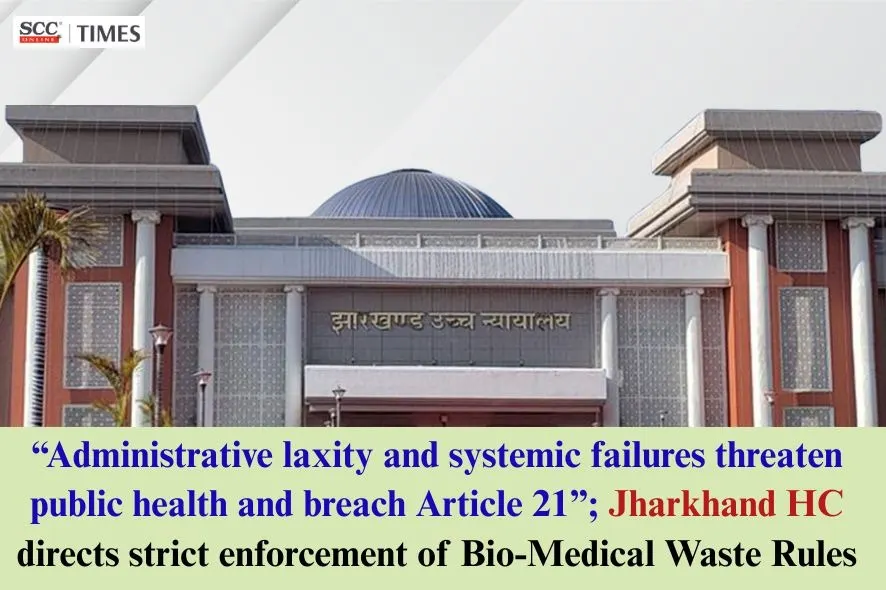
Jharkhand High Court: While hearing a public interest litigation (PIL) concerning biomedical waste management, the Division Bench of M. S. Sonak*, CJ. and Rajesh Shankar, J., observed that improper handling and disposal of biomedical waste directly endangers public health and ecological safety. The Court held that judicial intervention was necessitated by administrative inaction and systemic deficiencies, but having regard to the progress achieved and the institutional mechanisms now in place, the Court considered it appropriate to dispose of the matter with broad directions to ensure effective implementation of the Bio-Medical Waste Management Rules, 2016 (2016 Rules).
Background
The proceedings originated from a PIL filed in 2012 seeking robust enforcement of the statutory regime governing biomedical waste. The petitioner prayed for directions to ensure strict adherence to protocols for management, handling, and disposal of biomedical waste, initially under the Bio-Medical Waste (Management and Handling) Rules, 1998, (1998 Rules) and later under the 2016 Rules.
The petition highlighted indiscriminate dumping of hazardous biomedical waste in public spaces, posing grave risks to public health and the environment. The petitioner stressed the urgency of enforcing statutory mandates, while the State and Pollution Control Board (PCB) contended that steps were being taken but acknowledged infrastructural and administrative challenges.
However repeated deficiencies were noted including lack of consolidated data, open dumping of infectious waste, and inadequate treatment facilities, which necessitated judicial monitoring.
Analysis and Decision
The Court emphasised that biomedical waste, by its inherent character, consists of materials that are not only potentially infectious but also pose a significant hazard to human life and the delicate ecological balance. The Court observed that the handling of biomedical substances demands meticulous oversight and strict adherence to scientific procedures, and any administrative or institutional laxity in this sphere brings grave and irreversible consequences.
The Court further observed that, due to persistent administrative laxity and a lack of coordination between various agencies, the rules failed to achieve their desired objective, wherein the “procedural mandates” remained largely on paper, while the indiscriminate disposal of hazardous waste continued to threaten public health.
The Court noted that the progression of these proceedings demonstrates that sustained judicial oversight was necessary to address systemic deficiencies and to secure effective implementation of the statutory mechanism in the interest of public health and environmental protection. The Court further observed that biomedical waste management is not merely a matter of regulatory compliance but is intrinsically linked to the protection of public health and the right to a clean and safe environment, which forms an integral component of the guarantee under Article 21 of the Constitution.
The Court referred to Bhopal Municipal Corporation v. Subhash C. Pandey, wherein it was held that the mere introduction of new regulatory frameworks would not improve ground realities unless the authorities undertake adequate preparatory measures and infrastructure development prior to their enforcement. The Supreme Court further noted that deficiencies at the field level continue to impede effective implementation of statutory mechanisms.
The Court emphasised that the settled legal position is that where statutory mechanisms exist, but their implementation is weakened by administrative inaction or lack of coordination, Constitutional Courts may intervene to secure compliance and strengthen institutional processes, while restoring primary responsibility to the statutory authorities. The Court thus issued coordination and enforcement directions to operationalise the existing statutory framework, which shall operate in addition to, and not in derogation of, the statutory obligations.
Ultimately, the Court held that while judicial monitoring had yielded tangible improvements, continued supervision is neither warranted nor consistent with the principle that primary responsibility lies with the statutory authorities. Accordingly, the Court disposed of the petition with detailed directions to the State Government, PCB, and healthcare institutions to ensure strict compliance with the 2016 Rules.
[Jharkhand Human Rights Conference v. State of Jharkhand, 2026 SCC OnLine Jhar 261, decided on 26-2-2026]
*Judgment authored by: Chief Justice M. S. Sonak
Advocates who appeared in this case:
For the Petitioner: Samavesh Bhanj Deo, Advocate
For the State: Ashok Kumar Yadav, Sr. S.C.-I, Abhijeet Anand, A.C. to Sr. S.C.-I, Prashant Kumar Singh, Dy. S.G.I., Karbir, A.C. to Dy. S.G.I., Richa Sanchita, Advocate, Risheeta Singh, Advocate, Ashok Kumar Singh, Advocate, Sharon Toppo, Advocate, Bhanu Kumar, Advocate, Amit Kumar Sinha, Advocate, Saman Ahmad, Advocate, Vijay Kumar Roy, Advocate, L.C.N. Shahdeo, Advocate
Buy Constitution of India HERE