
Disclaimer: This has been reported after the availability of the order of the Court and not on media reports, so as to give an accurate report to our readers.
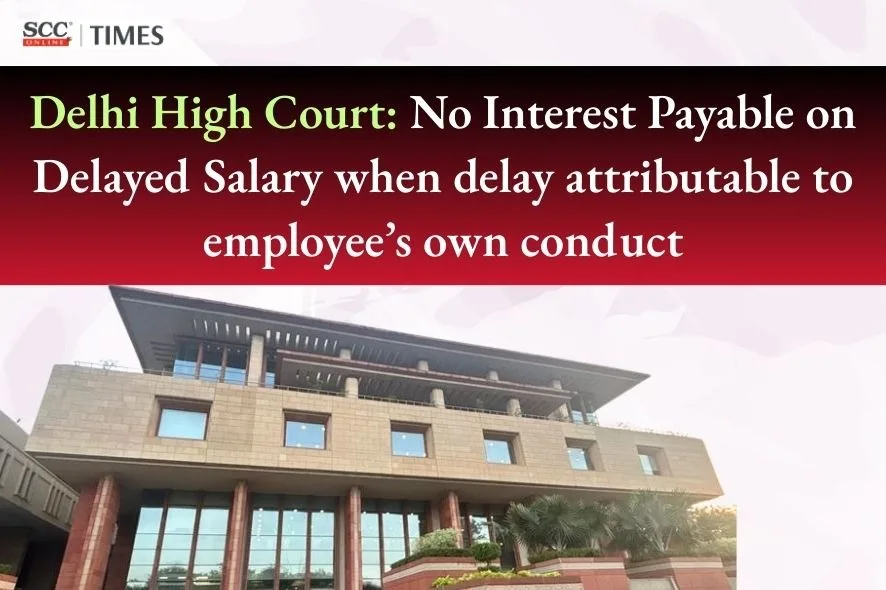
Delhi High Court: In a writ petition challenging orders of the Central Administrative Tribunal (the Tribunal) declining interest on delayed payment of salary and retiral dues, the Division Bench of Anil Khetarpal and Amit Mahajan*, JJ., affirmed the Tribunal’s orders holding that where delay in the disbursement of dues is substantially attributable to the employee’s own conduct, no entitlement to interest arises. The Court further held that interference under Articles 226 and 227 is limited and does not permit reappreciation of factual findings recorded by the Tribunal.
Background
The petitioner joined the Municipal Corporation of Delhi (MCD) as a Lower Division Clerk in 1971 and was subsequently appointed as an Assistant Teacher in 1976. He was promoted to the post of Headmaster, later redesignated as Principal, and superannuated on 28 February 2007.
Disputes arose regarding the release of salary, retirement benefits and election duty honorarium. Earlier proceedings before the High Court resulted in directions for payment of admissible dues. The matter was later transferred to the Tribunal, which directed the respondents to release legally payable dues but did not grant interest.
The petitioner alleged continued discrepancies and delayed payments, and the petitioner initiated contempt proceedings. The High Court permitted him to approach the Tribunal again.
Consequently, the petitioner sought interest on delayed salary and retirement benefits and payment of election honorarium and bonus with interest. The Tribunal held that the delay in salary payments was largely attributable to the petitioner himself, but directed payment of election duty honorarium with simple interest @ 6% per annum. The review application was dismissed, leading to the present writ petition.
Issues:
1. Whether the petitioner was entitled to interest on the delayed payment of salary and retirement dues?
2. Whether the Tribunal’s findings warranted interference under Articles 226 and 227 of the Constitution?
Analysis
At the outset, the Court reiterated the settled parameters governing judicial review that while exercising jurisdiction under Articles 226 and 227, the High Court does not function as an appellate forum. Interference is confined to cases involving jurisdictional error, violation of natural justice, manifest perversity, or patent illegality. Findings of fact based on an appreciation of the record cannot be reopened merely because another view is possible.
The Court noted that the Tribunal had recorded that the delay in the release of salary and retiral dues resulted substantially from the petitioner’s own conduct. Documentary material demonstrated that the petitioner failed to complete mandatory formalities such as signing pay bills, submitting pre-receipts, and furnishing bank account details. Correspondence placed on record, including letters calling upon the petitioner to collect salary and open a bank account, showed persistent non-cooperation extending over several years.
The Court held that this constituted a plausible factual conclusion based on documentary evidence. Since the finding was neither perverse nor unsupported by material, reappreciation of evidence was impermissible in writ jurisdiction.
The Court further noted that the Tribunal had already granted relief where delay was attributable to the employer, namely payment of election duty honorarium with interest at 6% per annum. Thus, the Tribunal had balanced equities after examining responsibility for delay.
Another significant consideration was the earlier round of litigation culminating in the Tribunal’s order dated 24 April 2009. That order directed payment of admissible dues but did not award interest. The Court observed that once a competent judicial forum grants only the principal relief and remains silent on interest, the claim for such ancillary relief must be treated as having been declined. The order having attained finality, the petitioner could not reopen the issue through subsequent proceedings.
The Court also emphasised that the claim pertained to payments dating back to 1975—2007, many of which had been disbursed between 1984 and 2011. Raising an interest claim decades later, after acceptance of payments and conclusion of earlier proceedings, was impermissible.
With respect to the dismissal of the review application, the Court affirmed that review jurisdiction is limited and cannot operate as an appeal in disguise. Since no error apparent on the face of the record was demonstrated, the Tribunal rightly rejected the review plea.
The Court concluded that even assuming administrative delay on the part of the respondents, such delay did not justify interference where the Tribunal had already examined responsibility and returned supported findings.
Cumulatively, the Court held that the Tribunal’s finding attributing delay to the petitioner’s own conduct was based on evidence and was plausible. Moreover, writ jurisdiction does not permit reassessment of factual findings. The Court also held that the earlier adjudication granting only principal dues had attained finality, precluding a fresh claim for interest. Accordingly, the review petition was dismissed.
[Bijender Kumar Gaur v. NDMC, 2026 SCC OnLine Del 754, decided on 13-2-2026]
*Judgment authored by Justice Amit Mahajan
Advocates who appeared in this case:
For the petitioner: Appearance not recorded
For the respondents: Akhil Mittal, Senior Counsel (MCD) with Riddhi Jain and Shayna Das Pattanayak, Advocates. Sujeet Kumar Mishra and Harsh Kumar Pandey, Advocates for Respondents 3 & 5. Anjana Gosain and Shreya Manjari, Advocates for Respondents 4 & 6
Buy Constitution of India HERE