
Day 2 of the 4th Insolvency Law Academy (4th ILA Annual Conference) divulged key areas of concern in the field of insolvency such as group insolvency, growing geopolitical tensions, hybrid insolvency, and much more.
SESSION 7: Insolvency Scholars Forum Session 1
Insolvency Scholars Forum (ISF) has been set up by ILA to bring together the community of academics in pursuit of education, research, and scholarship in the field of insolvency, and together, build a formidable cadre of insolvency scholars in the country. Every year ISF invites papers from scholars around the world. The papers selected by ISF are presented at the ILA Annual Conference. After peer review, these papers are presented in a reputed journal. The papers selected for this year’s conference will be published in the Journal of International and Comparative Law and the ILA Think Factory.
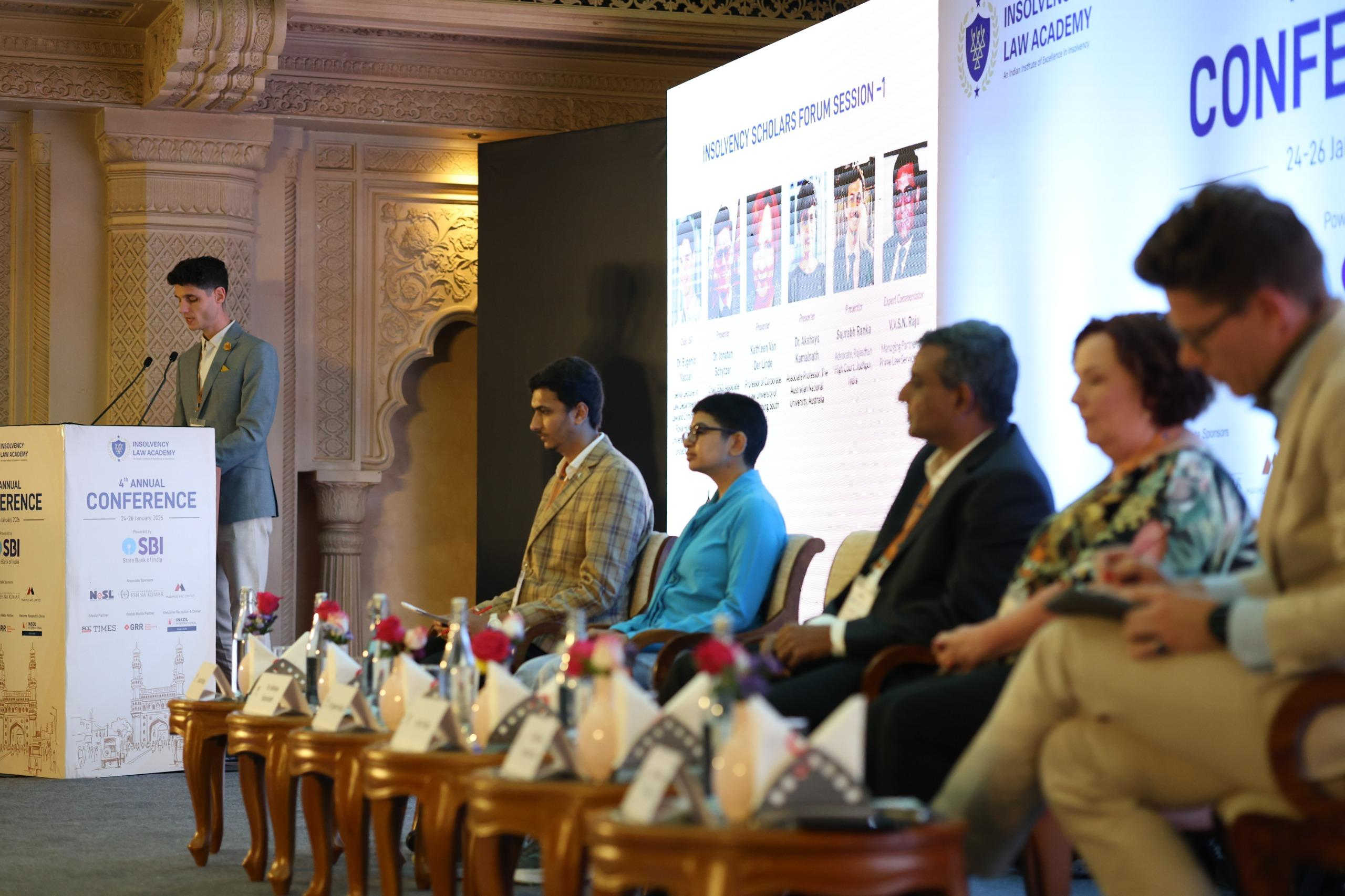
This year the following papers were selected for presentation:
-
‘Insolvency Issues in the Context of Space Law’ by Dr. Akshaya Kamalnath, Associate Professor, Australian National University, Australia, and Mr. Saurabh Ranka, Advocate, Rajasthan High Court, Jodhpur.
-
‘Individual Insolvency’ by Dr. Pier Mario Lupinu, Lecturer in Commercial Law, The University of Glasgow, Scotland
-
‘MSMEs in Financial Distress’ by Dr. Jonatan Schytzer, ESG Chair; Senior Lecturer, Department of Business Studies, Uppsala University, Sweden; Mr. Olof Wadell, Senior Lecturer in Private Law, Faculty of Law, Uppsala University, Sweden; Prof. Kathleen Van der Linde, Professor of Corporate Law, University of Johannesburg, South Africa; and Ms. Ishana Tripathi, Director, Research & Innovation, Shardul Amarchand Mangaldas & Co., India.
The presentation was moderated by Dr. Eugenio Vaccari, Senior Lecturer in Law, Department of Law and Criminology, Royal Holloway University of London; Chair, ISF, and Mr. V.V.S.N. Raju, Managing Partner, Juris Prime Law Services, was the expert commentator.
SESSION 8: IBC 2.0: Group Insolvency & Hybrid Insolvency
With Dr. Siddharth Srivastava, Partner, Khaitan & Co., India, serving as the moderator, this session consisted of three panellists, namely, Mr. Mark J. Forte, Managing Partner & Head of the Litigation and Restructuring practice, Conyers’, British Virgin Islands; Ms. Smitha Menon, Partner and Head of Restructuring & Insolvency Practice, Wong Partnership LLP, Singapore; and Mr. Nitin Jain, Partner (Restructuring & Turnaround), EY India.
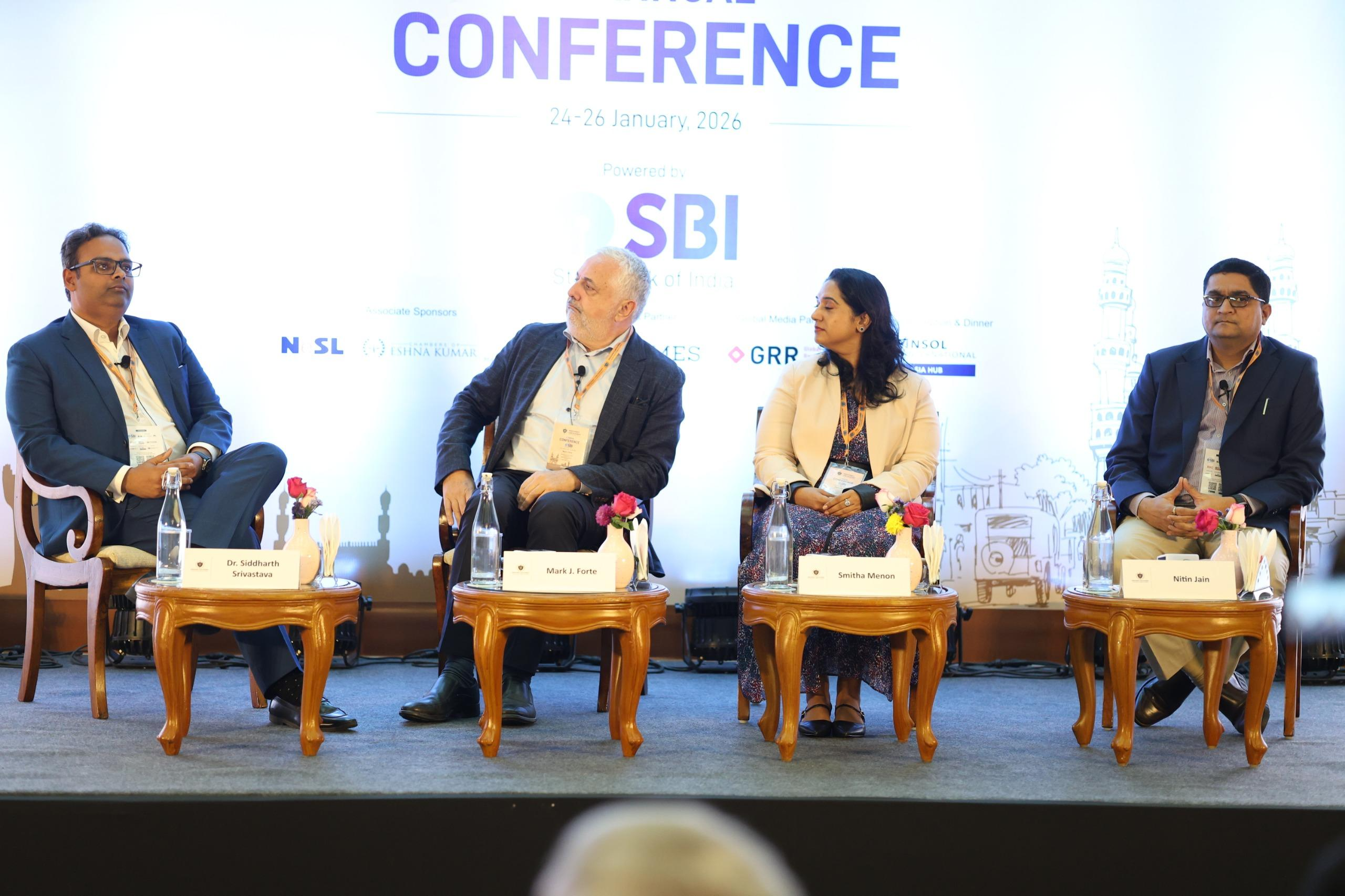
Dr. Siddharth Srivastava kick-started the session with a brief introduction about codification for group insolvency rules. Mr. Nitin Jain added that group insolvency did require some amount of legislative guidance, but it should not be too prescriptive. In this regard, he mentioned famous cases of group insolvency in India, such as Videocon, where there are extensive inter-company linkages, common debt structures, and value erosion risks. He underscored that legislation should focus on value protection as recovery of insolvent companies depended on the solvent ones in a group, whose values were at stake.
Emphasising the necessity for codifying basic principles, Mr. Jain emphasised that reliance on judicial precedents was difficult as it caused confusion between lenders and stakeholders and raised the risk of differences in interpretations.
Adding to what Mr. Jain said, Mr. Mark J. Forte underscored the importance of a moratorium for an effective group insolvency. He explained that without a moratorium, it becomes impossible to crystallise liabilities across group entities, leading to distortion of creditor rights and recoveries.
Regarding sector-wise group insolvency, Mr. Jain opined that group insolvency could not be sector-agnostic in India due to the way companies were organized within the group, so it had to be dealt with on a case-by-case basis. However, he cautioned that companies in the infrastructure or real estate sector were prone to group insolvency.
From the perspective of Singapore, Ms. Smitha Menon provided insights into Singapore’s experience with hybrid insolvency and debtor-in-possession (DIP) models. She explained that Singapore’s shift toward the DIP model was driven by changes in creditor profiles, particularly the rise of private credit and ESG-driven lending constraints on banks. This shift was important for Asian companies as they were mostly operated by the owner, i.e., the shareholders and management were the same, and it allowed them to remain in control while granting creditors enhanced information and monitoring rights.
Ms. Menon further emphasized the need to focus on operational turnaround, fairness among stakeholders, and long-term viability rather than mere debt resolution.
On the same topic, Mr. Forte stated that the British Virgin Islands (“BVI”) was a creditor-friendly, holding-company, and internationally cooperative jurisdiction as it had no entities of its own on the islands. He highlighted that the BVI Insolvency Act had a chapter on cross-border insolvency and how the jurisdiction used provisional liquidation to help creditors in their hybrid insolvency mechanism.
Thereafter, the panel delved into a plethora of topics, such as creditor-initiated insolvency process, India’s progress towards hybrid insolvency, 2015 AQR, shift from insolvency to restructuring mindset, trust deficit between the promoters or the management and the creditors in hybrid insolvencies, size of corporate that requires hybrid insolvency, and much more.
The session concluded with a question-and-answer session with the audience.
SESSION 9: UNCITRAL Working Group V: Future Work
Following the proposal made by Mr. Scott Atkins on behalf of the Australian Delegation to UNCITRAL, UNCITRAL hosted a colloquium on 11—12 December 2025 in Vienna focused on updating the Guide to Enactment and Interpretation (GEI) of the Model Law on Cross-Border Insolvency. This important event focussed on clarifying and supplementing the GEI to reflect recent developments in cross-border insolvency, without making any changes to the Model Law itself.
To help inform this process, UNCITRAL, together with several supporting non-governmental organizations from Working Group V, launched a survey to gather feedback from the international insolvency community. The UNCITRAL Working Group V meeting was held from 11 to 12 December 2025, in Vienna.
After a brief introduction of the Vienna meeting, Mr. Sumant Batra invited Mr. Evan Zucker, Of Counsel, Bankruptcy & Restructuring, Blank Rome LLP, New York, and Mr. Scott Atkins, Global Head, Restructuring, Norton Rose Fulbright, Australia, and Past President, INSOL International, London, to share insights on the discussions that took place in the meeting.
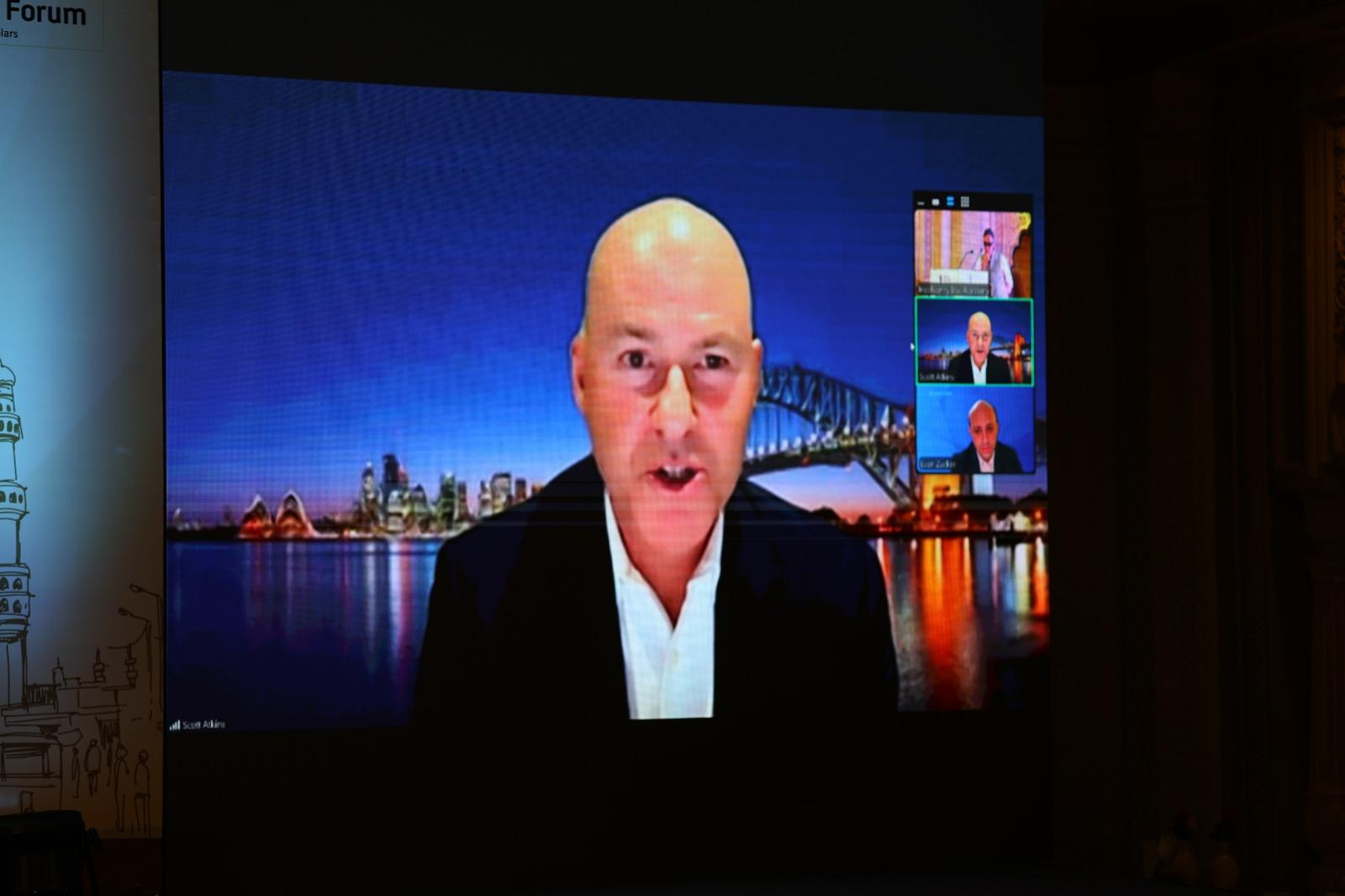
From the perspective of Australia, Mr. Scott Atkins traced the history of the UNCITRAL Working Group, which was established in 1997, the UNCITRAL Model Law, and the enactment of the GEI in 2014. He explained how the GEI was introduced to assist jurisdictions in implementing the UNCITRAL Model Law, considering economic convergence, but in 2024, the Australian Delegation proposed modernisation of the GEI to better fit the present scenario of geopolitical tensions and economic divergence. Thus, the UNCITRAL Model Law was a stabiliser of the global financial system.
Mr. Atkins indicated that this modernisation exercise was expected to take approximately two years, involving a provision-by-provision review and consideration of perspectives across a varied range of topics.
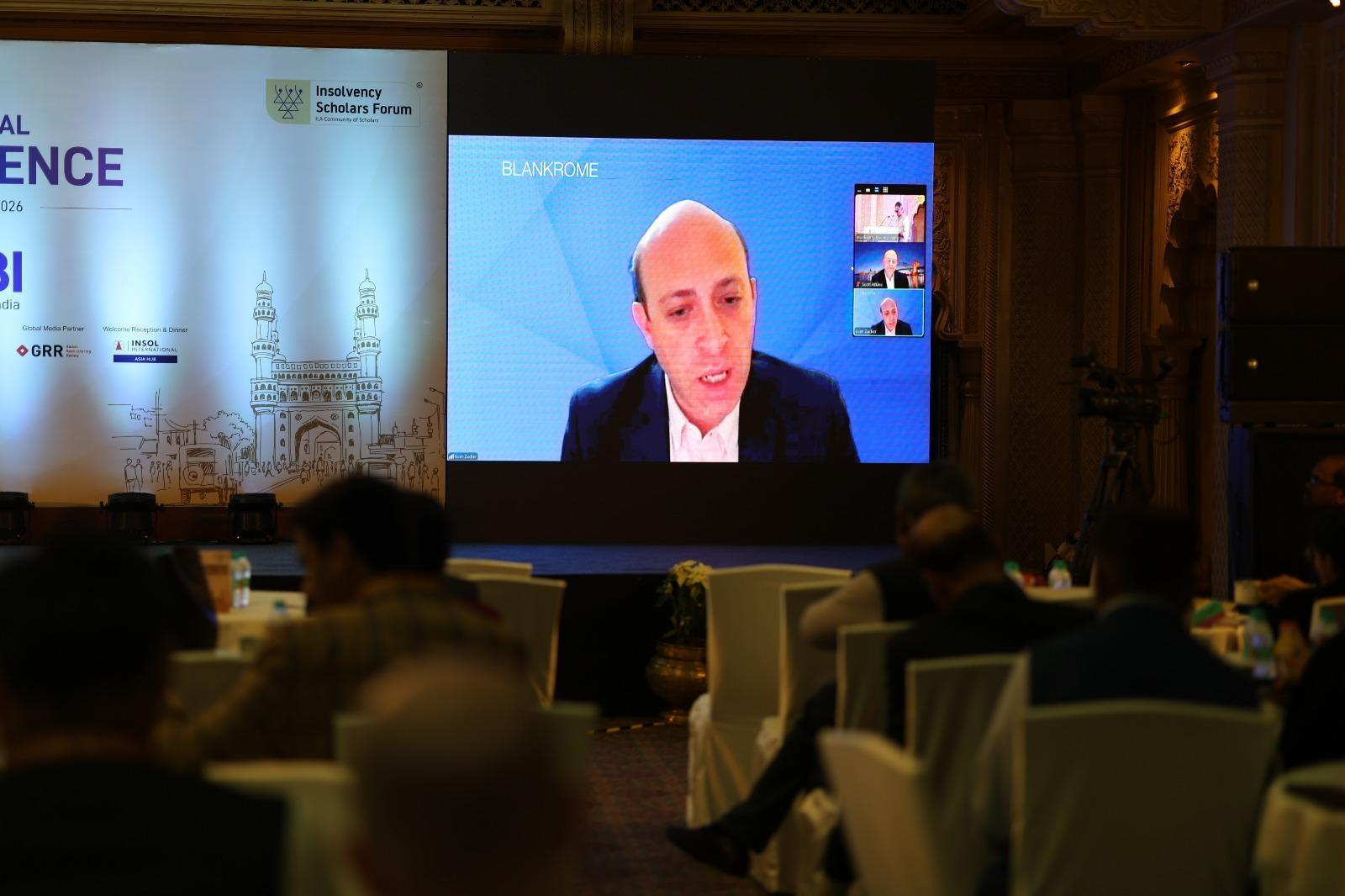
Taking over from Mr. Atkins, Mr. Evan Zucker elaborated on the substantive issues discussed during the Vienna meeting and identified the following key areas of divergence:
-
Recognition of foreign proceedings
-
Inconsistencies in reliefs and safeguards
-
Treatment of modern assets, especially digital assets, and the challenge of fitting them within the existing conceptual framework of the Model Law.
-
Preventive and debtor-in-possession proceedings
-
Foreign representatives and debtor-in-possession
-
Overlap between Articles 7 and 21
-
Public policy and reciprocity
Thereafter, the two panellists enlightened the audience about the meeting, which discussed climate change considerations, restructuring and insolvency, cross-border insolvency, the role of AI, and more.
The session ended with concluding remarks by Mr. Batra.
SESSION 10: Modified Universalism — The Road Ahead
There has been a perceptible shift in the geopolitical landscape. Protectionism and geopolitical contestations have reared their heads. This Modified Universalism requires policymakers, courts, and other stakeholders to revisit the “universalism” we have known until recently. In the insolvency context, it raises many pertinent issues, such as the Centre of Main Interest (COMI), the Gibbs Rule, and a new approach to cooperation.
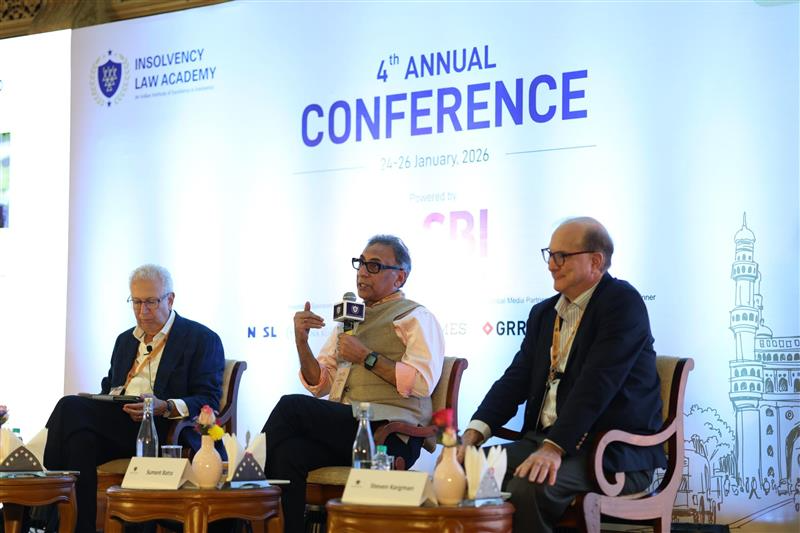
In light of these developments, the panel consisting of Mr. Steven Kargman, Founder and President, Kargman Associates, USA; and Mr. David Grant, Partner, Troutman Pepper Locke, United Kingdom, discussed the evolution of modified universalism in the new era. The session was moderated by Mr. Batra.
Starting the session with a brief introduction of the agenda, Mr. Batra spoke about the recent geopolitical and economic developments, continuing cross-border activity, and the changing meaning of globalization. He referred to a keynote speech delivered by Justice Kannan Ramesh, Judge, Supreme Court of Singapore, at a restructuring insolvency forum meeting hosted by the National University of Singapore and InsolAsia Hub. Justice Ramesh stated that the concept of modified universalism had emerged as a response to the tension between universal cooperation and national sovereignty. The modified universalism recognizes the realities of the interconnected nature of the new global economic order, while at the same time acknowledging the sovereignty and territoriality of jurisdictions.
He further stated that, as per Justice Ramesh, there had been a perceptible shift in the geopolitical landscape which required policymakers, courts, and other stakeholders to revisit the universalism that we have known until recently. In the context of insolvency, this raised several issues and urged a new approach to cooperation.
With this background, Mr. Steven Kargman delved into the reasons why some of the major emerging economies, such as the BRIC countries, had not adopted the UNCITRAL Model Law. He explained that while insolvency professionals and academics often understand the value of the Model Law, adoption ultimately depends on political acceptance, where concerns about sovereignty and foreign creditor influence frequently arose. In this regard, he mentioned the cases of China, Brazil, South Africa, and Singapore.
Mr Batra added that maybe one of the reasons for slow adoption was a lack of a sound municipal law of insolvency, and adopting the model law was beyond their capacities.
Dovetailing what Mr. Kargman said, Mr. David Grant addressed whether jurisdictions that had already adopted the Model Law might reconsider their position in a more protectionist world. He stated that while wholesale withdrawal was unlikely, greater friction and scepticism in the application of Model Law concepts was possible. For example, courts had become more alert regarding forum shopping and manufactured jurisdictional connections.
He further explained that adoption of the Model Law was driven largely by self-interest, as it enhanced a jurisdiction’s attractiveness to international investors and lenders while preserving sovereignty and allowing public policy safeguards. Accordingly, abandoning the Model Law would likely send adverse market signals without meaningful political gain.
Furthermore, the panellists discussed growing territorial insecurity, de-globalization, public policy exceptions, increased intersection of geopolitics with insolvency policy, ESG and climate change considerations, COMI, Gibbs Rule, and the future of insolvency amid political crises.
The session ended with a question-and-answer session with the audience.
Thus, Day 2 of the 4th ILA Annual Conference concluded and left the guests with deeper insights, questions for the future, and expert perspectives.