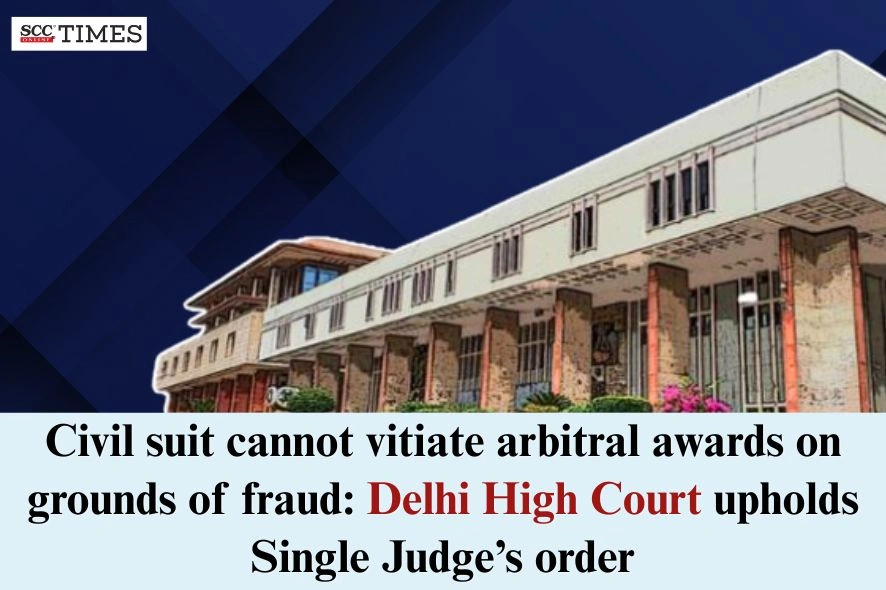
Delhi High Court: While hearing an appeal against an order dated 29-7-2025 (‘impugned order’), passed by a Single Judge Bench of the Court rejecting a challenge against an arbitral award, the Division Bench of Nitin Wasudeo Sambre, J and Anish Dayal, J.*, held that the alleged fraud pertained to internal relations between the parties and not fraud on the Court. Therefore, a separate civil suit could not be initiated to vitiate the arbitral award on grounds of fraud. Accordingly, the Court upheld the impugned order and dismissed the instant appeal.
Background
The appellant, MMTC Limited, a public sector undertaking under the Ministry of Commerce and Industry, entered into a Long-Term Agreement (LTA) in 2007 with Respondent 1, an international supplier of coking coal, for supply of coal to Neelachal Ispat Nigam Ltd., in which MMTC held a substantial shareholding. The LTA envisaged multiple delivery periods, with the option of extension through addenda.
Addendum 2, executed on 20-11-2008, extended the LTA for a further delivery period at a fixed price of USD 300 per metric tonne for a contracted quantity of 4,66,000 MT. MMTC later alleged that this price was arbitrarily and fraudulently fixed through collusion between its senior officials (Respondents 4 to 7) and representatives of Respondent 1 at a time when global coal prices had fallen sharply.
Disputes between the parties culminated in arbitration, resulting in an arbitral award dated 12-5-2014 in favour of Respondent 1 for damages exceeding USD 107 million. MMTC’s objections under Section 34 of the Arbitration and Conciliation Act, 1996 (‘the Act’) were dismissed. Although a Division Bench set aside the award in appeal under Section 37 of the Act, the Supreme Court restored the award on 17-12-2020. A review was partially allowed only to the extent of reducing the rate of interest and all substantive findings were left undisturbed.
During execution proceedings, MMTC had raised objections under Section 47 of the Civil Procedure Code, 1908 (‘CPC’) and sought stay under Order XXI Rule 29 of the CPC, alleging that the award was vitiated by fraud and corruption. These objections were dismissed, and enforcement was allowed. The Supreme Court, by judgment dated 3-11-2025, dismissed MMTC’s appeal and upheld enforcement of the award.
Meanwhile, MMTC had instituted a civil suit seeking a declaration that Addendum 2 and the arbitral award were void ab initio on account of fraud and corruption. The Single Judge vide the impugned order had rejected the plaint under Order VII Rule 11 of the CPC on the ground of non-maintainability, leading to the present appeal.
Analysis, Law and Decision
The Court affirmed the rejection of the plaint, holding that the suit constituted a clear abuse of process. The Court noted that the disputes arising from the LTA, including Addendum 2, had been fully adjudicated through arbitration and that the arbitral award had attained finality after being upheld by the Supreme Court, including in enforcement proceedings.
Placing reliance on Section 5 of the Act, the Court reiterated that the
The Court rejected MMTC’s contention that allegations of fraud justified a separate civil suit. It held that the alleged fraud pertained to internal decision-making and contractual pricing issues between the parties and did not amount to fraud on the court. Such allegations had already been examined and rejected by the Supreme Court while dealing with objections under Section 47 of the CPC. Permitting a separate suit at this stage would undermine the finality of arbitral awards and render Section 5 of the Act otiose.
The Court further held that the cause of action relating to Addendum 2 had merged into the arbitral award and could not be resurrected independently. The suit was also found to be barred by limitation, Order II Rule 2 of the CPC, and principles of res judicata and constructive res judicata, as MMTC had not raised allegations of fraud at any stage during arbitration or the earlier rounds of litigation.
The Bench endorsed the Single Judge’s view that reopening concluded arbitral disputes through civil suits, particularly after affirmation by the Supreme Court, would erode public confidence in arbitration as an effective dispute resolution mechanism.
Thus, the Court upheld the rejection of the plaint under Order VII Rule 11 of the CPC, holding that the civil suit seeking to invalidate an arbitral award on allegations of fraud was barred in law.
[MMTC Ltd. v. Anglo American Metallurgical Pty. Ltd., 2025 SCC OnLine Del 9585, decided on 24-12-2025]
*Judgment Authored by: Justice Anish Dayal
Advocates who appeared in this case:
For the Appellant: Sanat Kumar, Senior Advocate, Akhil Sachar, Sunanda Tulsyan, Sangram Singh, Kashish Maheshwari, Advocates
For the Respondent: Samar Kachwaha, Sumeet Kachwaha, Ankit Khushu, Akanksha Mohan, Pratyosh Khanna, Advocates
Buy Arbitration and Conciliation Act, 1996 HERE