Disclaimer: This has been reported after the availability of the order of the Court and not on media reports so as to give an accurate report to our readers.
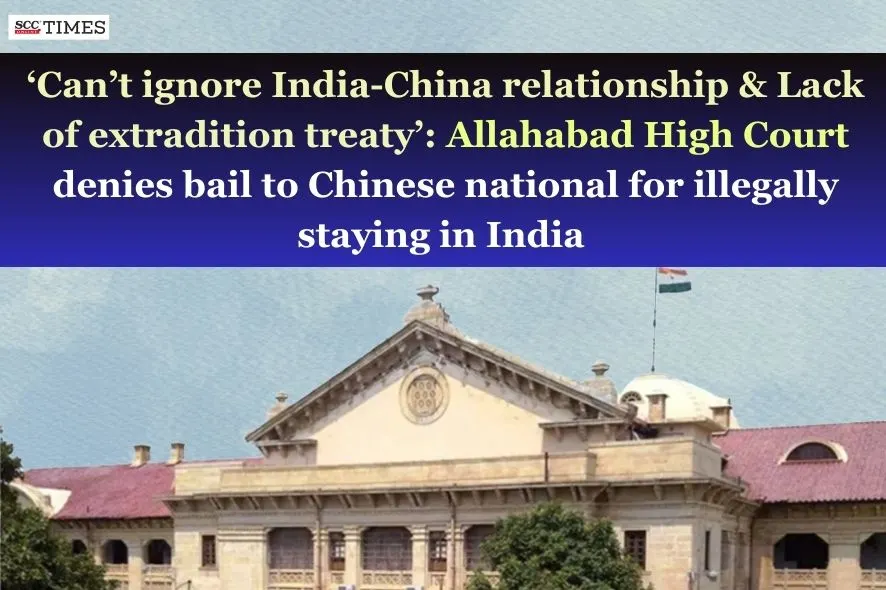
Allahabad High Court: In an application filed by a Chinese national seeking bail in case where he was accused of preparing forged passport and Aadhar card and, tampering with his visa to illegally stay in India., a Single Judge Bench of Arun Kumar Singh Deshwal, J., held that the relationship of India with China and the fact that there was no extradition treaty between the two countries couldn’t be ignored.
Therefore, the Court rejected the accused’s application and denied him bail.
Background
In the present case, two Chinese nationals entering India through Nepal were apprehended by the Indian police, and based on the information disclosed by them, the accused was subsequently arrested. Following his arrest, the police conducted a search at the flat where he was residing, from where a forged Indian passport and a Aadhaar card, in the name of some other person, were recovered. It was further revealed that the accused had fraudulently extended the validity of his visa from 2020 to 2022 despite its expiry in 2020. The flat in question had also been taken for rent relying on the said forged documents through an agreement executed between HTZN Pvt. Ltd. (‘the Company’) and its owner.
Based on information provided by the accused, the police carried out searches in the room of a hotel in Gurgaon, where several forged Aadhaar cards in the name of the co-accused and other incriminating materials were recovered. Co-accused disclosed that she was a close associate of the accused and had procured SIM cards and forged Aadhaar cards for Chinese individuals at his instruction. Consequently, an FIR was lodged in 2022 under Sections 419, 420, 467, 468, 471, 120B and 201 of the Penal Code 1860 (‘IPC’) and Section 14(A), 14(B), 14(C), 14AB and 14C of the Foreigners Act 1946 and Section 66D of the Information Technology Act 2000 (‘IT Act’).
During further investigation, searches were conducted at multiple locations including Noida, where a factory belonging to the Company was found operating. The director of the company stated that although he was the official director, the business was being run by the accused along with another person. It was also revealed that the accused and his associates were engaged in extracting processors and chips from scrap material and sending them to China. Statements of several witnesses indicated that the applicant was indirectly running the Company and was also managing a Hotel at Noida.
It was alleged that the accused was the key figure behind the illegal activities, including forgery of identity documents, unlawful extension of visa, managing shell companies, collecting electronic scrap, and siphoning illegally earned money to China through cryptocurrency transactions.
Analysis and Decision
The Court noted that while allegations exist regarding the transfer of funds through shell companies, purchase of cryptocurrency, and siphoning of money outside India, no such charge relating to money laundering had been levelled against the accused in the charge sheet.
The Cout stated that the accused stayed in India using forged documents and engaged in the illegal extraction and export of electronic components, thereby involving himself in activities amounting to economic offences and posing a threat to India’s economic interests. The Court further specified that the accused currently had no valid visa for residence in India and had not given any satisfactory explanation for the possession of forged Indian identity documents.
The Court opined that it could not ignore the relationship between India and China which the Court is bound to take judicial notice of under Section 57(11) of the Evidence Act 1872. The Court further highlighted the risk that the accused could abscond if released just how co-accused already had and remained untraceable till date. India also lacks an extradition treaty with China, making the prospect of securing the applicant’s return extremely uncertain in the event of his escape.
Considering the case diary, the Court stated that there was a prima facie established involvement of accused in forgery, illegal stay, and activities constituting economic offences. Therefore, the Court rejected the bail application and stated that the accused was not entitled to be released on bail. Further, considering that he had been incarcerated for nearly three and a half years, the Court directed the Trial Court to expedite the trial and conclude it as early as possible.
[Xue Fei@ Koei v. Nil, 2025 SCC OnLine All 7953, decided on 19-11-2025]
Advocates who appeared in this case:
For the Accused: Abhishek Chauhan, Amir Siddiqui, Naveen Prakash and Sumant Kumar Tiwari, Advocates
For the Opposite Party: G.A. and R.P.S. Chauhan, Advoctaes
Buy Penal Code, 1860 HERE