








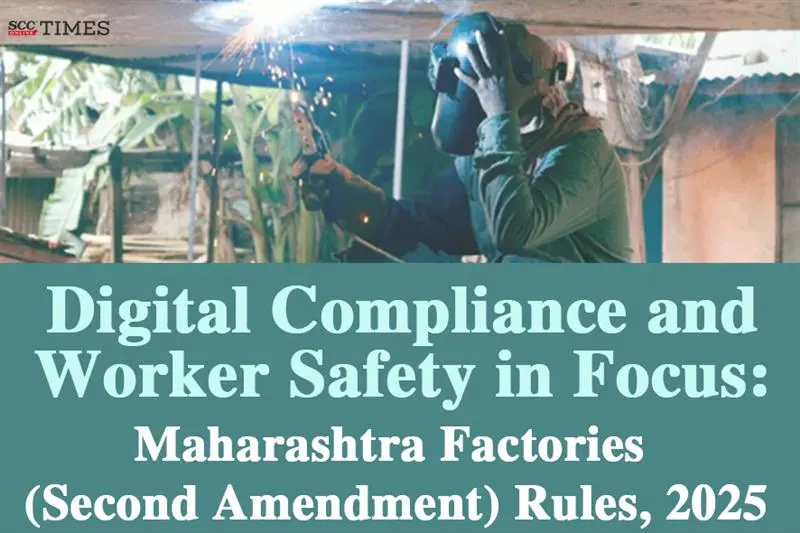
On 3-10-2025, the Government of Maharashtra notified the Maharashtra Factories (Second Amendment) Rules, 2025, aiming to digitize factory compliance processes and strengthen worker safety, especially for women and older employees, through updated forms, licensing, and health protocols.
Key Points:
-
The Factories Amendment Rule 2025 amends the Maharashtra Factories Rules, 1963, marking a decisive shift toward digital compliance, improved worker welfare, and gender-sensitive protections.
-
Rule 3 has been amended to mandate electronic submission of all applications in Form 1. References to “duplicate” and “one copy of” have been removed from sub-rules (1) to (4), simplifying the process.
-
Rule 3-A removes prior approval requirements and mandates that non-hazardous factories submit a Certificate of Stability (Form 1A) within 12 months of license issuance.
-
Rule 5 has been revised to update the licensing and fee structure. The licensing process is updated by eliminating triplicate submissions, changing the reference year from 2013 to 2026, and replacing Schedule A and B with revised fee structures based on installed horsepower and number of workers for general factories, and megawatt capacity for power-generating stations. These changes reflect a shift toward digital governance and scalable, transparent licensing.
-
The revised Schedule A and B introduce a tiered licensing fee system based on installed horsepower or megawatt capacity and workforce size, ensuring fair and scalable charges for both general factories and power-generating stations.
-
Under Rule 6 and Rule 8, factory licenses and renewals must now be submitted and issued electronically using Form 4.
-
Rule 14 requires that notices of occupation be filed digitally in Form 1, with licenses issued accordingly.
-
Rule 15 replaces the earlier Form 5 with Form 1 for electronic submissions related to managerial changes.
-
Rule 18-A mandates annual medical examinations for workers aged 45 and above, conducted by qualified professionals or institutions, with results submitted electronically in Form 7-A within 15 days.
-
Rule 73-W updates the thresholds for appointing medical officers, raising the minimum worker count:
-
Clause (a): From 50 → 150 workers
-
Clause (b): From 51—200 → 151—500 workers
-
Clause (c): From 200 → 500 workers
-
Sub-clause (i): From 500 → 1000 workers
-
-
It also introduces eligibility for medical officers with at least three years of experience in industrial health.
-
Rule 73-ZD introduces mandatory mock drills every 6 months to prepare for hazardous scenarios, with drill details to be reported to the Inspector within 15 days.
-
To strengthen protections for women workers, Rule 102-B outlines safety measures for women employed during night shifts (7:00 p.m. to 6:00 a.m.). Following are the measures are required to be taken:
-
Transport from home to factory and back.
-
Well-lit facilities including toilets, washrooms, and entry/exit points.
-
Minimum two women workers on duty at any location.
-
Grievance meetings every 8 weeks with management.
-
Written consent for night work, retained for 3 years.
-
CCTV surveillance with 45 day recording retention.
-
-
The amendment simplifies the regulatory framework by deleting outdated provisions such as Rule 11, Rule 102-C, and Schedule XIII, while fully substituting Rules 102-B and 114-A with comprehensive, updated guidelines.
-
Form 1 now serves as a unified electronic application for registration, licensing, occupation notices, and managerial changes, including factory location, process details, and digital signatures.
-
Form 4 replaces physical licenses with a fully digital format issued by the Directorate of Industrial Safety and Health.
-
Form 5 has been deleted to streamline documentation and a new Form 7-A records annual medical exams for workers aged 45 and above, capturing health details and requiring electronic submission within 15 days. These changes align with the broader push for paperless, transparent factory compliance.
-
The implications of the amendment include improved efficiency and worker protections but will require initial adjustments in digital infrastructure and compliance practices. It reflects a balanced move toward modern, accountable factory governance.






0 replies