Skip to content
Latest Updates
Fair market value of ESOP shares constitutes cost of acquisition under Section 49(2-AA) even if perquisite was taxed in UK, not India: ITAT Mumbai TOP LEGAL DEVELOPMENTS THIS WEEK [16-22nd Nov, 2026] | Bilkis Bano Case; ICJ Rohingya Genocide Judgment; Bakhra-Beas Power Dispute; and more Institutional trust, professional competence, and responsible innovation are key to future of mediation: ICA—RICS Conclave 2026 begins with an illuminating opening ceremony ESI wage ceiling fixed at ₹21,000 under Social Security Code; ₹25,000 limit retained for persons with disabilities Child’s right to know biological father outweighs privacy claim; Delhi HC upholds direction for DNA test despite mother’s failure to prove marriage ICA–RICS Conclave 2026: Experts examine AI’s role in mediation, professional responsibility and the limits of technology

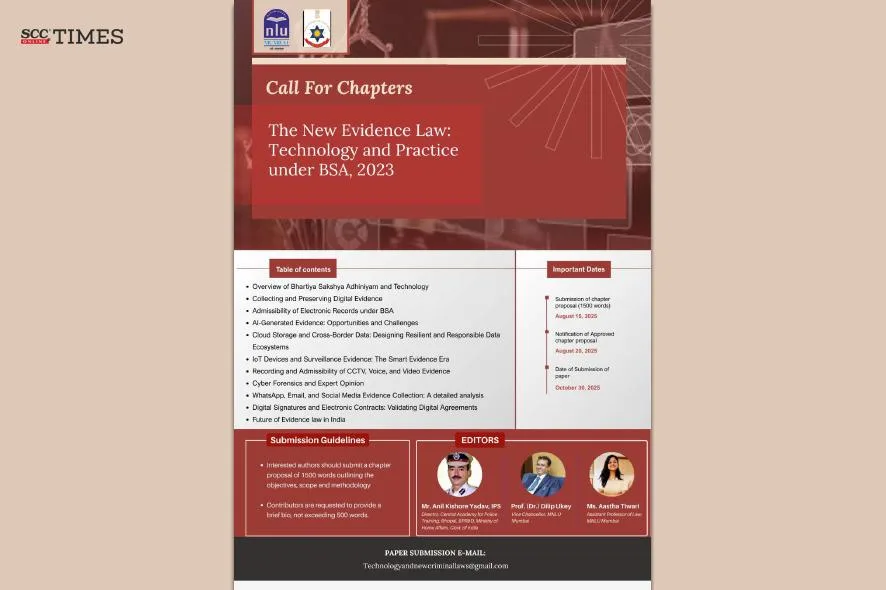
Call for Papers: Central Academy for Police Training, Bhopal and MNLU Mumbai invite chapter proposals for Book titled: The New Evidence Law: Technology and Practice under BSA, 2023.

The book is to be published by the Central Academy for Police Training, Bhopal, BPR&D, Ministry of Home Affairs, Government of India. Last date for submitting chapter proposals is 15th August 2025.

By
Content reader

Listen to this article

Ready to read this article aloud.
Call for Papers: Central Academy for Police Training, Bhopal and MNLU Mumbai invite chapter proposals for Book titled: The New Evidence Law: Technology and Practice under BSA, 2023.

As India moves towards a new framework of evidence law under the Bharatiya Sakshya Adhiniyam (BSA), 2023, the role of technology in the legal process has become more crucial than ever. While the legislation lays the foundation, the dynamic and complex nature of technology requires in-depth interpretation, practical tools, and structured protocols to fully implement the law in both letter and spirit.

This edited book aims to provide practical insights, real case scenarios, and suggestive Standard Operating Procedure (SoP) Guidelines that can support law enforcement officers, forensic experts, and the judiciary in effectively applying the new law to the digital realities of crime and evidence. This book will also serve as a comprehensive guide for students, researchers, scholars, and academicians who aspire to work at the intersection of technology and law, offering them a practical and policy-oriented understanding of how digital tools are reshaping legal procedures.

Inviting everyone engaged in the fields of technology and law or those who wish to contribute meaningfully to this evolving area to submit their chapters. Whether you are an academic, practitioner, technologist, policymaker, student or researcher, your ideas can help shape how justice is delivered in the digital age.

Submit your chapter proposals (1500 words) to: technologyandnewcriminallaws@gmail.com

Be a part of this critical dialogue. Let’s build a justice system that’s not just modern, but also meaningfully equipped.

WhatsApp LinkedIn

0 replies

Leave a Reply

Your email address will not be published. Required fields are marked *.

This site uses Akismet to reduce spam. Learn how your comment data is processed.